Lawmakers Demand Strategy, Exit Plan as Congress Debates Iran Military Campaign
Sen. Blumenthal said he's "more fearful than ever" U.S. troops could enter Iran as lawmakers grilled officials behind closed doors on the war's strategy and exit plan.

Tensions flared at the U.S. Capitol on Tuesday as questions mounted over the Trump administration's shifting rationale for war with Iran, with lawmakers demanding answers on strategy, exit plan and costs to Americans in lives and dollars in what is quickly becoming a widening Middle East conflict.
Trump officials made their case during a second day of closed-door briefings, this time with all members of the House and Senate, held in a secure room in the basement of the Capitol. Defense Secretary Pete Hegseth and Senate Majority Leader John Thune, R-S.D., were among those who arrived for the Tuesday session. The briefings came as Elbridge Colby, the under secretary of defense for policy, became the first Pentagon official to appear before Congress since the United States and Israel launched Operation Epic Fury against Iran.
Much of the anger inside the briefing room focused on a single, unresolved question: whether American soldiers could end up on the ground in Iran. Sen. Richard Blumenthal, D-Conn., said after the closed briefing: "I am more fearful than ever we may be putting boots on the ground." Democrats warned against sending U.S. military troops into Iran after more than two decades of war in Iraq and Afghanistan in the aftermath of the Sept. 11, 2001, attacks.
The administration's rationale for entering the conflict remained under scrutiny. Secretary of State Marco Rubio, who arrived at the Capitol on Monday, March 2, for an intelligence briefing with top lawmakers, pushed back on his own suggestion from a day earlier that Trump had struck Iran because Israel was ready to act first. Instead, he said Washington knew there was going to be an Israeli action, knew it would precipitate an attack against American forces, and determined that preemptive strikes were necessary to avoid higher casualties. Rubio boiled the president's logic down to a single sentence in a testy exchange with reporters: "The president determined we were not going to get hit first. It's that simple."
Colby, the undersecretary for defense policy, made the journey from the Pentagon to Capitol Hill twice last week. He had spent nearly two decades building his public persona on arguing that America needed to focus almost exclusively on China and pivot away from the Middle East. Defending the operation before the Senate Armed Services Committee, he told senators: "We understand from the President and the goals of the military campaign, this is certainly not nation building. This is not going to be endless." On the "America First" framework, Colby argued that "rolling back, as the military campaign is designed to do, the threats posed by Iran's very large and growing missile and one-way attack drone program, its navy and of course ensuring that it doesn't have a nuclear weapon" served those goals.
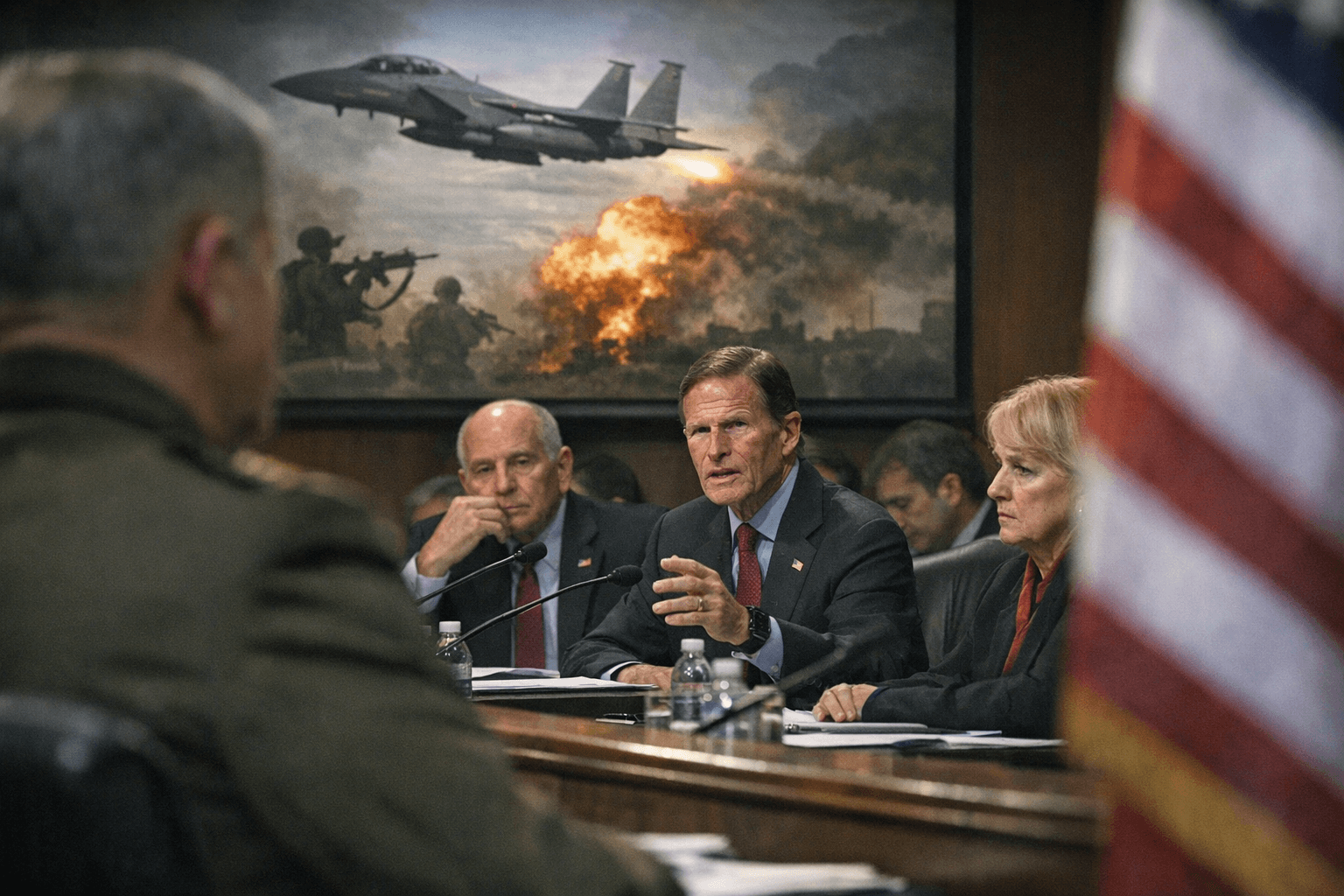
The top senators on the Armed Services Committee told Colby the National Defense Strategy says little about the country's "vital interest in the Middle East." Rep. Adam Smith, D-Wash., the ranking member of the House committee, asked Colby what success looks like in Iran. Rep. Mike Rogers, the committee chair, accused Colby of being "dishonest," Rep. Mike Turner called him "disingenuous," and Rep. Don Bacon accused his office of "moral blindness."
The U.S. and Israel launched extensive strikes against Iran on Saturday morning after months of stalled negotiations over the country's nuclear program. Trump later announced the operation had resulted in the killing of Ayatollah Ali Khamenei, Iran's supreme leader. Six U.S. service members have died since the launch of Operation Epic Fury, fueling questions about whether the campaign could widen further.
Questions are growing over who will lead Iran after Khamenei's death, as worries mount of a leadership vacuum that creates unrest. On March 7, the Assembly of Experts announced Mojtaba Khamenei, son of Ali Khamenei, as the new supreme leader.
The partisan fault lines inside the Capitol remained sharp. Senate Republicans voted down an effort Wednesday to halt the administration's war against Iran, demonstrating early support for a conflict that has rapidly spread across the Middle East. The congressional GOP largely supported the move, even though Trump had acted without their formal authorization. A looming war powers resolution vote, intended to restrict Trump's ability to continue the joint U.S.-Israel campaign, remained on the horizon as lawmakers left the briefings with few of their core questions answered.
Know something we missed? Have a correction or additional information?
Submit a Tip