Lebanese families uprooted again as border war deepens displacement crisis
A Beirut room now holds two grandmothers, a married pair of families, and the memory of a house in Maroun al-Ras that was destroyed, rebuilt, and destroyed again.
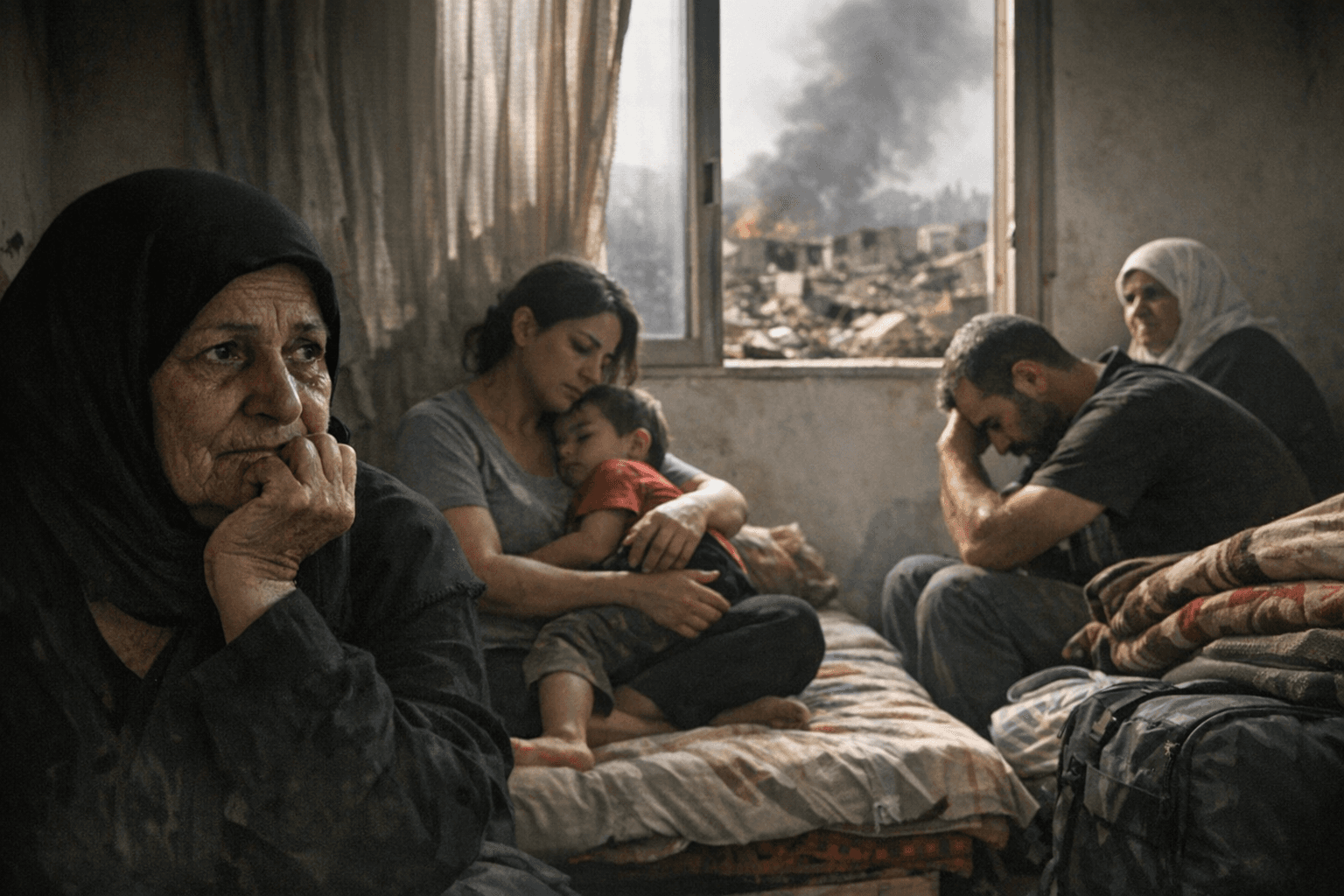
In a vacant building in central Beirut, Mariam Allawiya and Kafa Wehbe were living out another turn in a family history shaped by war. The two women, 60 and 67, had not just been uprooted again from southern Lebanon; their children had married each other, binding two lines of displacement into one household.
Both women had grown up amid olive groves near Maroun al-Ras, a border village that has been repeatedly damaged in Israeli-Lebanon conflicts. For Allawiya, the memory of flight stretched back to the 1982 Israeli invasion, when her family fled north to Beirut. Israel occupied south Lebanon for 18 years after that invasion, and the family settled in Beirut’s southern suburbs with other displaced Shia Muslims, returning home each summer to rebuild their house despite the occupation.
That pattern of departure and return had become part of the family geography. Allawiya showed a photo of the house in Maroun al-Ras that was destroyed just over a year ago. It had already been destroyed and rebuilt after successive Israeli invasions in 2006 and 2024, leaving the family with a home that existed as much in memory and labor as in stone.
Their story was unfolding inside a much wider displacement crisis that had pushed Lebanon toward a historic breaking point. By early April 2026, more than 1.1 million people, about one in five of the country’s population, had been displaced. More than 1,500 people had been killed and nearly 4,000 wounded. Blanket evacuation orders covered roughly 600 square miles of Lebanese territory, including all of south Lebanon below the Litani River and Beirut’s southern suburbs, known as Dahiyeh.
Humanitarian groups warned that the crisis was producing repeat displacement on a massive scale, with women and girls making up more than half of those forced from their homes. Overcrowded shelters and vacant buildings in Beirut had become temporary refuge for families who had lost everything, even as the prospect of a long-term occupation or buffer zone in the south revived memories of checkpoints and movement restrictions that older residents said felt like life in the Palestinian territories.
The warnings sharpened after Emergency Relief Coordinator Tom Fletcher visited Lebanon on March 31 and after airstrikes on April 8 struck parts of Beirut for the first time in the escalation, killing hundreds and injuring thousands. For families like Allawiya’s and Wehbe’s, the war was not a single rupture. It was a long civilian timeline, measured in houses rebuilt, villages emptied, and a word called home forced to carry the weight of each new war.
This article was produced by Prism’s automated news system from verified source data, official records, and press releases, then run through automated quality and moderation checks before publishing. The system is built and supervised by the people who set the standards it runs under. Read our full AI policy.
Did this article answer your question?


