London braces for rival protests and major security operation
London deployed 4,000 officers, plus horses, drones and live facial recognition, to keep rival marches apart as the FA Cup final added to the strain.
London’s police mounted one of their biggest operations in years on Saturday, sending about 4,000 officers into the streets as rival marches, and the FA Cup final at Wembley Stadium, turned the capital into a high-risk test of public order.
The Metropolitan Police said the operation was designed to keep far-right and pro-Palestinian marchers separated as tens of thousands gathered in central London. One march was led by Tommy Robinson, the alias of Stephen Yaxley-Lennon, under the banner of “Unite the Kingdom.” The other brought together a pro-Palestinian demonstration marking Nakba Day, which commemorates the 1948 displacement of Palestinians, and an anti-fascism rally organized with Stand Up to Racism.
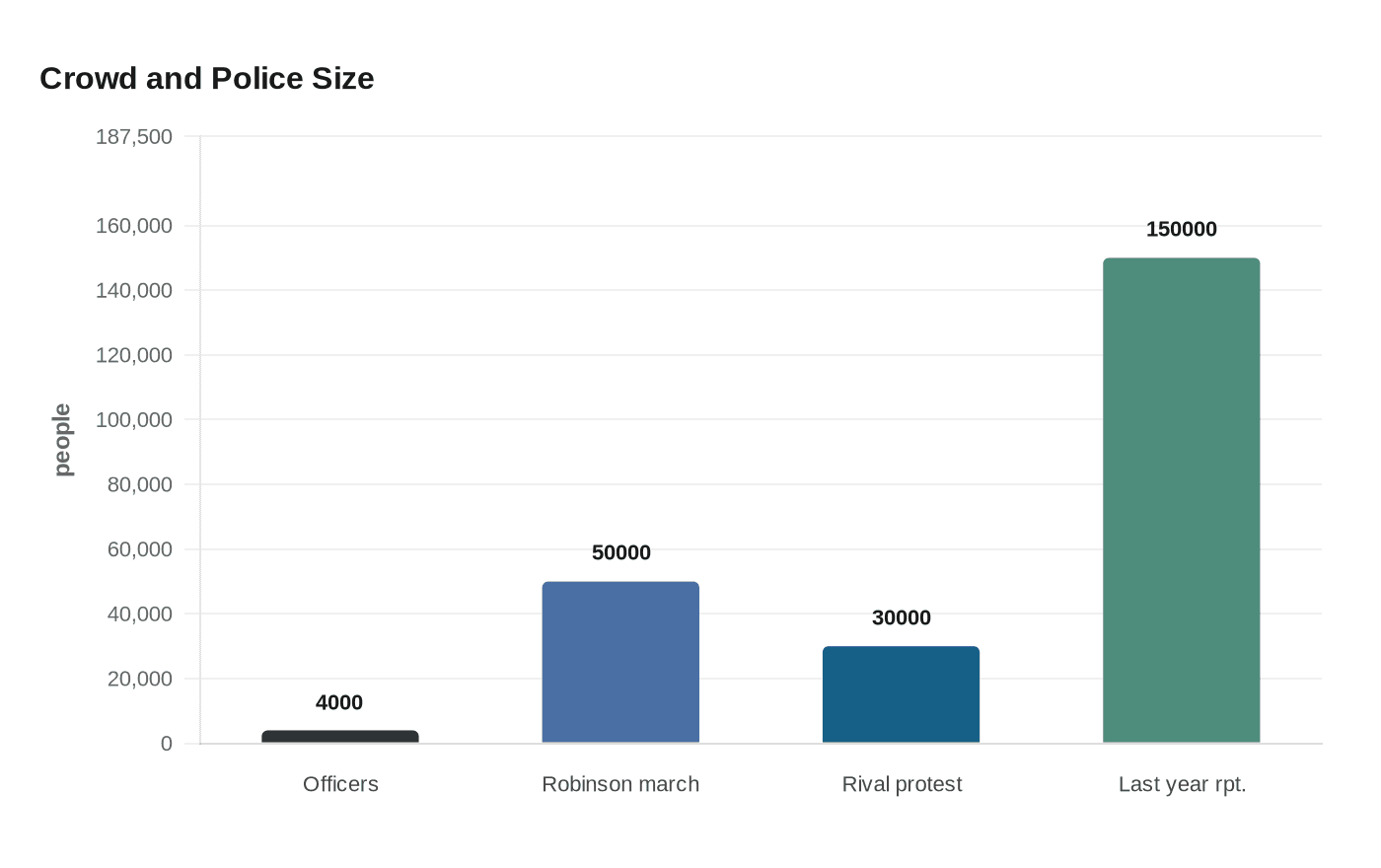
Police estimated about 50,000 people would attend Robinson’s march and about 30,000 would join the rival protest. With the FA Cup final drawing soccer fans to Wembley on the same day, officers faced a crowded security map that stretched from the city center to northwest London.
The Met imposed route and timing restrictions on both protests in an effort to keep the groups apart. It also said it would take a zero-tolerance approach to violence or disorder, a sign that the force was treating the demonstrations less as a routine expression of political speech than as a potential public safety crisis.
The policing toolkit reflected that concern. Officers deployed horses, dogs, drones and helicopters, and for the first time in a protest operation, live facial recognition was used. The scale of the operation underlined how London authorities were trying to preserve the right to march while reducing the chance that rival crowds would collide in the streets.
Prime Minister Keir Starmer condemned the far-right rally as peddling hatred and division, warning that anyone seeking to wreak havoc on the streets could face the full force of the law. His intervention sharpened the political stakes around a day already heavy with tension.
The city’s anxiety was not abstract. Last year’s Robinson rally drew more than 100,000 people, with some reports putting the figure at about 150,000. Saturday’s deployment suggested that London officials view mass protest, especially when it mixes nationalism, anti-immigration politics and pro-Palestinian activism, as a recurring stress test for democratic policing in a polarized era.
Know something we missed? Have a correction or additional information?
Submit a Tip