Lost Mines Hinder Iran's Compliance With Trump's Shipping Demands
Iran cannot find all the mines it planted in the Strait of Hormuz, leaving over 1,000 vessels stranded and undercutting a fragile ceasefire even as peace talks begin.
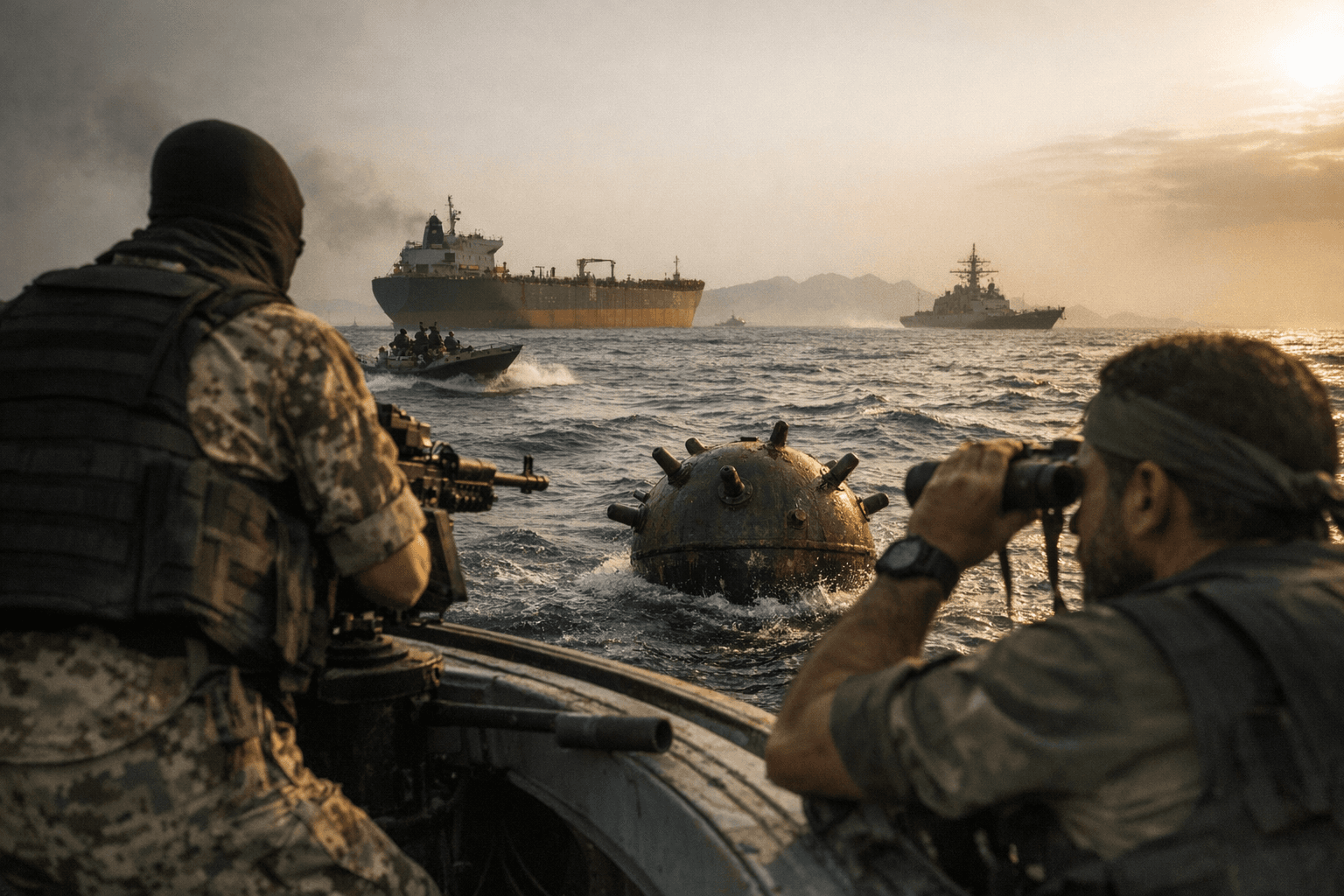
Iran's inability to locate and remove all of the naval mines it planted in the Strait of Hormuz has emerged as a central obstacle to reopening one of the world's most critical shipping corridors, with U.S. officials concluding that Tehran lacks both the situational awareness and the specialized capability required to conduct rapid mine clearance operations.
The predicament is not merely diplomatic embarrassment. Over 1,000 vessels are now queued outside the strait, including 187 tankers carrying an estimated 172 million barrels of stalled crude. Daily traffic through the waterway, which carried roughly 140 ships before the conflict began in early March, had fallen to between 7 and 18 transits per day as of April 10, with only 2 to 4 tankers among them. The backlog alone, analysts have noted, would take weeks to clear even if every mine were accounted for overnight.
The mines were planted by Iran's Islamic Revolutionary Guard Corps beginning around March 10, prompting Trump to post on Truth Social that "we want them removed, IMMEDIATELY!" The U.S. military responded by destroying 16 Iranian minelayers, but mines already in the water presented a harder problem. Iranian Deputy Foreign Minister Saeed Khatibzadeh later cited "technical limitations" in clearance operations, language that U.S. officials interpreted as a frank acknowledgment of Iran's constrained mine countermeasures capacity.
The commercial cost of that uncertainty has been severe. Before the conflict, war-risk insurance premiums for Strait of Hormuz transits ran between 0.15% and 0.25% of a vessel's hull value. Since fighting began, quotes reached as high as 5% to 10%, according to Lloyd's List finance editor David Osler. For a very large crude carrier worth around $100 million, that translates to millions of dollars in additional costs for a single passage. Major marine war risk providers stopped offering cover for Persian Gulf vessels altogether in the opening weeks of the crisis.
Iran's IRGC has issued maps indicating a narrowed safe corridor routed north of Larak Island inbound and south outbound, but those channels remain far from restoring normal operations. Ships that do attempt passage face a verification procedure governed by the IRGC Navy that requires detailed documentation on ownership, financing, insurance and trading history, with approvals negotiated ship by ship. Fees, reportedly paid in cryptocurrency, have varied widely, with at least one payment reported at $2 million.
The problem is compounded by a structural gap in allied mine countermeasures capability. The U.S. Navy decommissioned its last Avenger-class dedicated minesweepers before the conflict. The Royal Navy withdrew HMS Middleton, its final mine countermeasures vessel in the Gulf, in early 2026. As a Naval Institute analysis published in April noted, sanitizing even a single transit lane through the strait's 100-nautical-mile traffic separation scheme would require sweeping roughly 200 square miles.
Richard Meade, editor-in-chief of Lloyd's List, captured the strategic ambiguity during an April 10 webinar: "The Strait of Hormuz remains both open and closed, depending on your position, both geographically and geopolitically. It is, if you like, Schrödinger's Strait."
That ambiguity is now shadowing the peace process itself. Vice President JD Vance arrived in Islamabad on April 11 to lead U.S. negotiations with an Iranian delegation mediated by Pakistan, with the strait's status among the unresolved core issues. A two-week ceasefire announced on April 7 carried a condition that Iran immediately open the waterway, but unlocated mines make that commitment harder to honor regardless of Tehran's political will, a reality that narrows the margin for miscalculation on all sides.
Sources:
Know something we missed? Have a correction or additional information?
Submit a Tip