Magnitude 6.2 Earthquake Shakes Western Japan’s Chugoku Region
A preliminary magnitude 6.2 earthquake struck eastern Shimane Prefecture on Jan. 6, producing a sequence of sizable aftershocks, suspending Shinkansen services and prompting safety checks near a nuclear plant. The event underscores ongoing seismic risk in Japan and poses localized transport and supply disruptions with limited immediate systemic market impact.

The Japan Meteorological Agency recorded a preliminary magnitude 6.2 earthquake in the western Chugoku region at 9:18 a.m. Japan Standard Time on Jan. 6, with the epicenter located in eastern Shimane Prefecture. The main shock was followed by a series of aftershocks, including events measured at magnitudes of about 4.5, 5.1, 3.8 and 5.4. Seismic intensity reached up to upper-5 on Japan’s 1-to-7 scale in parts of the affected area, a level of shaking that can make movement difficult without support.
Officials warned residents to remain vigilant for strong tremors for about a week, citing historical precedents in which larger quakes have followed initial shocks. The agency said there was no danger of a tsunami and no tsunami alerts were issued. The Nuclear Regulation Authority and Chugoku Electric Power Co. reported no abnormalities at the Shimane Nuclear Power Station, located roughly 32 kilometers from the epicenter. The plant’s No. 2 reactor, which returned to operation in December 2024 with an output of about 820,000 kilowatts, continued running while environmental radiation monitoring posts showed no irregular readings.
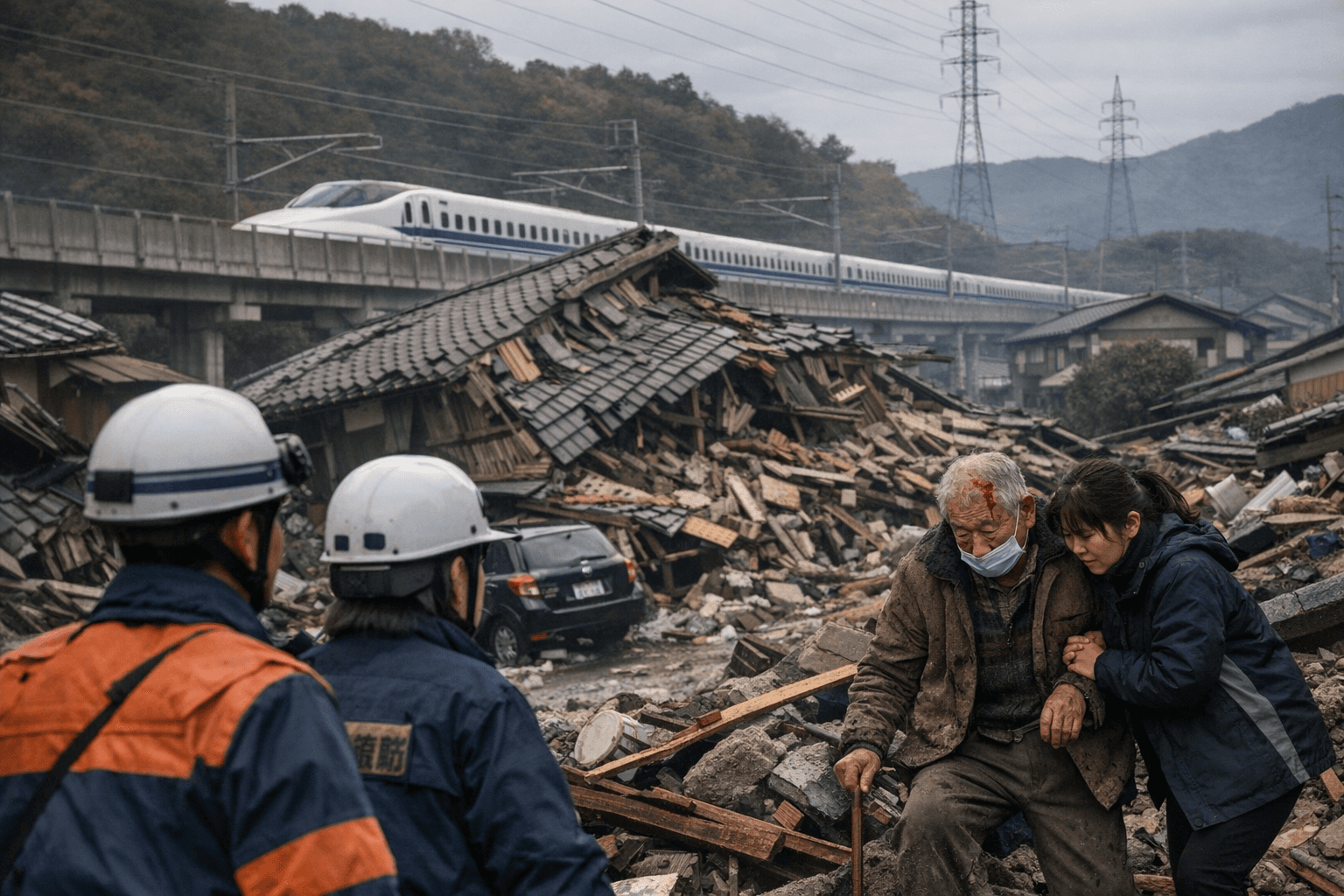
Transport infrastructure experienced immediate but localized disruption. West Japan Railway suspended Shinkansen bullet-train services between Shin-Osaka and Hakata as part of standard safety checks, temporarily curtailing a key travel corridor linking western Honshu and Kyushu. Municipal governments and emergency services deployed personnel for damage inspections, and some officials advised residents to remain indoors while strong tremors continued.
Field reports indicated no widespread catastrophic damage. Localized incidents included a collapsed cliff behind a house in Yasugi, Shimane Prefecture, and fallen books at Yonago city hall resulting from violent shaking. Disaster-prevention staff near the epicenter described repeated long tremors and said they were conducting calm, systematic responses as they assessed structures and infrastructure.
Economically, the shock is likely to cause short-term disruption to regional travel and logistics rather than impose broad market shocks. Temporary suspension of high-speed rail can interrupt commuter flows and same-day freight that relies on punctual connections, with immediate effects concentrated on service providers, local tourism and small businesses. Insurance and reconstruction spending will be determined by damage assessments, but the absence of major structural failures or nuclear irregularities limits the potential for large-scale fiscal or market consequences at this stage.
The quake also highlights enduring policy tensions over seismic resilience and energy strategy. Japan experiences a disproportionate share of global seismic activity, accounting for roughly one-fifth of the world’s earthquakes of magnitude 6 or greater, and ongoing aftershock risk underscores the need for rigorous infrastructure inspection protocols and contingency planning for critical transport and energy assets. Authorities said they would continue monitoring seismic activity closely and urged residents and businesses to follow local safety guidance as assessments proceed.
This article was produced by Prism’s automated news system from verified source data, official records, and press releases, then run through automated quality and moderation checks before publishing. The system is built and supervised by the people who set the standards it runs under. Read our full AI policy.
Did this article answer your question?