Martha Stewart's new book shares classic cooking basics for home chefs
Martha Stewart’s latest book returns to first principles: technique, routine, and domestic confidence. Its message is clear, she still sells the authority of basics in a trend-driven culture.

A new manual from a familiar authority
Martha Stewart’s latest book, *The Martha Way: Essential Principles for Mastering Home and Living*, arrives as a broad manual for domestic competence, not just a cookbook. Retail listings place it at 288 pages and date it for May 5, 2026, while describing Stewart as the author of more than 100 books. The scale matters because the book is not built around novelty; it is built around control, repetition, and the belief that everyday tasks can be taught with precision.
The title itself signals the central argument of Stewart’s brand. Cooking is part of the package, but so are entertaining, home organizing, collecting, and gardening. In an era when lifestyle advice is often reduced to quick clips and algorithm-friendly tricks, Stewart is still selling a complete system for how to live, keep house, and present a polished result.
Why the basics still carry weight
Stewart’s publishing arc helps explain why this book lands with such force. *Martha: The Cookbook: 100 Favorite Recipes, with Lessons and Stories from My Kitchen* was released on November 5, 2024, marking a major milestone in a catalog already defined by consistency and instruction. The new book is being described as her 102nd, which underscores how long she has been refining the same core promise: that domestic skill is learnable, repeatable, and worth mastering.
That message has always been part of Stewart’s appeal, but it now reads differently in a media landscape shaped by speed and improvisation. Her books still trade on a slower form of authority, one that assumes readers want standards, not just inspiration. The business logic is straightforward: when trust is scarce, a brand built on method becomes more durable than one built on novelty.
The omelet as a test of authority
The clearest proof of Stewart’s staying power may be something as simple as an omelet. Her recipe archive includes a Swiss chard and cheese omelet, shown in a video with Ivan Alegrete, and a potato and chorizo sausage omelet, a Spanish-style version built around potato slices, chorizo sausage, and onion. These are not flashy dishes, but they show the range of her instruction, from a vegetable-forward breakfast to a more substantial, savory variation.
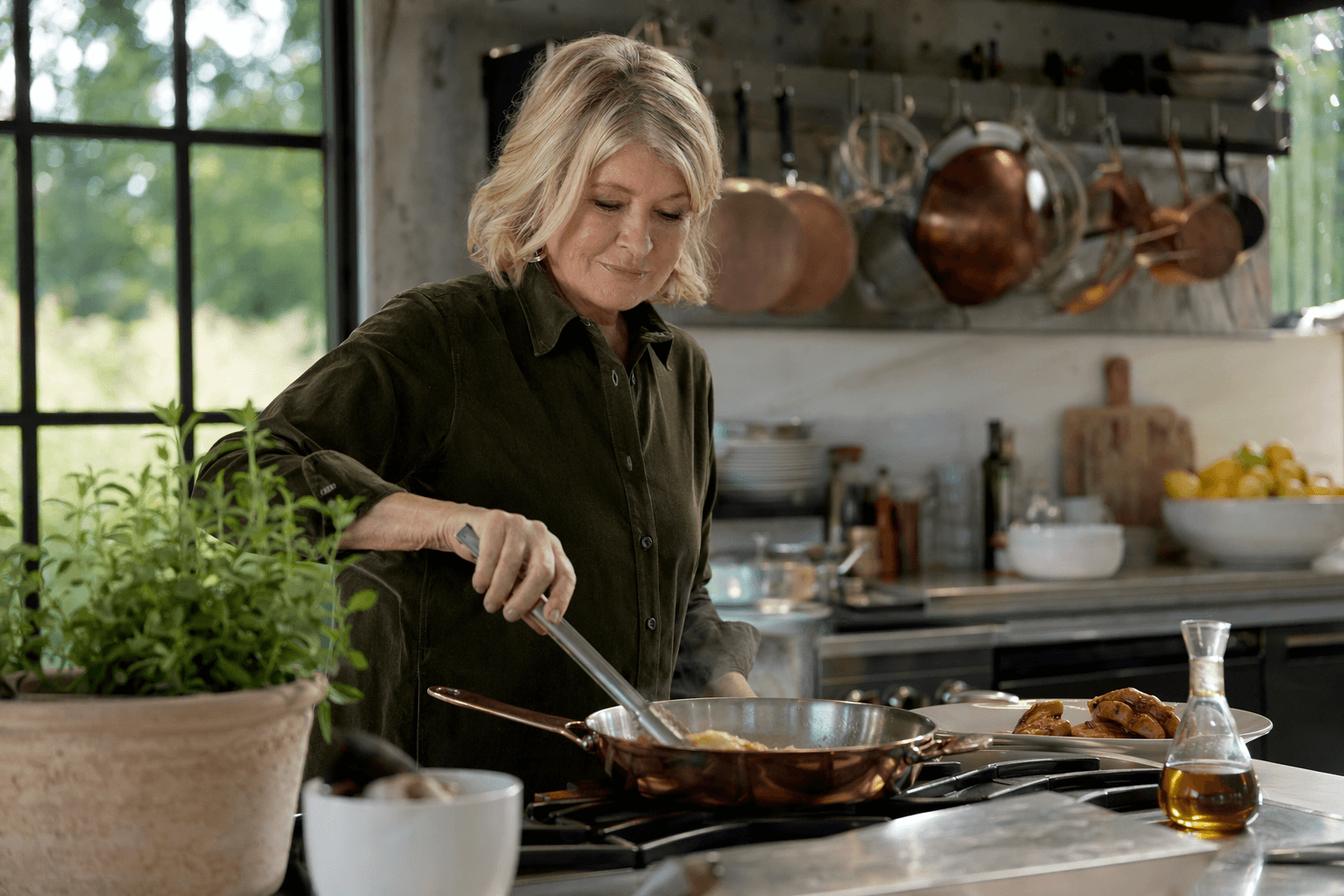
Even more telling is the way Stewart presents the classic cheese omelet. One breakfast recipe collection says it should be served plainly, with buttered toast, salted tomatoes, and chopped chives. That kind of presentation is the opposite of culinary theatrics: it emphasizes technique, timing, and restraint over garnish or trend chasing.
That simplicity is exactly why the example matters. A perfect omelet is a basic test of kitchen competence, and Stewart has long treated basics as the foundation of confidence in the home. Her continued return to eggs, vegetables, and clean plating shows that her authority rests less on spectacle than on a disciplined understanding of what ordinary cooking is supposed to do.
What her durability says about lifestyle media
Stewart’s relevance also says something larger about the business of domestic instruction. Lifestyle media often rewards the newest voice, the fastest recipe, or the most easily shared visual trick, yet Stewart’s brand keeps proving that expertise with history behind it still has commercial value. The fact that *The Martha Way* reaches beyond cooking into entertaining, organizing, collecting, and gardening reinforces that her appeal is built around a whole philosophy of order rather than a single category.
Marquee Brands has kept Stewart’s publishing and product ecosystem active through ongoing updates, which suggests that her authority is not just editorial but institutional. That matters in lifestyle media because trust is cumulative: it is built through books, recipes, videos, and a recognizable standard of taste that readers come back to when trends fade. Stewart’s catalog now spans at least 102 books, and that volume is part of the message.
What persists, then, is not just nostalgia. It is the business case for expertise that can be repeated, packaged, and still feel useful in the home. Stewart’s new book shows that the old language of domestic instruction still has a market, especially when it comes from someone who has spent decades proving that basics are not boring. They are the backbone of the brand.
This article was produced by Prism’s automated news system from verified source data, official records, and press releases, then run through automated quality and moderation checks before publishing. The system is built and supervised by the people who set the standards it runs under. Read our full AI policy.
Did this article answer your question?