Mayor Lurie Unveils Financing Tool to Drive 2026 Office-to-Residential Conversions
Mayor Daniel Lurie signed legislation Feb. 12 creating a Downtown Revitalization Financing District to turn vacant downtown offices into housing.
Mayor Daniel Lurie signed legislation on February 12, 2026 establishing a Downtown Revitalization Financing District to support conversion of vacant and underutilized downtown offices and commercial buildings into housing. Supervisor Aaron Sauter said, “San Francisco’s Downtown Revitalization District is open for business. We’re ready to engage with partners to help transform empty offices into new homes and usher in a new wave of activity to accelerate our downtown recovery.”
The new financing district builds on prior city efforts to reduce impact fees and transfer taxes on conversions and is intended to use property tax relief to make projects financially viable. Marc Babsin, president of the Emerald Fund, said, “With the finalization and inauguration of the downtown revitalization financing district today, San Francisco joins the ranks of major cities around the country, from New York to Boston to Chicago, that have recognized the power of property tax relief to enable the revitalization of downtown districts through office-to-residential conversions.”
City officials and backers are explicit about ambitions for scale. Supervisor Ahsha Safaí Mahmood said, “Converting San Francisco’s office buildings into housing will create construction jobs, fill stores and restaurants, and add to the vitality of our city’s downtown,” and added, “I am proud to support this creative approach to investing in new homes in the transit-rich heart of the city.” The press announcement described the district as a tool to “create homes for thousands of new residents downtown,” though the release did not include a citywide square footage total or a fiscal model.

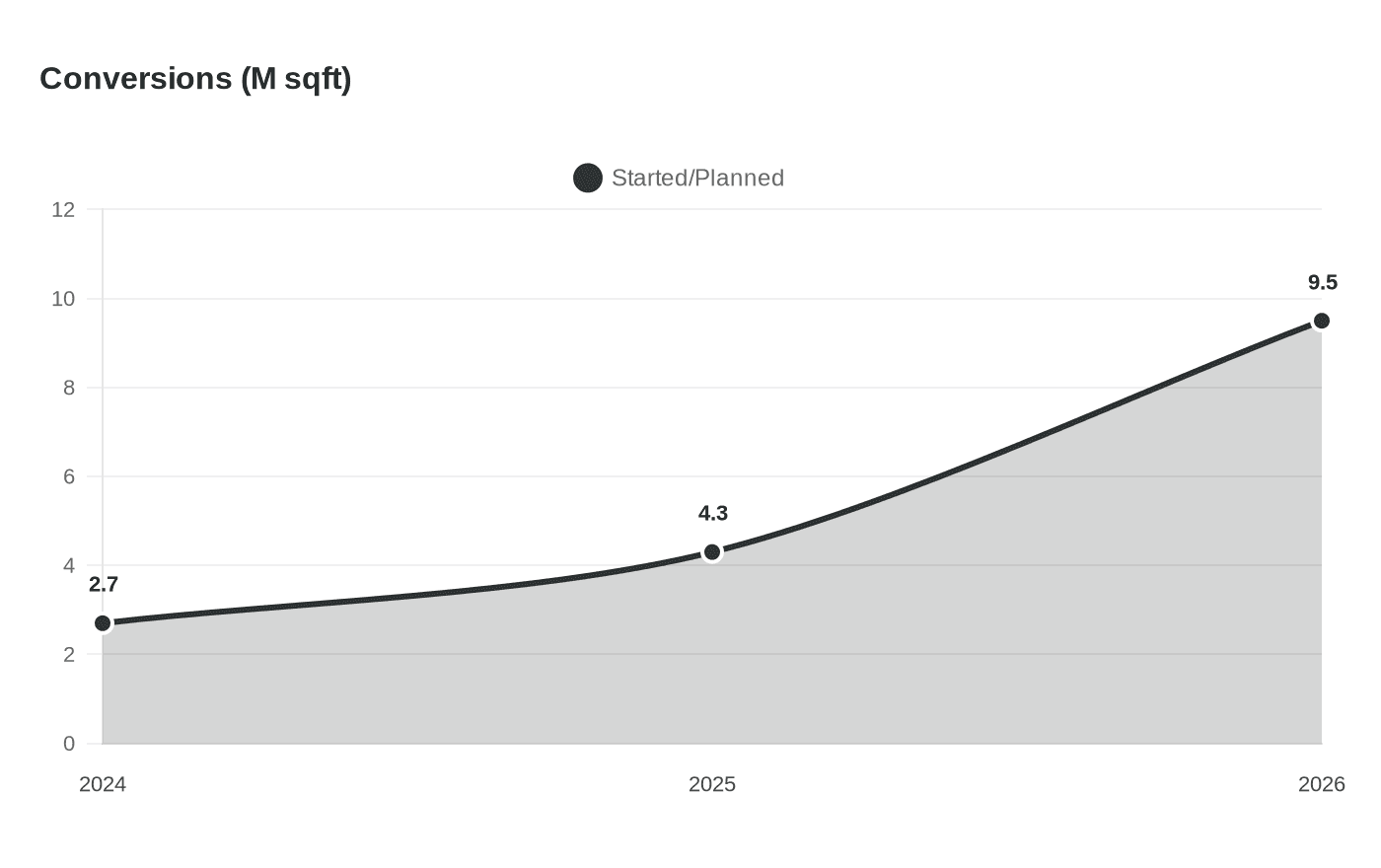
San Francisco’s move arrives as other U.S. markets report rapid conversion activity. Cushman & Wakefield tracking shows 4.3 million square feet of residential conversions started construction in the 11 months leading up to December 2025, up from 2.7 million square feet in 2024, and indicates developers plan to begin construction on 9.5 million square feet of office-to-residential conversions in 2026. Industry observers caution that conversions require a narrow set of favorable conditions; Jeremy Shell, a TF Cornerstone principal, said, “Adaptive reuse takes an ‘alignment of stars for it to make sense,’” while another industry speaker, Schleis, warned, “It does seem like some of the super large [projects] might start to taper off, just because we are seeing some rebound, especially in the high-end office leasing market.”
Fiscal analyses elsewhere illustrate the tradeoffs San Francisco will confront. The New York City Comptroller’s property tax projections estimate that 12.2 million gross square feet could potentially qualify for 467-m benefits by June 30, 2026 in Manhattan south of 59th Street, and that a first wave could turn 15.2 million gross square feet into 17,400 apartments. The Comptroller expresses results in present value terms over a 37-year schedule and uses simplifying assumptions that all conversions start in fiscal year 2026; its example building, 830 Third Avenue, traded in September 2022 for $72 million at $478 per gross square foot, had about 40 percent vacancy in 2023 and received a conversion permit in October 2024 for 188 units.
On the local pipeline, a Fisherman’s Wharf proposal at 2300 Stockton Street filed by Thousand Architects seeks to increase floor area from 62,300 square feet to 90,160 square feet and add 70 units across five floors. That initial filing is not a permit application, and the project expects to rely on the Family Zoning Plan height limit that was enacted January 31, 2026 to reach its residential capacity.
Contractors and suppliers warn that conversions disclose hidden costs. A January 27, 2026 analysis by Spartan Surfaces noted, “Conversions often reveal challenges you can’t see until you start peeling back the layers,” and added, “When every dollar counts, knowledge makes a huge difference.” San Francisco’s new financing district will test whether tax relief, zoning changes and developer appetite can combine to replicate the conversion momentum seen in New York. The city has not published a fiscal estimate tied to the Downtown Revitalization Financing District; the DRFD legislation text, staff analyses and records of prior impact fee and transfer tax reductions remain to be obtained to quantify how many buildings and how many homes the program will produce.
Know something we missed? Have a correction or additional information?
Submit a Tip