McCormick CEO Defends $44.8 Billion Unilever Foods Merger on CNBC
McCormick CEO Brendan Foley took to CNBC to defend a $44.8 billion Unilever foods merger, the largest deal in the spice maker's 137-year history.
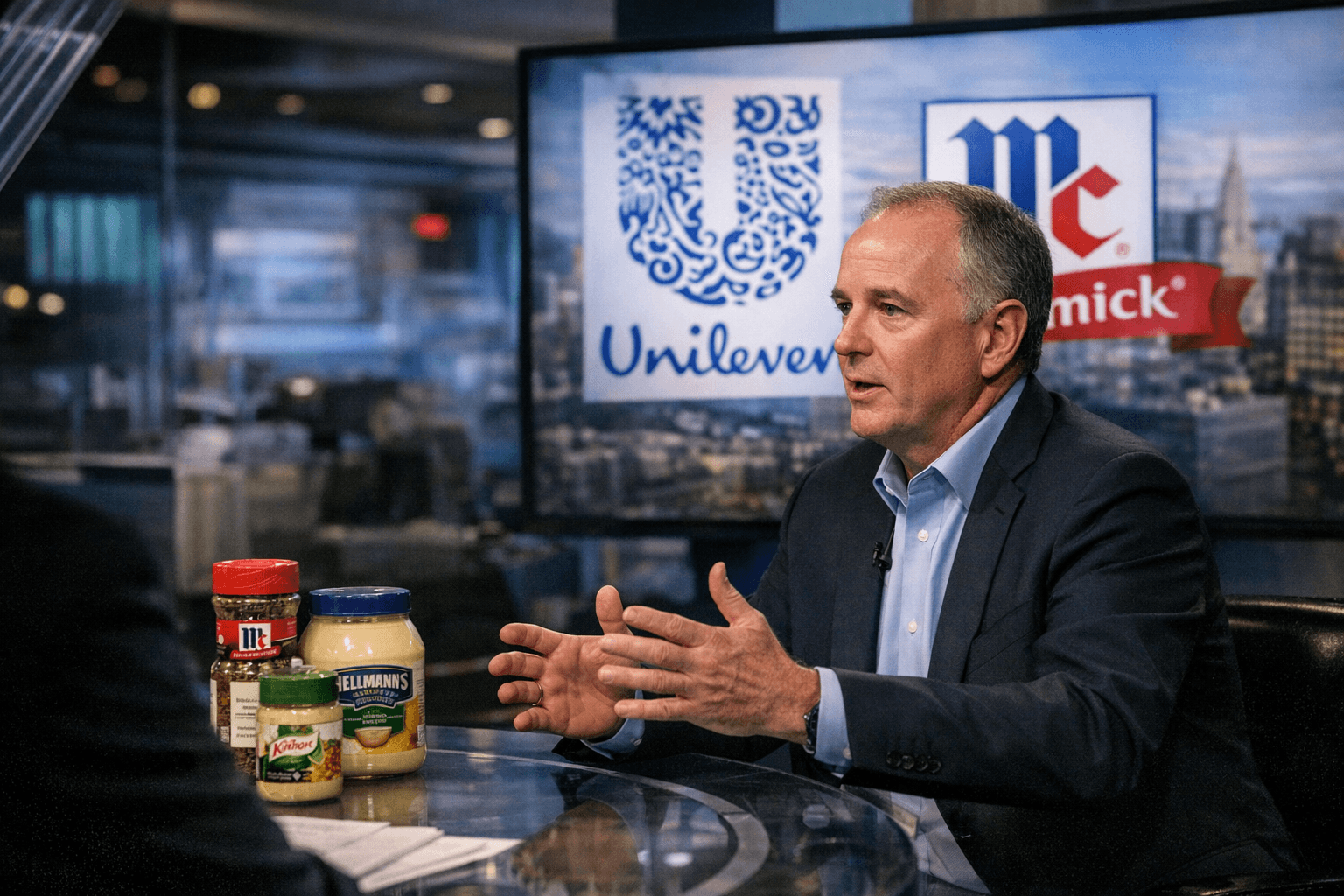
Brendan Foley stepped in front of CNBC's Squawk on the Street cameras Wednesday morning with a clear mission: convince investors that McCormick & Company's $44.8 billion combination with Unilever's foods business is worth the risk. Less than two weeks after the March 31 announcement rattled McCormick's stock price by nearly 6%, the company's chairman, president and chief executive used the 9 a.m. hour to lay out the strategic logic for what amounts to the largest deal in the spice maker's 137-year history and the second-largest food transaction ever recorded.
The transaction would create a global flavor company with approximately $20 billion in combined revenue, folding iconic Unilever food labels including Hellmann's mayonnaise and Knorr soups into a portfolio already anchored by McCormick's Frank's Hot Sauce, Old Bay and Cholula. Foley told viewers that Unilever's infrastructure and global reach would "help accelerate" growth for the combined business, giving McCormick entry into higher-growth geographies and channels at a speed the company could not achieve independently.
Unilever shareholders are set to receive 55.1% of the combined company's equity, with Unilever retaining an additional 9.9% stake to be sold down over time. McCormick will pay $15.7 billion in cash as part of the transaction's structure. McCormick's existing shareholders would hold a significant minority stake, and Foley confirmed he would continue as chief executive of the enlarged company. The combined group's global headquarters will remain in Hunt Valley, Maryland, with an international headquarters established in the Netherlands, the long-standing home for Unilever Foods.
On the question of financial returns, Foley pointed to cost savings as a central pillar of the deal's justification. The companies forecast annual run-rate cost synergies of approximately $600 million by the third year following completion, driven largely by consolidating manufacturing and streamlining global logistics. McCormick is also projecting sustainable organic sales growth of 3% to 5% after the two businesses merge. Foley said the combined scale in procurement and distribution would underpin those targets, while the broader brand portfolio opens up what he described as underpenetrated markets for flavored and specialty condiment products.
The interview came as analysts have wrestled with competing interpretations of the deal. Shares of McCormick fell 6% in morning trading on announcement day, while Unilever's stock dropped 4%, reflecting investors' hesitance about the mega-merger. Historically, the industry has a mixed record with such deals, as seen with Kraft Heinz and Keurig Dr Pepper. Foley acknowledged the scale of integration required, noting in official comments at announcement that the companies had prepared a "detailed integration roadmap" supported by teams from both organizations and external advisers.
The deal is structured as a Reverse Morris Trust, a tax-efficient mechanism that allows Unilever to divest its food arm without incurring the massive tax liabilities associated with a straight sale. For Unilever, the transaction completes a strategic pivot that began with the 2024 spin-off of its ice cream business, leaving the Anglo-Dutch consumer giant refocused entirely on home and personal care products.
The deal is expected to close in mid-2027, pending shareholder and regulatory approval. Antitrust scrutiny across multiple jurisdictions remains a variable that neither company has publicly quantified, and the sheer financing load on McCormick, whose previous largest deal was the $4.2 billion acquisition of RB Foods in 2017, will keep analyst pressure on Foley's execution well before the first integration milestone is reached.
This article was produced by Prism’s automated news system from verified source data, official records, and press releases, then run through automated quality and moderation checks before publishing. The system is built and supervised by the people who set the standards it runs under. Read our full AI policy.
Did this article answer your question?

