Mediators Meet in Miami, Push to Break Gaza Ceasefire Stalemate
U.S. Middle East envoy Steve Witkoff is convening senior officials from Qatar, Egypt and Turkey in Miami today to try to move the Gaza ceasefire into a second phase that would transfer security and governance responsibilities. The meeting matters because failure to advance Phase 2 risks a return to wider fighting, complicates reconstruction financing, and could alter regional market and investor sentiment around energy and political risk.
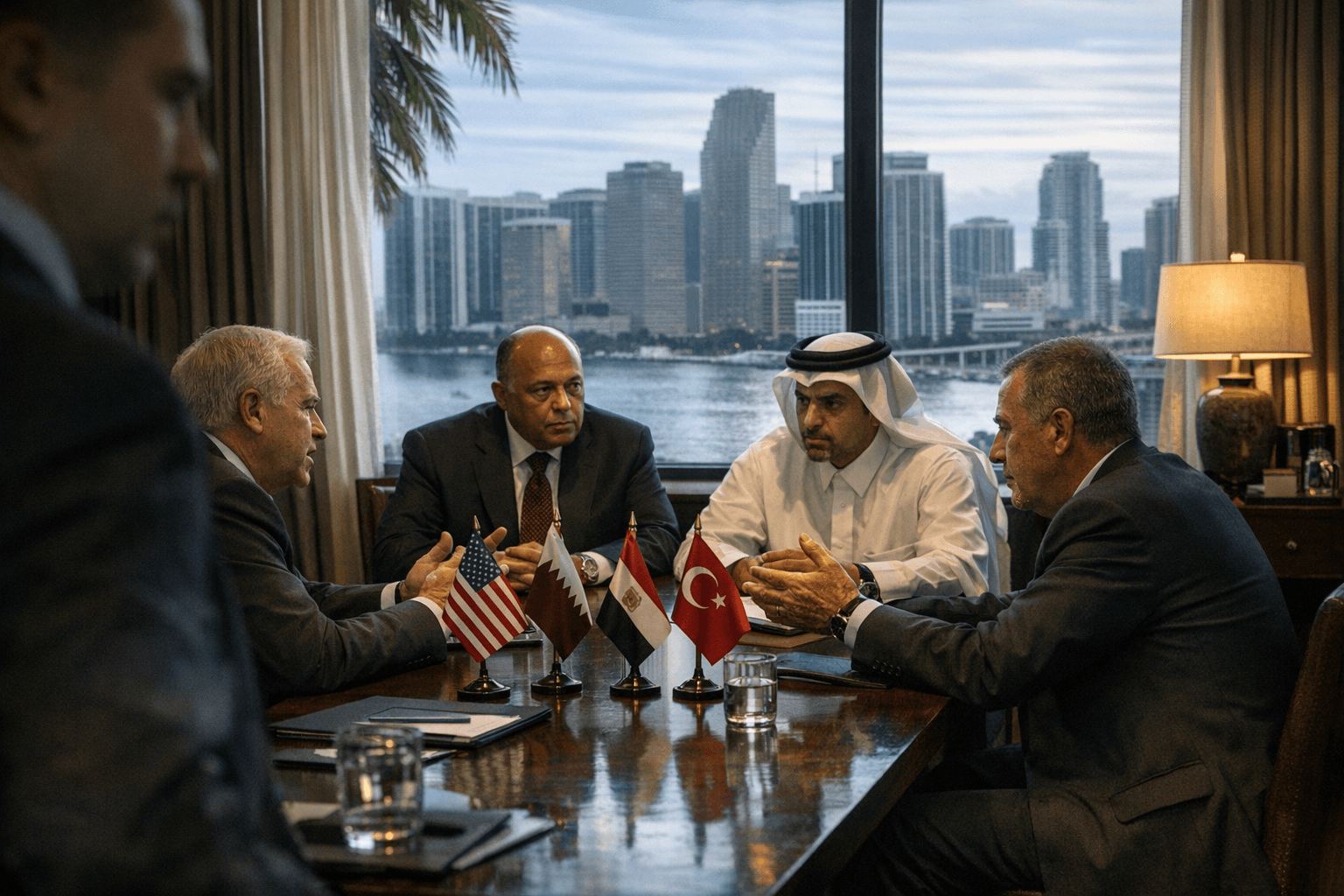
U.S. Middle East envoy Steve Witkoff is convening senior officials from Qatar, Egypt and Turkey in Miami on Dec. 19 to attempt to break a stalemate over implementing Phase 2 of the Gaza ceasefire negotiated in October. The gathering brings together the mediators who helped secure the initial truce and places the United States at the center of an effort to translate a fragile pause in hostilities into concrete political and security steps.
Participants expected to attend include Qatari Prime Minister Mohammed bin Abdulrahman al Thani, Turkey's Foreign Minister Hakan Fidan and Egyptian Foreign Minister Badr Abdelatty. The deliberations are aimed at moving beyond the current agreement into a sequence that several governments and mediators have described as involving an Israeli withdrawal from positions inside Gaza, the establishment of an interim authority to govern the territory in place of Hamas, and the deployment of an international stabilization force to prevent a return to large scale fighting.
The ceasefire took effect on Oct. 10 and has been punctuated by frequent violations. Gaza officials report more than 800 alleged breaches since Oct. 10, a figure that averages to more than 11 reported violations per day over the roughly 70 day period through Dec. 19. Mediators say that both Israel and Hamas are contributing to delays or obstruction in moving to the next stage, creating the impasse that the Miami talks seek to resolve.
The timing of the meeting is politically sensitive. It comes ahead of an expected meeting later this month between Israeli Prime Minister Benjamin Netanyahu and President Donald Trump at Mar a Lago to discuss the ceasefire and related security arrangements. The United States has signaled that the mediation file will remain a priority for privately led diplomacy that draws on regional partners, even as official state channels continue to operate.
Economic and market stakes are tangible. Proposals under discussion include using revenue from Gaza's undeveloped offshore natural gas resources to help finance reconstruction, a concept that would require commercial development, revenue sharing agreements and international guarantees. If mobilized, such revenues could alter the financing profile of reconstruction, reduce reliance on donor grants, and attract private capital. Conversely, continued stalemate raises risk premia across regional assets, with investors likely to demand higher returns for exposure to Israel, Palestinian territories and neighboring markets until a durable stabilization framework is in place.
Operationalizing Phase 2 poses complex policy choices. Establishing an interim authority raises questions about legitimacy and representation while deploying an international force will require troop contributions, mandate clarity and budget commitments from states wary of lengthy engagements. Those logistical and political hurdles help explain why mediators describe the agreement as tenuous.
The Miami talks represent a concentrated push to unblock implementation at a moment when both diplomatic momentum and investor patience could be decisive. If the mediators can reach agreement on sequencing, funding and international responsibilities, Phase 2 could set conditions for reconstruction and economic normalization. If not, the truce risks fraying and with it broader prospects for regional economic recovery and stability.
This article was produced by Prism’s automated news system from verified source data, official records, and press releases, then run through automated quality and moderation checks before publishing. The system is built and supervised by the people who set the standards it runs under. Read our full AI policy.
Did this article answer your question?


