Metro Growth Masks Weak Ridership as Last-Mile Gaps Persist
Metro lines are multiplying, but many commuters still cannot reach them cheaply or quickly. The gap between infrastructure spending and daily ridership is now the real test.
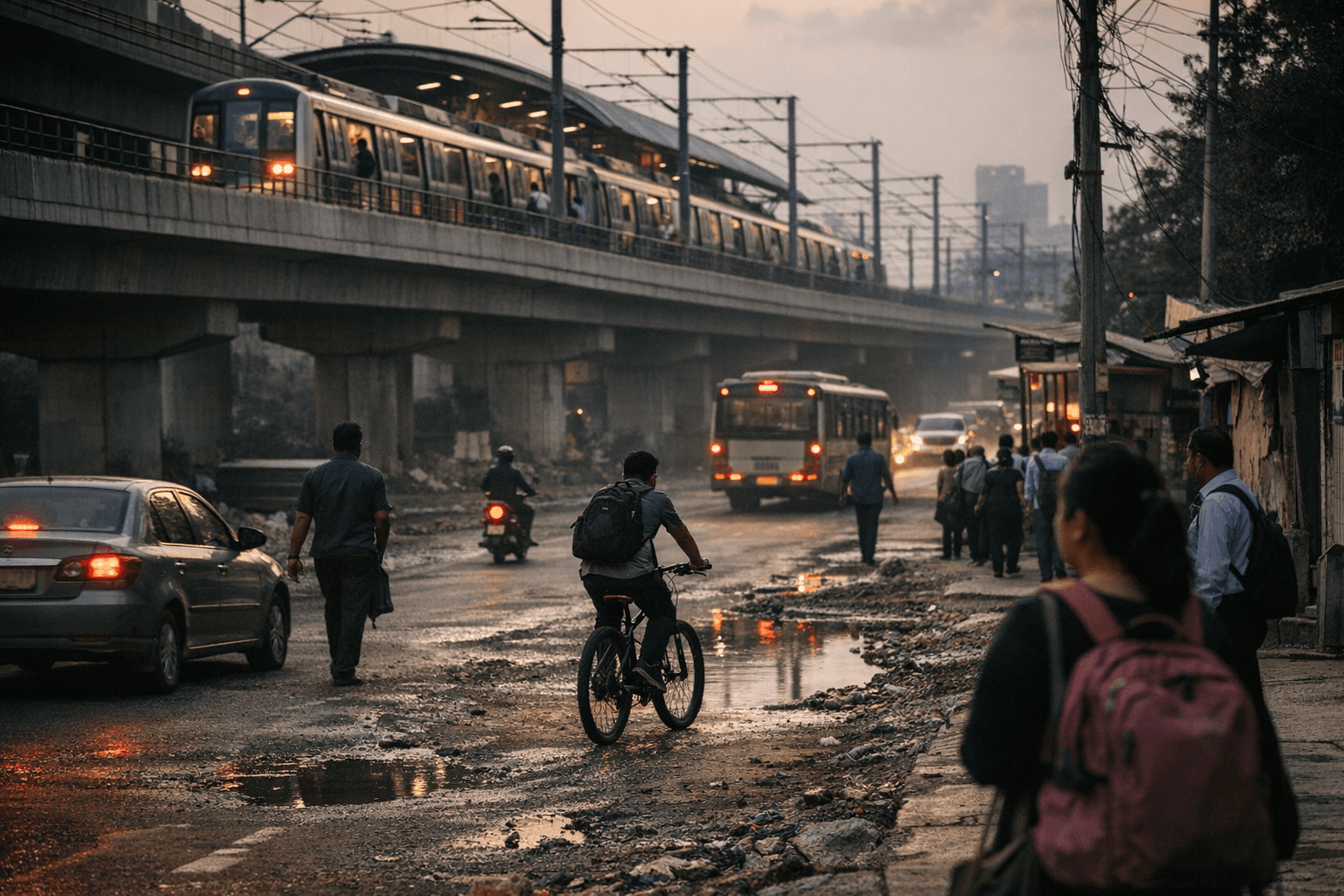
The buildout is impressive. The habit is not.
India has spent more than $26 billion on metro connectivity since 2014, and the network has expanded from under 300 km to more than 1,000 km by 2025. Yet the lived reality for many urban commuters is still defined by long walks, uncertain feeder services and fares that feel too high for short trips. That mismatch is why the country’s metro story is no longer just about construction milestones. It is about whether the system can actually move people, every day, from home to work without forcing them back into private vehicles or slow surface transport.
The headline ridership numbers look strong at first glance. Average daily metro ridership has climbed from about 3 million to more than 11 million over the past decade, and the Ministry of Housing and Urban Affairs has repeatedly pointed to the speed of expansion as evidence of progress. But those aggregate figures hide a more uneven picture at the corridor and city level, where several systems are still falling far short of demand forecasts.
Ridership gains are real, but projections remain out of reach
A 2023 report from the Indian Institute of Technology Delhi found that ridership on many corridors was only 25% to 35% of projected levels. Other studies cited by researchers show even sharper gaps. In Kanpur, actual usage has been estimated at as low as 2% of projected demand, while Chennai’s first phase reached about 37%. In Pune and Nagpur, the range cited in related analyses is roughly 20% to 50% of projections.
Delhi often looks like the exception, but even there the numbers can flatter the system. Some experts argue that usage appears stronger partly because interchanges may be counted as separate trips, which can inflate apparent demand. That matters because planning, funding and political messaging often rely on totals that make the system seem more successful than it is in practice. The broader lesson is that India has built a lot of track, but not yet a uniformly strong ridership base across cities.
The real bottleneck is getting to the station
A 2023 working paper by WRI India and the Toyota Mobility Foundation, covering Delhi, Bengaluru and Nagpur, puts the focus where many metro plans still do not, on the first and last mile. The study found that walking and shared modes accounted for more than 75% of last-mile travel in all three cities, which means most riders are still stitching together the trip themselves rather than relying on a well-connected feeder network.
The same research found that commuters, especially women, were reluctant to wait more than 10 minutes for a feeder service. It also found that users were willing to spend up to 20 minutes in total reaching a metro station, including waiting time. That is a tight window, and it explains why a metro line can run through the heart of a city while still missing large parts of its potential market. A station that is physically close but functionally hard to reach is not much better than no station at all.
Madhav Pai of WRI India has said that understanding last-mile commuter behaviour is crucial because it is the biggest hindrance to metro usage. Pras Ganesh of the Toyota Mobility Foundation has argued for better journey information, booking systems, hardware, software and seamless payment integration. Together, those points make clear that urban rail success is not only about laying tracks; it is about solving the logistics of the full trip.
Affordability is becoming part of the access problem
The fare debate has added a second layer of friction. The WRI India and Toyota Mobility Foundation study warned that current fare structures can disadvantage women because they often make shorter trips and therefore pay more per kilometre. That is a significant policy issue in a system where access is already constrained by feeder gaps and where short urban trips remain a large share of daily movement.
Bengaluru has become the sharpest example of this tension. A 2025 fare revision made Namma Metro India’s most expensive metro service, according to The Economic Times, and drew criticism from BJP MP Tejasvi Surya and entrepreneur Ashish Singhal. Critics say commuters are being pushed toward private vehicles when they must also absorb extra first- and last-mile costs, turning the metro into only one expensive component of a larger journey. Bangalore Metro Rail Corporation Limited has defended the increase by pointing to higher operating costs and warning that losses could widen to ₹577 crore if annual fare revisions are not introduced.
That argument is fiscally understandable, but it also reveals the strategic bind. Higher fares may protect balance sheets in the short run, yet they can weaken ridership growth if the full journey remains inconvenient. In a market where commuters have alternatives, price and access work together. If both are poor, the metro risks becoming an asset that looks successful in capital spending terms but underperforms as daily transport.
The government’s own data shows how fast the network is still growing
Official figures underline the scale of the buildout. A March 14, 2024 Ministry of Housing and Urban Affairs factsheet said about 945 km of metro lines were operational in 21 cities and 919 km were under construction in 26 cities. By December 2024, the ministry said around 993 km were operational and about 998 km were under construction, including the Delhi-Meerut RRTS balance section.
The ministry also said the average pace of metro commissioning had risen to about 6 km per month, compared with 0.68 km per month before 2014. Delhi Metro’s average daily passenger journey in October 2024 was reported at 64,08,029, with a peak of around 78 lakh on November 18, 2024. Those numbers show that the system can carry heavy volumes where it is well integrated and heavily used, but they do not erase the uneven performance elsewhere.
The policy challenge now is not whether India can keep building metro lines. It is whether the next phase of urban transit invests with the same intensity in feeder buses, walking routes, shared mobility, fare design and seamless payment systems. Without that shift, the country will keep adding stations that are easier to inaugurate than to reach, and the metro boom will remain weaker on the ground than it looks on paper.
This article was produced by Prism’s automated news system from verified source data, official records, and press releases, then run through automated quality and moderation checks before publishing. The system is built and supervised by the people who set the standards it runs under. Read our full AI policy.
Did this article answer your question?


