Mexico Truckers, Farmers Blockade Highways Across 20 States Over Safety, Costs
Truckers and farmers shut down freight corridors across 20 Mexican states Monday, snarling border crossings and threatening perishable cargo as an indefinite strike entered its second day.

Major freight corridors spanning 20 of Mexico's 32 states ground to a halt Monday as blockades coordinated by the National Association of Transporters (ANTAC) and the National Front for the Rescue of the Mexican Countryside (FNRCM) slammed key supply chains and stacked up delays at U.S.-Mexico border crossings critical to maquiladora operations and agricultural exports.
The action, which began in the early morning hours of April 6, disrupted routes across northern, central and southern Mexico, with particularly heavy congestion reported around Mexico City and along border corridors that serve manufacturers relying on just-in-time delivery schedules. As the strike entered its second day Tuesday, organizers warned it could continue indefinitely unless the federal government met their core demands.
Those demands converge on three pressure points: mounting highway violence and cargo theft that organizers say has made long-haul trucking increasingly dangerous and economically untenable; fuel costs and operating expenses that have squeezed margins across the transport sector; and concrete government commitments to agricultural support programs and rural policy reforms backed by the farming coalition.
The supply-chain consequences moved fast. Logistics firms issued advisories warning clients to prepare for rerouting and delays on perishable goods, including fresh produce, as well as manufactured components and industrial inputs. Freight handlers documented long lines of trucks stalled at toll booths and temporary closures across federal highway networks. For factories dependent on cross-border inputs, the disruption carried immediate production risk; even short-lived blockades on Mexico's freight arteries can force manufacturers to slow assembly lines or draw down buffer inventory.
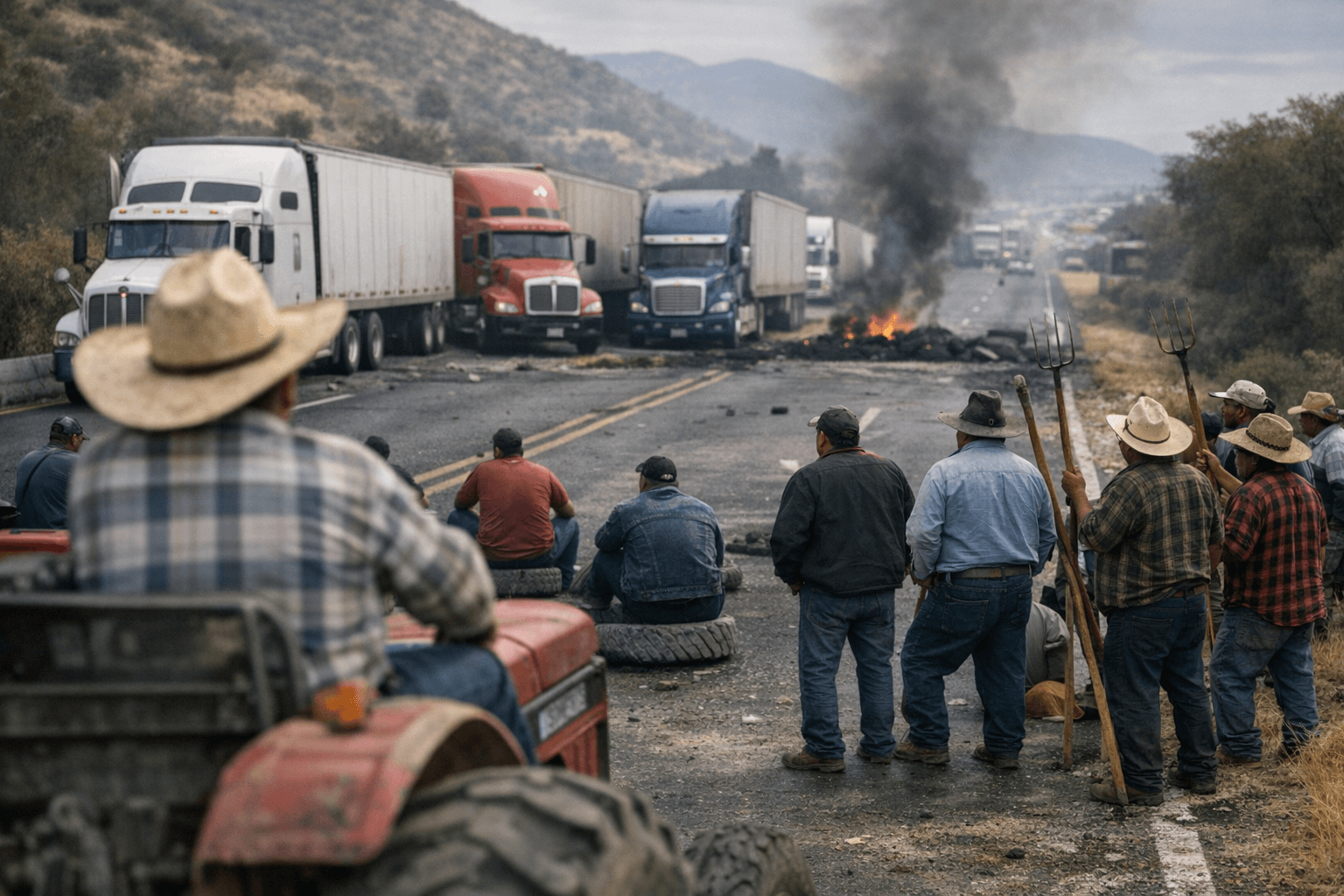
The border crossing impact added a cross-national dimension to what began as a domestic labor and agricultural grievance. Routes servicing maquiladoras and agricultural exporters sustained delays, putting pressure on U.S. buyers and retailers who depend on timely Mexican imports. Logistics providers signaled potential force majeure declarations if disruptions extended further into the week.
Officials in several affected states opened negotiations with protest leaders, and federal agencies urged a return to dialogue while simultaneously warning that blocking federal highways carries legal consequences. Whether those parallel tracks can produce a resolution fast enough to prevent deeper economic damage remained the central question as the strike held into its second day.
Mexico has weathered repeated large-scale transport blockades in recent years, each driven by the same converging pressures: extortion on federal highways, cargo theft, and operating costs that organizers argue the government has failed to address structurally. The ANTAC-FNRCM coalition's decision to coordinate across 20 states simultaneously signals an escalation in both scale and political intent, designed to force federal negotiations rather than allow regional officials to manage the protests piecemeal. If the strike persists, economists and logistics analysts warn of short-term inflationary pressure on food items, with the heaviest exposure concentrated in industries built around tight delivery windows.
This article was produced by Prism’s automated news system from verified source data, official records, and press releases, then run through automated quality and moderation checks before publishing. The system is built and supervised by the people who set the standards it runs under. Read our full AI policy.
Did this article answer your question?