Trump Threatens Total Destruction of Iran Over Strait of Hormuz Deadline
Trump warned "a whole civilization will die tonight" as his 8 p.m. Strait of Hormuz deadline loomed, with legal experts calling the threats war crimes.
A whole civilization will die tonight, never to be brought back again. I don't want that to happen, but it probably will." Those words, posted by President Trump to his Truth Social platform on April 7, framed an ultimatum that drew immediate condemnation from international leaders, legal scholars, and members of both parties in Congress: reopen the Strait of Hormuz by 8 p.m. Eastern time, or face the wholesale destruction of Iran's power plants and bridges.
The deadline arrived roughly five weeks into an active armed conflict that began February 28, when the United States and Israel launched surprise airstrikes on sites and cities across Iran in an operation internally called "Operation Epic Fury." The strikes killed Supreme Leader Ali Khamenei along with several other Iranian officials and resulted in more than one hundred civilian casualties. Iran responded by launching missile and drone strikes against Israel, U.S. bases, and American-allied nations across the Middle East, and closed the Strait of Hormuz, the narrow waterway between the Persian Gulf and the Gulf of Oman through which approximately one-fifth of global oil supply flows, as an economic and strategic pressure point.
Trump had been escalating toward Tuesday's ultimatum for more than two weeks. At a White House news conference on April 6, he threatened to blow up every bridge and power plant in Iran and said he would like to seize the country's oil, a move legal experts said could constitute pillaging under international law. Asked directly whether he was concerned about committing war crimes, Trump said he was "not at all" concerned.
Legal experts were sharply at odds with that assessment. Tess Bridgeman, who served as a legal adviser to President Obama's National Security Council, said plainly: "Electrical generating plants power hospitals, they power schools, water sanitation facilities... Obliterating all power plants, threatening coercive actions against the civilian population to try to bring a government to the negotiating table, those kinds of things are flatly illegal." More than 100 legal experts signed an open letter through the Just Security forum warning that Trump's threatened strikes, if carried out, "could entail war crimes." Legal analysts framed the threat itself, not merely any eventual action, as constituting an "indiscriminate attack" under the laws of armed conflict, a specific term of art in the law of war.
International condemnation was swift. Pope Leo XIV called the threats "truly unacceptable" and said they would violate international law. French Foreign Minister Jean-Noël Barrot said attacks targeting civilian and energy infrastructure could constitute a war crime, though such cases are notoriously difficult to prosecute. A spokesman for UN Secretary-General António Guterres said the UN chief was "deeply troubled," adding that no military objective justified targeting civilian infrastructure. Amnesty International Secretary General Agnès Callamard condemned Trump's "apocalyptic threats" as a violation of international law. Pakistani Prime Minister Shehbaz Sharif publicly asked Trump for a two-week extension of the deadline and called for a ceasefire to allow diplomacy.
On Capitol Hill, Senate Democrats issued a joint statement calling the threatened strikes "a war crime, a betrayal of the values this nation was founded on, and a moral failure." Sen. Elissa Slotkin of Michigan, a former CIA analyst, called it "a clear violation of the law of armed conflict." Rep. Yassamin Ansari introduced articles of impeachment against Defense Secretary Pete Hegseth, who has removed senior military lawyers and replaced judge advocates general, dismantling the institutional framework that has historically applied international humanitarian law to military operations. Most senior Republicans remained publicly silent; Sen. Joni Ernst of Iowa said Trump was "absolutely not" threatening a war crime, while Sen. Ron Johnson of Wisconsin said he did not "want to see us start blowing up civilian infrastructure."
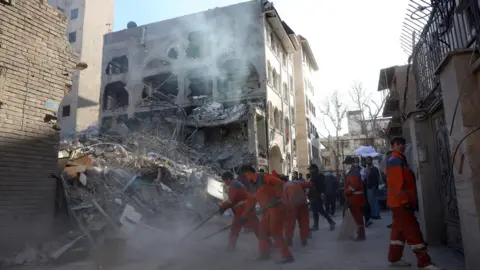
Military operations continued as the deadline approached. U.S. forces struck military targets on Kharg Island, and Israel's military said it had attacked eight bridges across Iran, destroying sections in Tehran, Karaj, Tabriz, Kashan, and Qom. Iran is heir to one of the world's oldest continuous civilizations, making Trump's rhetorical framing particularly charged. He ended his Truth Social post, the one threatening the annihilation of that civilization, with "God Bless the Great People of Iran.
Sources:
Know something we missed? Have a correction or additional information?
Submit a Tip