Microsoft unveils Surface RTX Spark Dev Box for local AI development
Microsoft’s new Surface RTX Spark Dev Box brings 1 petaflop of AI compute to the desktop, giving Windows on Arm developers a local alternative to cloud-heavy workflows.
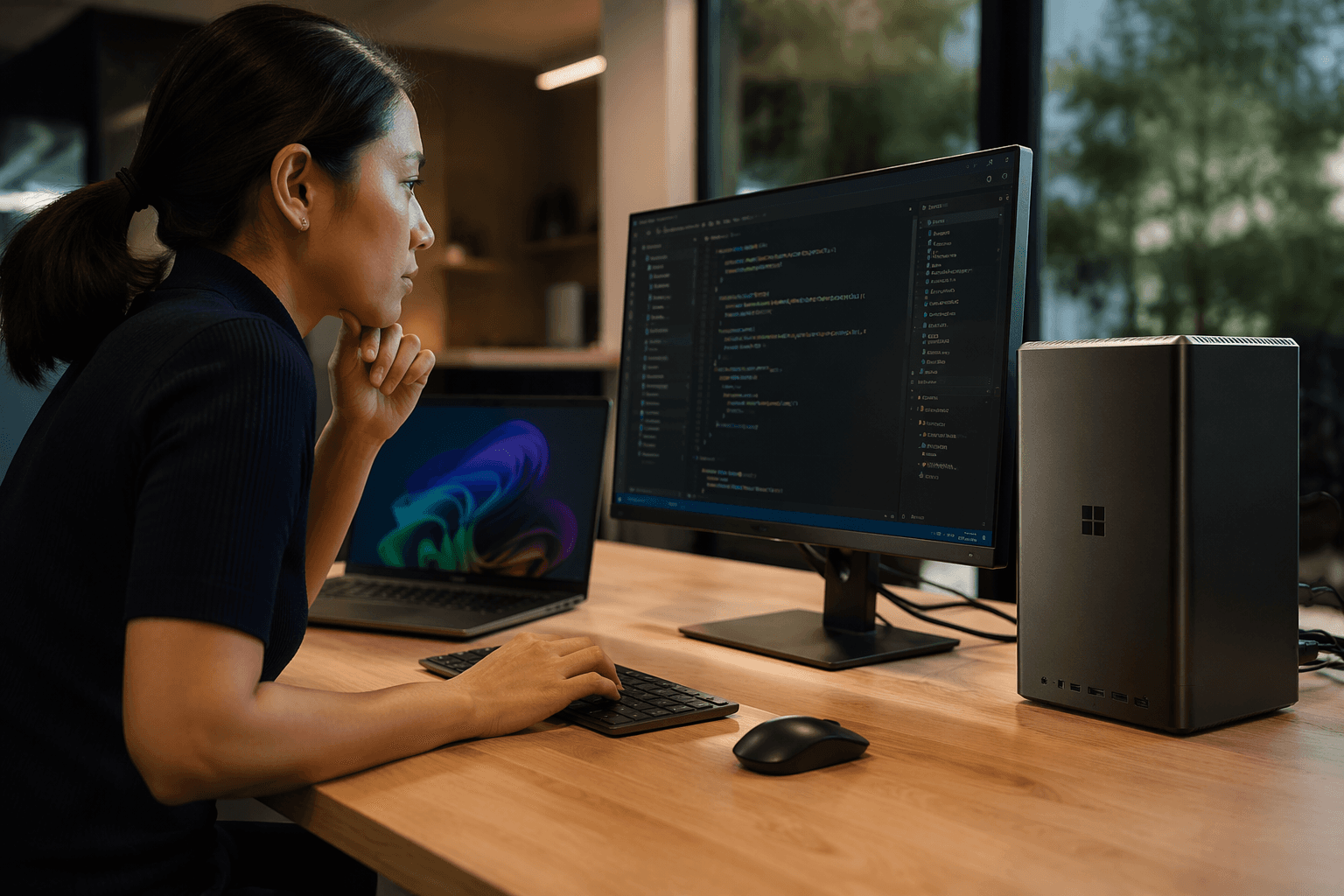
Microsoft used Build on June 2, 2026 to unveil the Surface RTX Spark Dev Box, a compact developer PC meant to keep serious AI work on the desk instead of in the cloud. The machine is built around Nvidia’s Arm-based RTX Spark superchip and is pitched as a local-first development system for prototyping, fine-tuning and running capable models with the cloud used only when needed.
The specs show why Microsoft is making the bet. The company says the box can deliver up to 1 petaflop of AI compute, includes 128GB of unified memory and can run 120B-plus parameter models locally at interactive speeds. Its aluminum chassis doubles as a heatsink, a design choice aimed at sustaining long training runs, large-model inference and agentic pipelines without turning the device into a throttling problem on a developer’s desk.
Microsoft also preloads the hardware for the exact workflows it wants to accelerate. The system ships with WSL2 GPU passthrough and full CUDA support, along with Visual Studio Code, GitHub Copilot and other developer tools already installed. That matters for teams building AI software that depends on Linux tooling, GPU acceleration and rapid iteration, especially as more development moves toward models that need persistent compute rather than brief cloud calls.
The launch also fills a long-standing gap in Windows on Arm developer hardware. Qualcomm’s Snapdragon X Elite Developer Kit, which had been expected to ship in June 2024, was later canceled in October 2024 and refunded after delays. Microsoft’s new box lands as Qualcomm pushes its next Snapdragon X2 Elite lineup and Nvidia moves deeper into Windows on Arm, a sign that Microsoft is no longer waiting for partners to define the category.
That shift has strategic weight in the post-Intel AI-PC race. Microsoft has spent years building Arm-focused development hardware, starting with the $599 Windows Dev Kit 2023, then Project Volterra, powered by Qualcomm’s Snapdragon 8cx Gen 3 and a dedicated Hexagon AI processor. The company has also pointed to Arm-based devices such as Surface Pro 11th Edition and Surface Laptop 7th Edition as proof that Windows on Arm can now deliver better performance and compatibility than earlier attempts.

For developers, the new Surface RTX Spark Dev Box is the clearest signal yet that Microsoft wants the Windows ecosystem to own more of the AI workflow stack itself. Teams building local inference tools, edge prototypes, CUDA-based AI apps and agentic software are the most likely to switch, especially if they are trying to cut cloud costs, reduce latency and keep model development closer to the hardware. Microsoft’s message is blunt: the next phase of AI development is not just bigger models, but more of that work happening locally on Windows.
This article was produced by Prism’s automated news system from verified source data, official records, and press releases, then run through automated quality and moderation checks before publishing. The system is built and supervised by the people who set the standards it runs under. Read our full AI policy.
Did this article answer your question?