Military Archbishop Says Iran War Fails Just War Test, Not God's Work
The U.S. military's top Catholic archbishop declared the Iran war fails just war doctrine, saying it's "hard" to see the conflict as "sponsored by the Lord."
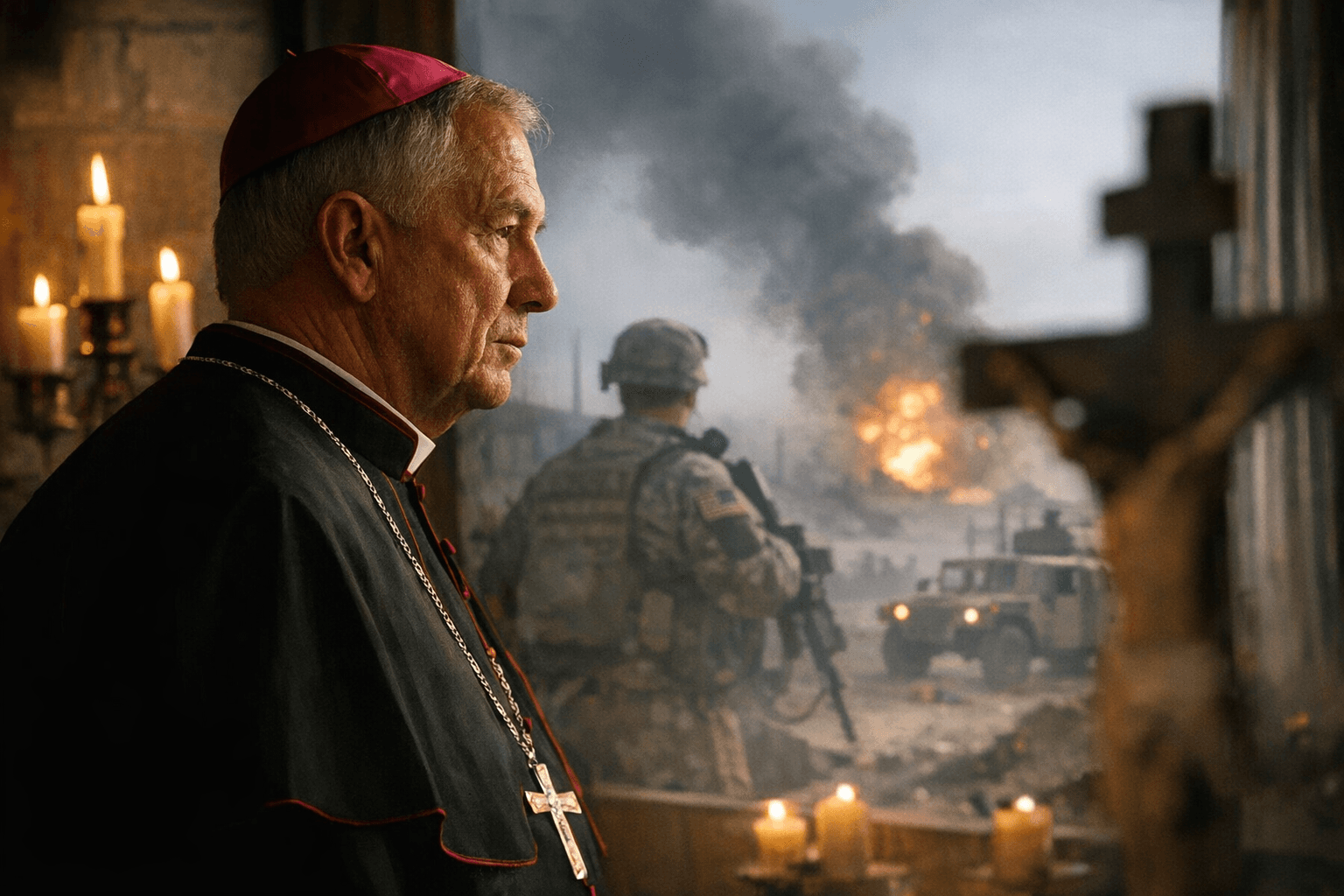
Archbishop Timothy Broglio, the Catholic Church's top religious leader for U.S. military personnel, said the American war against Iran fails Catholic just war doctrine, adding that he finds it "hard" to see the conflict "as something that would be sponsored by the Lord."
Speaking on Face the Nation with host Margaret Brennan, Broglio was direct: "Under the just war theory, it is not [justified], because while there was a threat with nuclear arms, it's compensating for a threat before the threat is actually realized."
The statement carries institutional weight beyond one bishop's opinion. As Archbishop for the Military Services since January 25, 2008, Broglio leads the only Catholic institution authorized to endorse Roman Catholic chaplains for U.S. government service. No Catholic priest can serve as a military chaplain without the Archdiocese's express permission. As of 2020, 204 priests were endorsed for active duty, and the Archdiocese holds responsibility for more than 1.8 million Catholics in the armed forces, their families, VA patients, and U.S. government personnel abroad. Catholics make up approximately 20 percent of active-duty military personnel.
Just war theory, codified in the Catechism of the Catholic Church, requires four simultaneous conditions: the aggressor's damage must be lasting, grave, and certain; all other means of resolution must have been exhausted; success must be reasonably likely; and the harm caused must not outweigh the evil being eliminated. Broglio's objection targets the first and most foundational of these conditions. Iran's nuclear threat, he argues, had not yet been "actually realized" when the strikes began. Preemptive force against a potential, unrealized threat does not clear that bar.
That distinction bears directly on what the United States executed. Operation Midnight Hammer, launched June 22, 2025, dispatched seven B-2 Spirit stealth bombers from Whiteman Air Force Base in Missouri alongside more than two dozen Tomahawk cruise missiles and over 100 aircraft total to strike three Iranian nuclear sites: Fordow, Natanz, and Isfahan. The operation used 14 GBU-57A/B MOP bunker-buster bombs and was the first U.S. strike on Iranian territory since 1988. A ceasefire arrived on June 24, 2025, but hostilities continued well into 2026, with airstrikes causing civilian casualties in Tehran as recently as March 12.
Broglio's judgment aligned with a broad wave of Catholic voices from Rome to Washington. On Palm Sunday 2026, Pope Leo XIV condemned those who "wage war." On March 26, Vatican Secretary of State Cardinal Pietro Parolin said the conflict "does not seem to meet the conditions" for a just war. Washington Archbishop Cardinal Robert W. McElroy stated the U.S. strikes fail the just war threshold "in at least three requirements." Analysts at the Foundation for Defense of Democracies argued the opposite, contending that Iran's advancing nuclear program and collapsed negotiations did satisfy the doctrine's criteria.
The Iran comments were not an isolated stand. In January 2026, Broglio said it would be "morally acceptable" for Catholic troops to refuse orders to seize Greenland, warning that troops "could be put in a situation where they're being ordered to do something which is morally questionable." In December 2025, responding to naval attacks on alleged drug smugglers, he wrote: "No one can ever be ordered to commit an immoral act."
Broglio holds a Doctorate in Canon Law from the Pontifical Gregorian University in Rome and served as USCCB President from 2022 to 2025. His repeated invocations of conscience and just war doctrine against Trump administration military directives carry a direct practical consequence for the 204 Catholic chaplains embedded across the armed forces: when a commander reaches for religious language to justify military action, those chaplains now have a clear theological verdict from the top of their own ecclesiastical chain of authority.
This article was produced by Prism’s automated news system from verified source data, official records, and press releases, then run through automated quality and moderation checks before publishing. The system is built and supervised by the people who set the standards it runs under. Read our full AI policy.
Did this article answer your question?


