China's Xinjiang Party Secretary Ma Xingrui Concludes Four-Year Regional Leadership Role
Ma Xingrui, former Xinjiang party chief, was placed under investigation Friday for severe violations of discipline and law, becoming the third Politburo member probed since 2022.
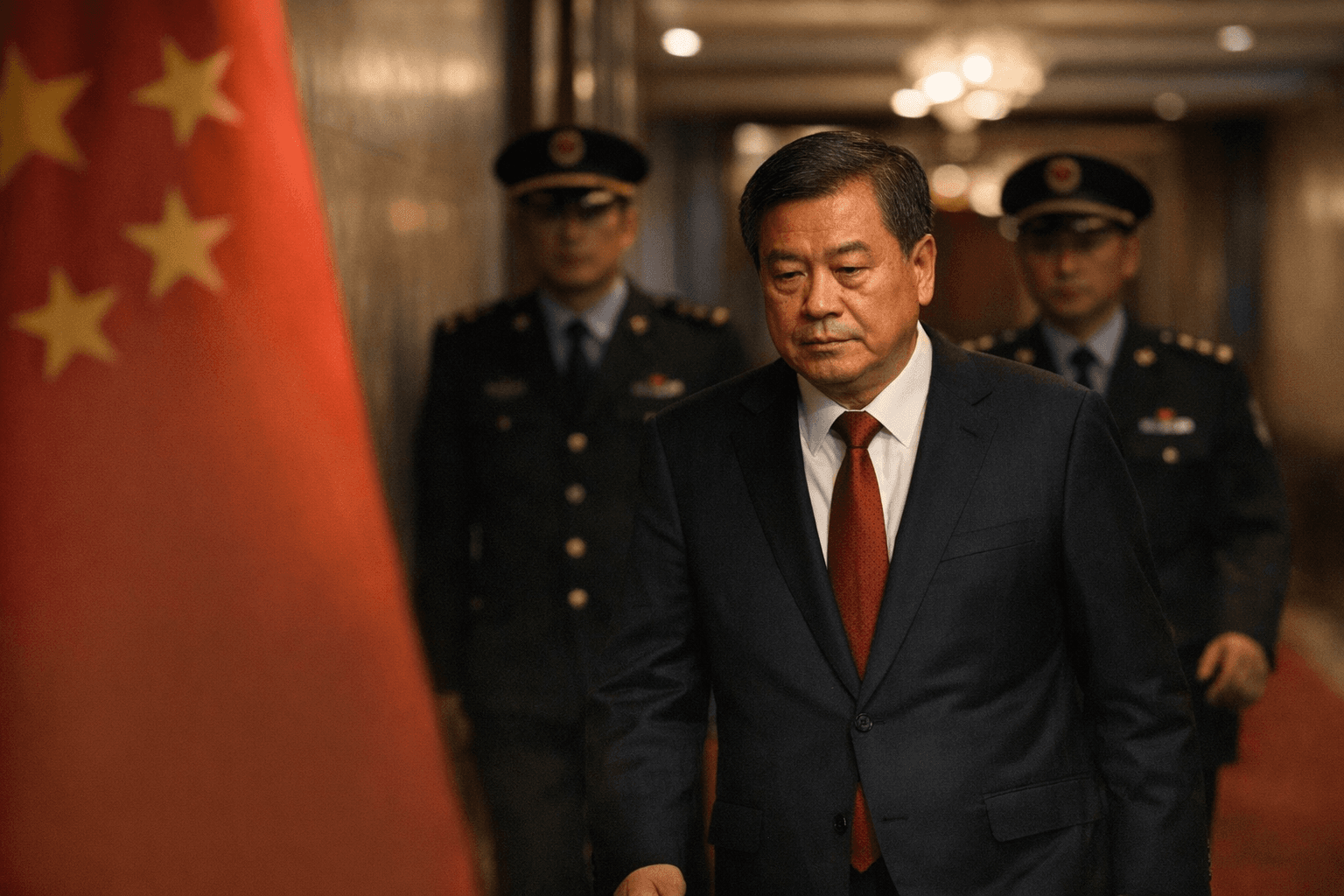
The disciplinary body for China's Communist Party placed former Xinjiang party chief Ma Xingrui under investigation Friday over suspected violations of discipline and law. He is the third member of the ruling party's elite political body to come under investigation in the current term that began in 2022, a situation unseen in decades.
Ma is a member of China's Politburo and served as the former Communist Party boss of Xinjiang from December 2021 until July 1, 2025, when he was replaced by Chen Xiaojiang. The Xinhua News Agency reported he was placed under investigation for "severe violations" of unspecified laws and party discipline. Before Xinjiang, Ma had served as governor of Guangdong, one of China's wealthiest provinces. His career trajectory before provincial governance was rooted in science and engineering: Ma worked on aerospace technology for many years at the same research institute as Yuan, and they continued to work together for five years as CEO and deputy CEO of the China Aerospace Science and Technology Corporation, China's top state-owned enterprise in the sector. As a rocket scientist, Ma served as chief commander for several space missions, including the Chang'e 3 mission, China's first lunar surface exploration.
Xinjiang had become well-known internationally for a yearslong campaign of extrajudicial detentions. That international dimension persisted throughout his tenure: in March 2025, Ma held a meeting with Thai Deputy Prime Minister Phumtham Wechayachai regarding Thailand's deportation of 40 Uyghurs to China. The scrutiny of a former Xinjiang chief carries weight beyond a single official's fate. Beijing has long insisted its policies in the region represent legitimate counter-terrorism measures; an investigation into the man who administered those policies for four years complicates that narrative, signaling to both domestic audiences and foreign governments that the party's accountability reach now extends to officials who oversaw its most internationally contested security apparatus.
Signs of political trouble had been accumulating for months before Friday's formal announcement. Politburo member Ma Xingrui was absent from the recently concluded proceedings, with the two most plausible explanations being that he was either dealing with serious health issues or was under investigation. China's top anti-corruption authority had announced an investigation into Li Xu, a senior official of the Xinjiang Production and Construction Corps widely regarded as a close associate of Ma Xingrui, making him the second senior official to fall in 2026. Then, in late March, a former top official of Guangdong province, widely seen as a "right-hand man" of former provincial governor Ma Xingrui, was placed under investigation for corruption. The investigation into Guo Yonghang, Communist Party secretary for Guangzhou from June 2023 until December, deepened uncertainties about Ma's political fate.
In Beijing's political lexicon, anti-corruption investigations at this level function as much as instruments of factional course-correction as straightforward legal proceedings. The sequence matters: associates fall first, then the principal. He Weidong, former vice-chairman of the powerful Central Military Commission, was also investigated and expelled from the party and military in October. Xi Jinping also removed the top general in charge of the country's military in January. Ma's investigation, coming atop the military purges, suggests Xi's current sweep is the broadest consolidation of authority since the reform era.
Ma was also deputy head of the Leading Group for Rural Affairs of the CPC Central Committee, and he was placed under disciplinary and supervisory investigation by the Central Commission for Discipline Inspection and the National Supervisory Commission. No specific allegations were stated, as is standard when senior officials enter the party's disciplinary system. For a man who spent a quarter-century building rockets before governing two of China's most strategically sensitive regions, the formal accounting has now begun.
This article was produced by Prism’s automated news system from verified source data, official records, and press releases, then run through automated quality and moderation checks before publishing. The system is built and supervised by the people who set the standards it runs under. Read our full AI policy.
Did this article answer your question?


