MIT CSAIL’s PhysiOpt uses AI and physics to generate 3D-printable parts
MIT CSAIL’s PhysiOpt turns a text or image prompt into a physics-tested, 3D-print-ready model in roughly 30 seconds by combining generative AI with finite element analysis.

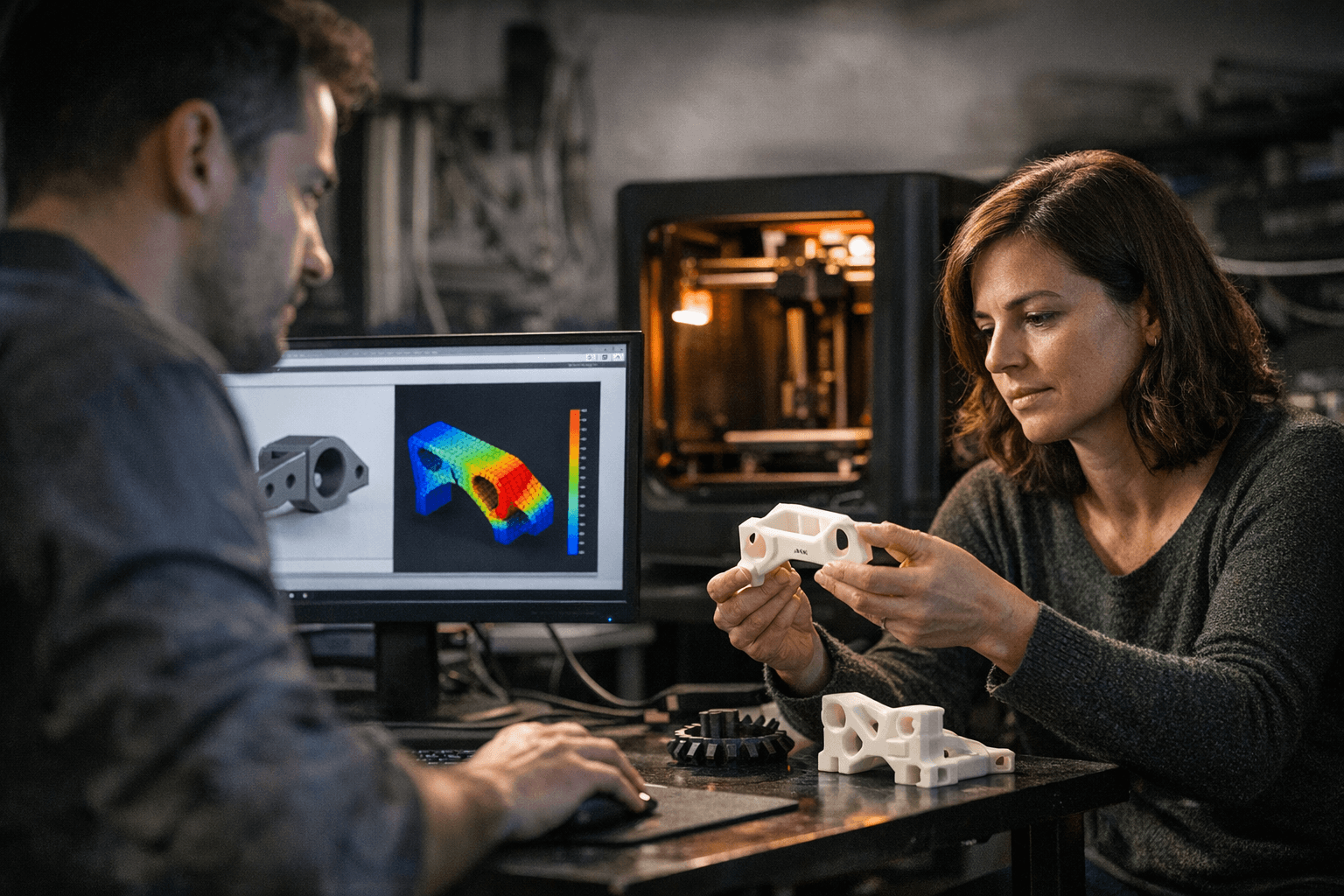
PhysiOpt, developed at MIT’s Computer Science and Artificial Intelligence Laboratory, returns a refined, 3D-printable design in roughly 30 seconds by merging generative AI with finite element analysis. The system stress-tests AI-generated geometry, produces heat maps of weak regions, and makes subtle, automatic adjustments so everyday objects hold up when fabricated.
Users feed PhysiOpt either a text prompt or an image and specify practical constraints such as how much force or weight the object must handle, the fabrication material like plastic or wood, and how the object will be supported. Examples used in the project materials include a flamingo-shaped drinking glass and a bookend that holds five books, as well as cups, hooks, keyholders, and birdhouses.
Under the hood PhysiOpt relies on a pre-trained generative model that researchers say carries “shape priors” — prior knowledge of forms and aesthetics — which the system uses to preserve appearance while optimizing structure. After the generative step, PhysiOpt runs finite element analysis to stress-test the shape and generate a heat map showing stress concentrations; VoxelMatters and News Mit described support beams under a birdhouse colored bright red to indicate likely failure unless reinforced.
The optimization loop then incrementally changes geometry to reinforce weak points while keeping intended function. Xiao Sean Zhan, an MIT EECS PhD student and CSAIL researcher listed as a co-lead author on the paper, said, “PhysiOpt combines GenAI and physically-based shape optimization, helping virtually anyone generate the designs they want for unique accessories and decorations.” Zhan also described the workflow’s iteration capability: “It’s an automatic system that allows you to make the shape physically manufacturable, given some constraints. PhysiOpt can iterate on its creations as often as you’d like, without any extra training.”
Project materials claim PhysiOpt works faster than other methods and produces more realistic, 3D-print-ready designs, though no head-to-head benchmark numbers were published alongside the roughly 30 second timing. The team presented the work at SIGGRAPH Asia and acknowledged support from the MIT–IBM Watson AI Lab; VoxelMatters noted a photo credit on its coverage as “Photo of Joseph Caron-Dawe.”
Development continues: the researchers plan to automate constraint prediction and improve manufacturing compatibility to better translate AI ideas into production-ready parts. With a paper listed at SIGGRAPH Asia and Xiao Sean Zhan named among the co-lead authors, PhysiOpt frames a concrete next step for hobbyists and makers who want AI creativity that survives the printer bed and the real world.
Know something we missed? Have a correction or additional information?
Submit a Tip