MIT model lets violin makers hear design changes before building
MIT’s virtual violin lets makers hear design tweaks before carving wood. The physics-based model could cut costly trial-and-error, but only for plucked notes so far.

A violin maker could soon hear the effect of thicker wood or a different body shape before carving a single piece. MIT engineers have built a physics-based “computational violin” that turns design changes into sound, giving luthiers a digital way to test choices that now usually require building one instrument, listening, then starting over on the next.
The model, published April 29, 2026 in npj Acoustics by Arun Krishnadas, Yuming Liu, Bryce Campbell, Roman Barnas and Nicholas C. Makris, simulates how vibrating strings interact with the surrounding air rather than relying on sampled notes from real instruments. That matters for makers because sampled plug-ins can imitate a violin’s tone, but they do not show how a specific change in wood type, body thickness or internal geometry alters the instrument’s response.
For now, the system handles plucked strings, the technique musicians call pizzicato. MIT says bowing remains a much more complicated interaction to model. Even so, the researchers demonstrated the virtual instrument with short passages including Bach’s Fugue in G Minor and “Daisy Bell,” showing that the simulation can produce recognizable musical phrases, not just isolated tones.
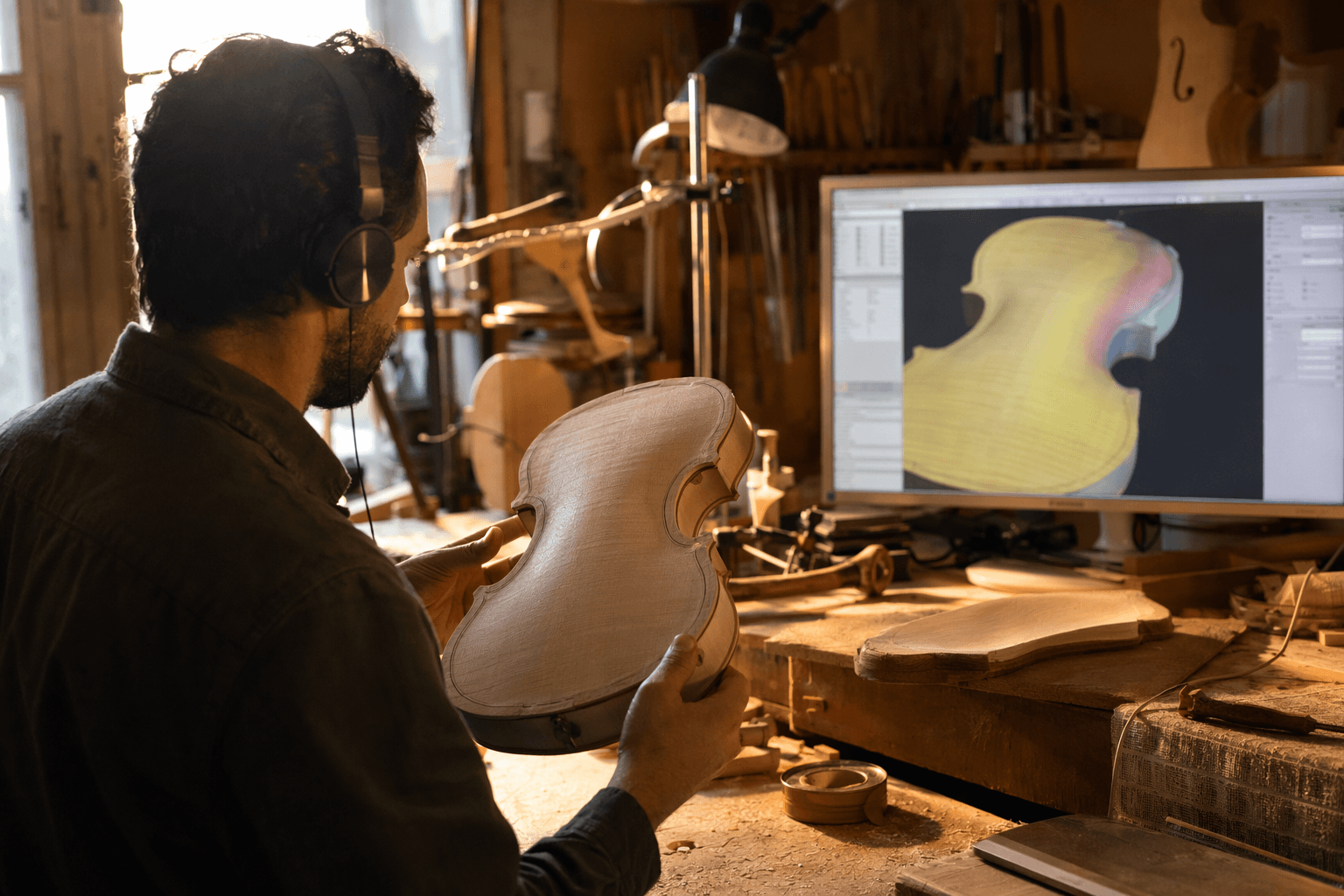
Yuming Liu said the practical appeal is speed and cost. Violin making is slow and expensive because builders typically make an instrument, compare the sound and then revise the next one. A computational model could move part of that process onto a screen, letting makers test options before any wood is cut. In a craft where small changes can alter tone, that kind of early feedback could reduce wasted labor and material, especially for shops making expensive one-off instruments.
The tool also fits into a longer MIT line of violin acoustics research. In 2015, MIT acousticians and fluid dynamicists working with violinmakers at the North Bennet Street School in Boston analyzed measurements from hundreds of Cremonese-era violins and found that elongated f-holes and thicker back plates were associated with greater acoustic power. That work helped reinforce why the instruments of Amati, Stradivari and Guarneri, made in Cremona, Italy, are still treated as the golden age of violinmaking and valued at millions of dollars.

MIT has been thinking about this problem for even longer. In 2004, physicist and violin maker Jack Fry argued that violins’ voices can be analyzed with acoustics and then modified. The new computational violin pushes that idea into a more practical form. It is not replacing artisans; it is making iteration cheaper, faster and more legible, which may be the difference between a lab curiosity and a tool that changes how high-skill instrument makers work.
This article was produced by Prism’s automated news system from verified source data, official records, and press releases, then run through automated quality and moderation checks before publishing. The system is built and supervised by the people who set the standards it runs under. Read our full AI policy.
Did this article answer your question?