Montepulciano’s barrel race turns historic streets into a wine-fueled battleground
Montepulciano’s August barrel race is part sport, part civic ritual, with eight contrade hauling 80-kilo barrels uphill to Piazza Grande. Its power comes from turning heritage into living competition.
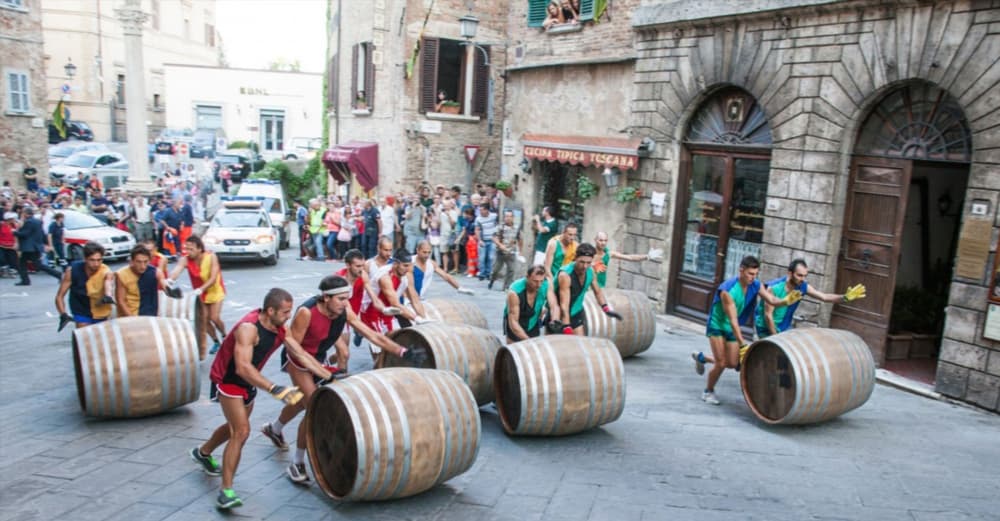
The streets of Montepulciano become a steep, noisy arena each August, as neighborhood rivals drive heavy wine barrels uphill toward Piazza Grande. The Bravìo delle Botti is not just a race, but a civic ritual built around wine, local identity, and the town’s medieval layout.
What the Bravìo delle Botti is
Every year on the last Sunday of August, Montepulciano stages the Bravìo delle Botti, the town’s signature barrel race. The modern version has been run since 1974, but it replaced an earlier horse race that dates back to 1373, giving the event a rare mix of continuity and reinvention.
Eight historic districts, or contrade, line up for the contest: Cagnano, Collazzi, Coste, Gracciano, Poggiolo, San Donato, Talosa and Voltaia. Each district fields two spingitori, the pushers who roll an 80-kilogram barrel, about 176 pounds, through the town’s steep streets.
How the course turns the old town into a test of endurance
The race covers roughly 1.6 to 1.8 kilometers, depending on how it is described in the program and route notes, and nearly all of it climbs. That uphill profile matters: Montepulciano’s narrow medieval lanes are not a backdrop so much as the obstacle itself, forcing the pushers to fight gravity as much as one another.
The finish line sits in Piazza Grande, the cathedral square and symbolic center of the town. Teams are not simply racing for speed, but for a painted banner and the pride that comes with bringing it back to their own contrada.
The festival week that builds the race
The barrel race is the climax of a longer stretch of celebrations that usually runs from about Aug. 22 to Aug. 30 or 31, depending on the year. In 2026, the official program opens on Saturday, Aug. 22, with the traditional Proclamation of the Gonfaloniere, which marks the start of competition between the eight districts.
That opening matters because the Bravìo is structured as a week-long civic performance, not a single athletic event. Ceremonies, parades, and district rituals build pressure before race day, with the historical procession drawing more than 300 locals and making the town itself part of the spectacle.
The procession is one of the clearest signs that this is a community event rather than a detached festival for spectators. Montepulciano turns its own residents into the cast, and the result is a public display of continuity that links present-day rivalry with the town’s long historical memory.
Wine, saint’s day tradition, and civic identity
The Bravìo is closely tied to Montepulciano’s reputation for wine, especially Vino Nobile di Montepulciano. That connection gives the race a deeper economic and cultural logic: the event reinforces the same place identity that supports the town’s most famous product.
It is also associated with the patron saint San Giovanni Decollato, which places the race inside a calendar of religious and civic remembrance. In practice, that combination of wine heritage and saint’s-day tradition makes the Bravìo feel less like a stand-alone festival and more like Montepulciano performing itself in public.
What makes the race endure
The Bravìo survives because it does several jobs at once. It keeps an older ritual alive, but it does so through competition, costume, procession, and district loyalty, all of which are easier to sustain when they remain visible and contested every year.
The contrade structure is especially important. By splitting the town into eight historic districts that meet on the same course every August, Montepulciano turns local memory into a recurring contest, one that gives the town a way to pass on identity through participation rather than display alone.
That is why the event feels so tightly woven into the city’s future as well as its past. The race uses a medieval route, a 14th-century origin, and a modern format from 1974 to keep the town legible to itself and to visitors, while the finish in Piazza Grande keeps the most symbolic part of Montepulciano at the center of the story.
How to read the spectacle on the ground
The most useful way to watch the Bravìo is to follow the sequence of rituals rather than waiting only for race day. The proclamation of the Gonfaloniere on Aug. 22 sets the tone, the parade with more than 300 locals shows how broad the participation runs, and the uphill finish reveals how punishing the course really is.
A few details define the event at a glance:
- Eight contrade compete: Cagnano, Collazzi, Coste, Gracciano, Poggiolo, San Donato, Talosa and Voltaia.
- Each team uses two pushers to move an 80-kilogram barrel.
- The course climbs about 1.6 to 1.8 kilometers through steep, narrow streets.
- The race ends in Piazza Grande, Montepulciano’s cathedral square.
- The race has existed in its current barrel form since 1974, after replacing a horse race first recorded in 1373.
Taken together, those details explain why the Bravìo has lasted. It is a competition, but also a disciplined way for Montepulciano to turn heritage into a public, repeatable event that keeps the town’s streets, wine identity, and neighborhood loyalties inseparable.
This article was produced by Prism’s automated news system from verified source data, official records, and press releases, then run through automated quality and moderation checks before publishing. The system is built and supervised by the people who set the standards it runs under. Read our full AI policy.
Did this article answer your question?