More Talk, More Play: How Parents Are Helping Young Brains Beat Screen Dependency
Screen time displaces the parent-child talk that builds young brains. Research and no-cost routines show how families can reclaim it, even amid the inequities that make "just play more" easier said than done.
The science behind the talk
A 2024 study published in JAMA Pediatrics delivered one of the starkest findings in early childhood research in years. Researchers at the Telethon Kids Institute, part of the University of Western Australia, tracked 220 families across multiple recording sessions between the time their children were 12 and 36 months old. The conclusion was precise and troubling: for every additional minute of screen time, children heard fewer adult words, spoke fewer vocalizations, and engaged in fewer back-and-forth interactions with their parents. The researchers described this as "technoference," whereby young children's exposure to screen time is interfering with opportunities to talk and interact in their home environment.
This matters because early verbal interaction is not merely enrichment; it is architecture. Research highlights three key aspects of parent-child interactions that matter for language development: how much parents talk to their child, how diverse and complex their talk is, and how sensitive and responsive they are to their child. The quality of those exchanges, according to a study published in *Psychological Science* by researchers at the University of Texas at Dallas, outweighs raw word count. "Learning to communicate is a shared endeavor," the researchers noted, arguing that shared attention, routines and rituals, words and gestures form what they called parent-child "conversational duets" that predicted successful language learning.
What the evidence actually supports
Not every concern about screen time holds up equally under scrutiny, and honest reporting requires distinguishing the well-supported from the speculative. The strongest evidence targets passive, solitary screen use in children under two. Children below 22 months old were not able to learn novel words with repeated exposure to a child-directed television programme, but were able to learn similar new words within their natural environment. Background television compounds the problem even when a child is not actively watching: television, even if used as a background and not as a primary activity, tends to distract the child from surroundings and play and negatively affect communicative interaction with other family members.
Research has found that 60% of children with delayed language development tend to watch television alone, while those with normotypic language development had more interaction with their caregivers. The relationship is associative rather than strictly causal, but the directionality matters: screens fill time that would otherwise go to the conversational exchanges that build language circuits. World Health Organization guidelines recommend that children under the age of two should not use screens at all, and those between the ages of two and four should not spend more than an hour a day on them.
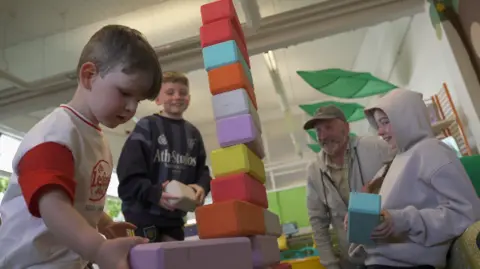
Play-based strategies are well-supported for language and attention development, but the mechanism is not magical. What works is what play produces: sustained joint attention, back-and-forth turn-taking, and the kind of language-rich narration parents naturally produce during physical, imaginative, or constructive play. Interventions implemented in play routines and shared book reading have shown significant effects on expressive vocabulary development, according to a meta-analysis by Heidlage and colleagues.
The inequity hiding inside the advice
Children from low-income families spend an average of three and a half hours each day on screen media, according to a nationwide survey by the nonprofit Common Sense Media. Children from lower-income families spend 40 percent longer than middle-income children looking at screens and approximately double the time compared to children from affluent backgrounds. These figures are not evidence of worse parenting; they are evidence of structural pressure.
Screen time research is subject to population bias and confounding factors. Kids who watch more television tend to live in homes that earn less money and with parents who have fewer years of education. A parent working two jobs in a small apartment, without access to a yard or affordable childcare, faces a fundamentally different set of choices than a parent with flexible hours and a garden. Children from lower income families, 46.6% had more than one hour of screen time per day, compared to 35.7% of children from higher income families exceeding that threshold. Framing excessive screen use primarily as a parenting decision ignores the material conditions that make it, for many families, closer to a necessity.
Childcare access sharpens the inequality further. Higher-income families are enrolling children in formal early care and education programs at increasingly younger ages, with 22 percent of one-year-olds from higher-income families attending center-based settings, compared to just 11 percent from lower-income families. Quality early childhood programs offer exactly the kind of structured, language-rich, play-based environments that research says matter most, and access to them is inequitably distributed.
Routines that work, without buying anything
The most actionable finding from the research is also the most democratic: the interventions that show the strongest effects cost nothing. They require time, presence, and repetition, and they can be woven into moments families already have.
- Narrate caregiving tasks. Bath time, dressing, and meals are natural language laboratories. Describing what you are doing ("Now we're putting on your left sock, can you see it?") builds vocabulary through repetition in context, with no books or apps required.
- Follow the child's lead during play. Research on parent-child interaction interventions consistently shows that following a child's attention rather than redirecting it produces more conversational turns, which are the critical unit of language development.
- Create device-free mealtimes. Recommendations consistently advise no screen use during mealtimes and before bedtime, two periods when family conversation is most naturally available. The habit requires no special equipment or space.
- Read aloud daily, even briefly. Shared book reading is among the best-studied language interventions available to families; five to ten minutes per day of dialogic reading (asking questions, pausing, letting the child respond) is more effective than longer, passive sessions.
- Use transitions as talk time. Walking to school, riding public transit, or waiting in a checkout line are conversational opportunities that require no planning. Naming what you see, asking open questions, and responding to a child's observations builds exactly the conversational density researchers have linked to stronger language outcomes.
The honest limits of "just play more"
The gap between evidence and lived reality is where policy needs to meet practice. Families in overcrowded housing have less floor space for physical play. Families in unsafe neighborhoods have less access to outdoor play without supervision. Families stretched across multiple jobs have fewer hours for the unhurried interaction that research consistently identifies as the most valuable. Public school systems that have cut recess and free play from early childhood classrooms have removed one of the few equalized settings where structured play still happens at scale.
Researchers and pediatricians increasingly acknowledge that screen-time guidance aimed at individual parents, without addressing the structural factors that drive high screen use, reaches those who need it least. The families most likely to read parenting articles about screen dependency are not the families bearing the greatest risk. Useful policy would invest in paid parental leave, subsidized childcare, quality early education programs, and outdoor play infrastructure precisely because those investments expand the conditions under which talk and play become genuine options rather than aspirational advice.
The science is clear: young brains are built through conversation, and screens that displace conversation carry a measurable cost. The harder question is who has the resources to act on that science, and who gets the structural support to close the gap.
This article was produced by Prism’s automated news system from verified source data, official records, and press releases, then run through automated quality and moderation checks before publishing. The system is built and supervised by the people who set the standards it runs under. Read our full AI policy.
Did this article answer your question?