Moscow Accuses Kyiv of 91 Drone Attack on Putin Residence
Russian officials said Ukraine launched 91 long range drones against President Vladimir Putin’s state residence in the Novgorod region overnight, a claim Kyiv denies and independent confirmation does not support. The competing narratives raise the stakes for fragile peace talks and increase the risk of a calibrated, and possibly miscalculated, response.
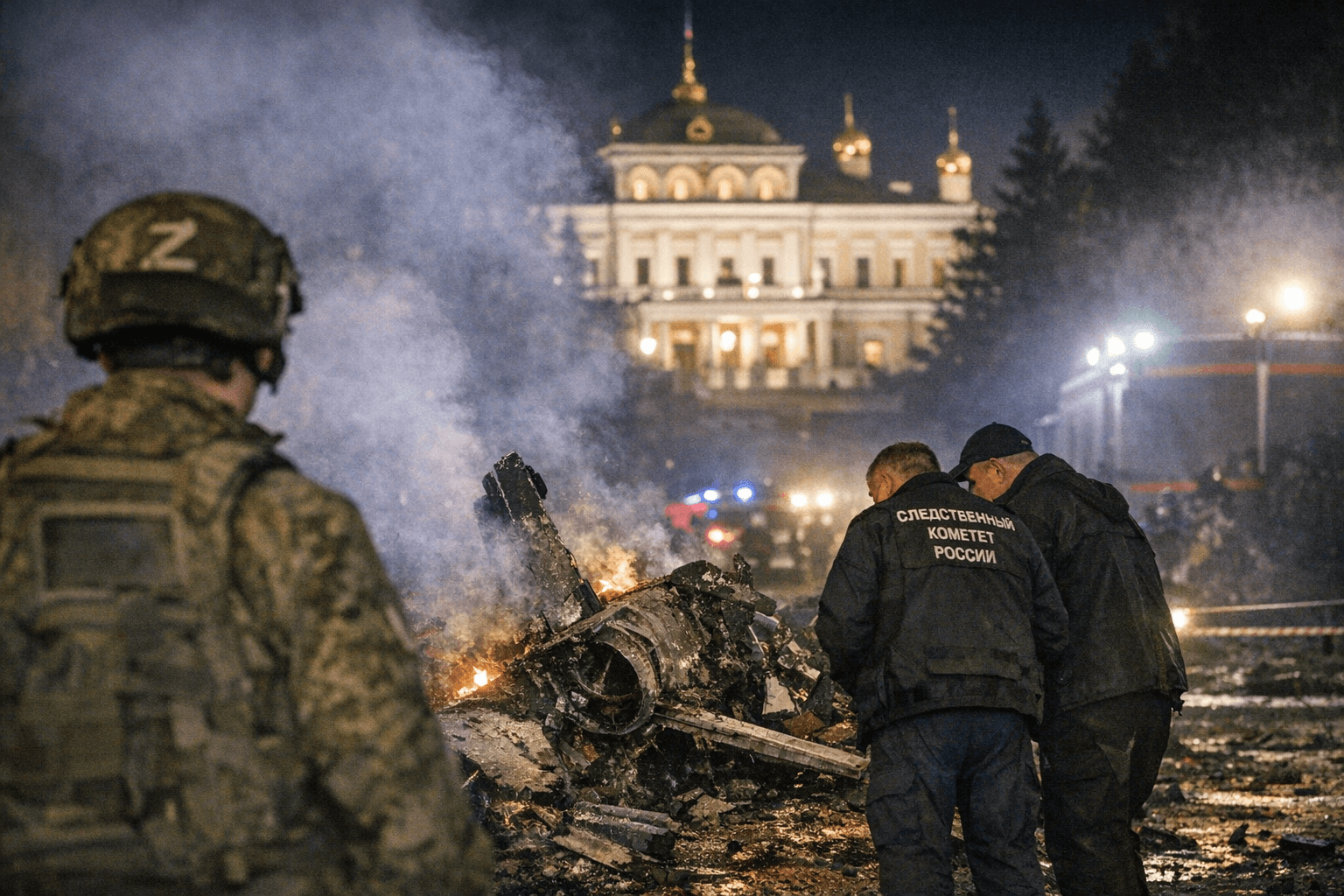
Russian Foreign Minister Sergei Lavrov said on December 29 that Ukraine had attempted a coordinated strike on a presidential state residence in the Novgorod region overnight on December 28 and 29. Lavrov said the operation involved 91 long range unmanned aerial vehicles and that Russia’s air defence systems intercepted and destroyed all of them, resulting in no injuries and no damage to the property.
Lavrov linked the alleged incident directly to ongoing negotiations over a possible Ukrainian peace deal, warning that Moscow would review its negotiating position and had already selected targets for a retaliatory response. He framed the episode as consequential for diplomacy, saying the strike attempt could not be treated as a neutral event while talks continued.
Kyiv rejected the allegation. President Volodymyr Zelensky dismissed the account as false and said the claim was intended to derail or undermine peace negotiations. Ukrainian officials suggested Moscow might be preparing a pretext to justify further strikes on government sites in Kyiv, a move that would complicate both battlefield dynamics and diplomatic openings.
Independent verification of the drone launches, intercepts and any wreckage was not presented by Russian officials when the claim was made. It remained unclear whether President Putin was at the residence at the time of the alleged attack. Open source imagery, third party monitors and Western governments did not immediately produce confirmation of the events, leaving a factual vacuum that will bear on how international actors respond.
The residence identified by Russian officials is known locally as Dolgiye Borody or Long Beards. The site has a layered history, having been used by leaders from Joseph Stalin to Nikita Khrushchev and more recently by Boris Yeltsin and Mr. Putin. Its symbolic value adds an element of political theatre to any attack or allegation of attack, and that symbolism informs both Moscow’s messaging and Kyiv’s forceful denial.
The dispute over what happened now has implications beyond immediate battlefield maneuvers. Lavrov’s warning that Russia’s negotiating stance would be reassessed suggests Moscow might use the claim as leverage in talks or as justification for military measures. Ukrainian leaders say the opposite, that Moscow is manufacturing a casus belli to undermine diplomacy and impose a narrative that excuses new strikes.
The allegation also drew a terse reaction from international figures. Former United States President Donald Trump said he was “very angry” about the reported attack and urged restraint, calling it “not the right time.” Other capitals urged caution while noting the absence of independent corroboration. Analysts warn that in the fog of war, unverified claims around sensitive sites can harden positions and increase the risk of escalation.
For now the competing narratives remain unresolved. Investigators outside Russia and Ukraine have not confirmed drone activity at the Novgorod site, and Moscow has not released verifiable physical evidence. The lack of clarity will complicate any diplomatic effort intended to sustain the fragile negotiation channel and may shape military calculations in the days ahead.
This article was produced by Prism’s automated news system from verified source data, official records, and press releases, then run through automated quality and moderation checks before publishing. The system is built and supervised by the people who set the standards it runs under. Read our full AI policy.
Did this article answer your question?