Moscow says Savyolovsky rail hub blast was suicide bombing
Moscow officials say a suicide bomber killed a traffic police lieutenant at Savyolovsky Station; two officers were injured and airport security was tightened.
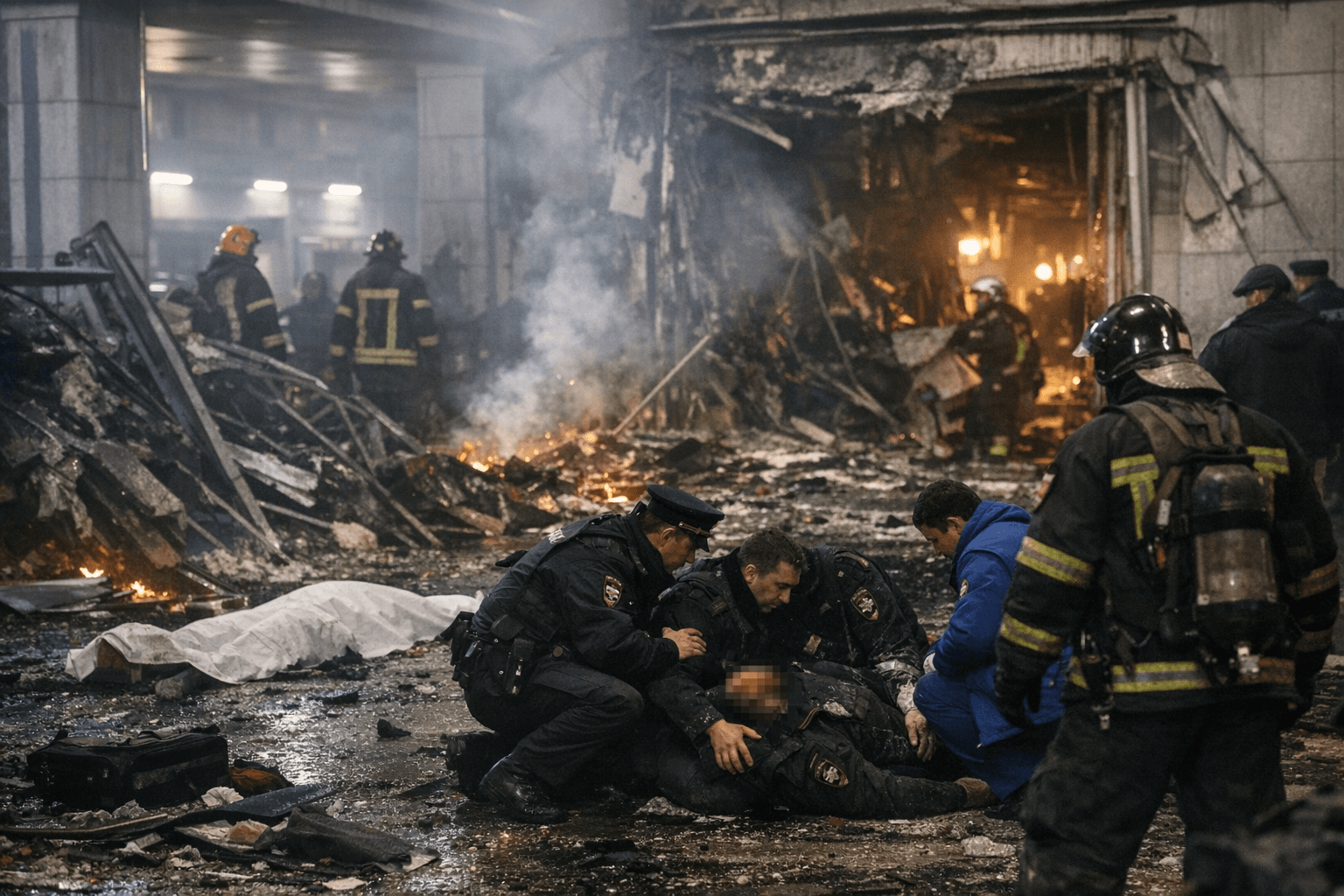
An assailant detonated an explosive device next to a traffic police patrol vehicle outside Savyolovsky Train Station Square just after midnight, killing a traffic police officer and the attacker and injuring two other officers, Russian officials said. The Interior Ministry identified the dead officer as Police Lieutenant Denis Bratuschenko, 34, a senior traffic inspector who joined the force in 2019 and is survived by his wife and two children.
Interior Ministry statements said the attacker approached officers from Moscow’s north-eastern district and that law enforcement agencies were working in tandem to "establish all the circumstances." Investigators initially reported confusion over whether the suspect had fled the scene before later saying the assailant died where the device detonated.
The Investigative Committee has opened a criminal case into the attempted murder of a law enforcement officer and on charges related to illegal possession of explosive devices, officials said. Interior Ministry spokeswoman Irina Volk conveyed official condolences, saying, "The leadership and personnel of the Ministry of Internal Affairs of Russia express their sincere condolences to the family."
Authorities treated the blast as part of a wider terror probe. Moscow’s civil aviation authority ordered increased security at all city airports, and law enforcement stepped up patrols around major transport hubs while forensics teams examined the scene at Savyolovsky, a principal rail hub north of the city centre.
The Savyolovsky explosion came amid an acute security shock to the capital: earlier the same day two suicide attacks struck central Moscow subway stations during the morning rush, security sources and analysts said, in strikes that analysts described as having killed more than three dozen people. Those attacks were reported to have been carried out by women, a pattern that evokes earlier decades of violence from the North Caucasus. Fred Weir, writing in a backgrounder on the recent bombings, said, "If Russia’s security services are correct in blaming two Chechen 'black widows' or female suicide bombers, it represents the return of a nightmare that the Kremlin thought it had ended years ago."
No group had claimed responsibility for the Savyolovsky attack at the time of the official statements, and investigators have not publicly linked the late-night patrol-vehicle explosion to the morning subway bombings. Officials and analysts cautioned against premature attribution while forensics and intelligence inquiries continue.
The episode deepens a sense of vulnerability in Moscow after recent targeted strikes on senior officers in the city. Security reporting and local sources referenced the Feb 6 shooting of Lieutenant General Vladimir Alekseyev, who survived a gun attack on his residence, and a December car bombing that killed Lieutenant General Fanil Sarvarov. Those incidents have fed speculation among some officials that the capital is facing a new, complex campaign of violence, though clear evidence tying the events together has not been released.
Investigators have urged patience as they gather forensic evidence, review CCTV and witness statements, and seek to determine whether the late-night attack was part of a coordinated wave or an isolated act. For now the known toll from Savyolovsky stands at one officer dead, two hospitalised, and the attacker killed at the scene, with the city’s authorities moving to bolster visible security at transport nodes.
This article was produced by Prism’s automated news system from verified source data, official records, and press releases, then run through automated quality and moderation checks before publishing. The system is built and supervised by the people who set the standards it runs under. Read our full AI policy.
Did this article answer your question?