Mossi Traoré stages Guilty of Creativity mock trial at Palais de Justice
Mossi Traoré turned the Palais de Justice into a staged courtroom on March 6, 2026, and was theatrically "sentenced to a lifetime of creativity" as the reveal for MOSSI AW 2026/27.
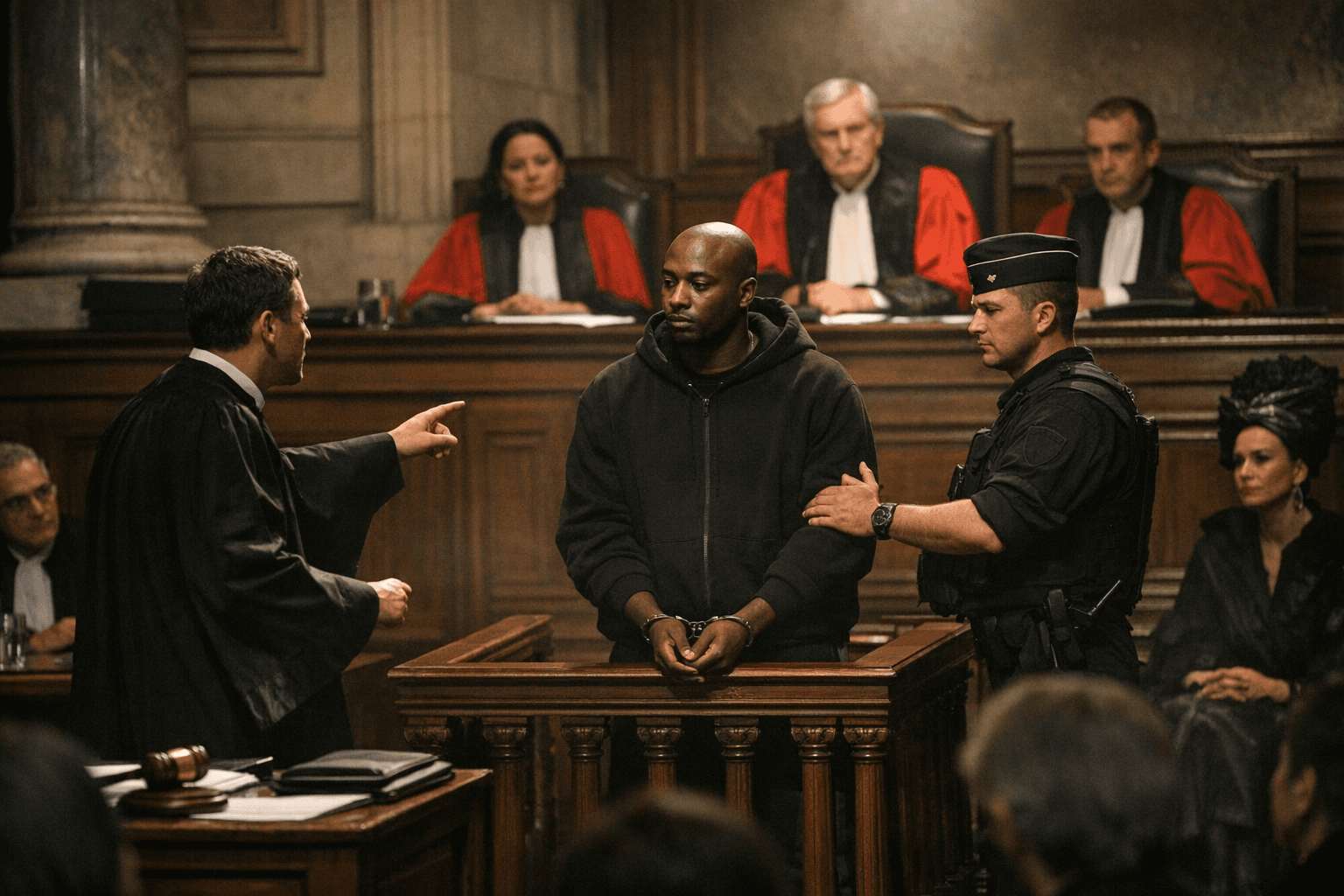
Mossi Traoré staged an actual mock trial as his MOSSI Autumn/Winter 2026/27 presentation at the Paris Court of Appeal, the Palais de Justice, on March 6, 2026, culminating in a poetic verdict that FashionUnited reports as Traoré being "sentenced to a lifetime of creativity" and mandated to help youth from the suburbs. The 30-minute performance left the room laughing, unsettled, and looking at the collection as evidence rather than decoration.
The venue mattered. WWD and Shopping noted the Palais de Justice is controlled by the French armed forces, forcing attendees to queue and be admitted one by one, a security lag that delayed the start by nearly an hour. WWD captured the mood with an official's wry line: "It’s the first time I’ve seen people in a hurry to go into court." WWD also reported the show ran roughly 30 minutes.
The staging reproduced a courtroom down to the ritual: judge, prosecutor, lawyer, clerk, jury, victims and witnesses populated the space, and FashionWeekOnline writes that "the scenography faithfully reproduces the configuration of a real courtroom, including a judge, prosecutor, lawyer, clerk, and the formal structure of a hearing." The hearing was public, FashionWeekOnline adds, with testimonies heard and fashion journalists even called to the stand as witnesses, turning press scrutiny into props.
Traoré's indictment was intentionally absurd and pointed. FashionUnited lists the mock charges as a laundry list that included shoplifting Levi’s from Le Printemps, identity fraud to bypass Anna Wintour’s gatekeepers, an unauthorized photoshoot at the Taj Mahal, and siphoning electricity from a luxury maison to power his own show. WWD framed the accusations more broadly around theft and impersonation and placed an Anna Wintour impersonator in the scene to recall the time Traoré, WWD reports, "pretended to be his own press officer to attract [Anna Wintour] to one of his shows."
The clothes answered the verdict. FashionWeekOnline and FashionUnited note the collection referenced judiciary wardrobe—judges’ robes and lawyers’ silhouettes reinterpreted through MOSSI’s signature pleating and structured volumes—while sculptural forms nodded to South Korean artist Lee Bul and the technical discipline of Madame Grès. WWD added that Traoré even created outfits for police officers as part of the tableau, folding costume into couture so the staging and the tailoring read as one proposition.
This performance was also political practice. FashionUnited frames the trial as a biting critique of fashion’s insularity, social inequalities, and exclusion of marginalized communities, and reminds readers that Traoré runs a school in Villiers-sur-Marne and has backing from the House of Chanel for programs that help unemployed people and those on social benefits re-enter the workforce. At La Caserne he has said plainly, "Today, being a young designer is an uphill battle. Most fashion schools are not financially accessible, and young people struggle to find apprenticeships. Basically, entry is determined by the size of your wallet." FashionUnited records that Traoré answers whether that mission justifies "bending the rules" with a firm yes.
FashionWeekOnline called the evening "more than a fashion show," an "unprecedented format designed as a true immersive experience" where personal narrative becomes material. Between the courtroom choreography, the Madame Grès tribute, and the theatrical sentence, Traoré used the Palais de Justice to stage a provocation: fashion on trial, and fashion as the means of its own defense and remedy. WWD and Shopping even flagged it as the first fashion show ever held at the Court of Appeal, a claim that only amplifies the stunt's audacity. Whether you left wanting to buy or to join his school, Traoré made clear that his runway is a courtroom and his sentence is a career-long sentence to do the work.
Know something we missed? Have a correction or additional information?
Submit a Tip