Mount Merapi Spews Multiple Hot Ash Clouds, Threatens Yogyakarta Region
Three hot ash clouds rumbled off Merapi before dawn, with flows reaching as far as 3 kilometers and keeping Boyong River communities under sustained alert.
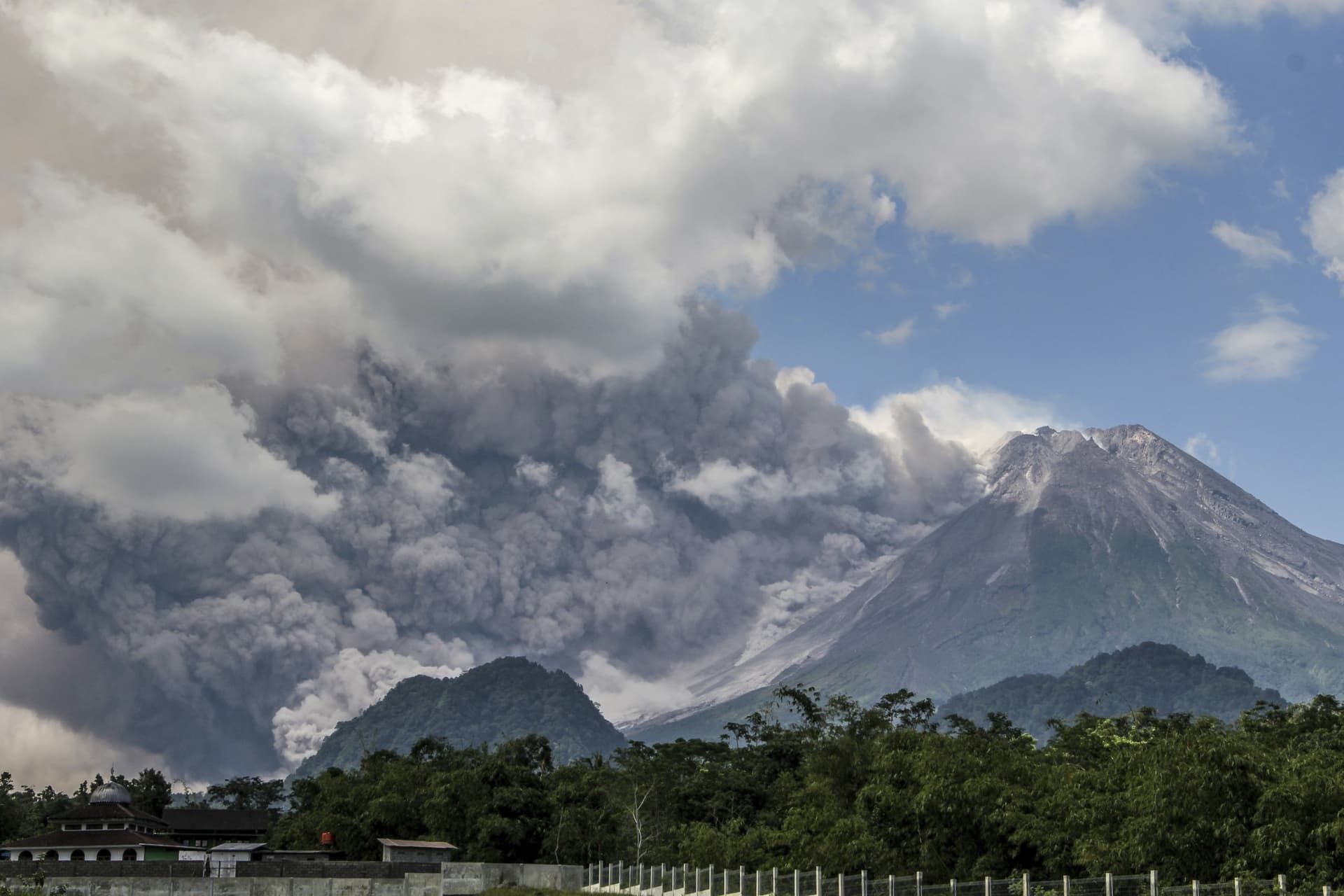
Three hot ash clouds rose from Mount Merapi before sunrise Sunday, sending pyroclastic flows up to about 1.5 to 3 kilometers toward the Boyong River and underscoring how Indonesia’s busiest volcano can stay dangerous for months, not just in a single eruption burst.
The Yogyakarta Volcanology and Geological Hazard Mitigation Center logged the morning activity as part of an ongoing eruptive phase marked by repeated dome collapses and incandescent avalanches. In the 00:00 to 06:00 WIB observation window, the agency recorded one hot-cloud seismic event with an amplitude of about 47 mm and a duration of 166.43 seconds, along with multiple rock-fall and hybrid events used to estimate how far material could travel downslope. BPPTKG chief Agus Budi Santoso said, “The status is still at Level III or Alert,” a designation that keeps the mountain under strict access limits and puts nearby communities on notice that hazardous flows can still surge through river channels.
Level III, or Siaga, has been in place since November 5, 2020, and it carries concrete consequences for people living and working around Merapi. BPPTKG hazard maps identify the Boyong sector as vulnerable out to about 5 kilometers in some bulletins, with other southwest channels such as Bedog, Krasak and Bebeng mapped as far as 7 kilometers. The southeast Woro sector is listed to about 3 kilometers, Gendol to 5 kilometers, and ballistic ejection hazards are commonly cited to 3 kilometers from the summit. That means no casual access to river valleys, no ignored exclusion zones, and no room for tourists or residents to treat the mountain as if it were simply steaming.

The risk is not only the hot clouds themselves. Emergency managers in Yogyakarta and Central Java have kept contingency crews ready, with evacuation centers, heavy equipment for road clearing and public-warning campaigns prepared for ash fall and possible lahars if rain remobilizes loose volcanic debris. The latest dome estimates, based on February 20 aerial analysis, put the southwest summit dome at about 4,044,000 cubic meters and the central dome at 2,368,800 cubic meters, a reminder of how much unstable material remains perched above the valleys below. Airports serving Yogyakarta also remain sensitive to ash that can affect visibility and aircraft engines, adding a transport risk to the local safety problem.
That threat became even more tangible in early March, when a lahar in the Senowo River area of Magelang killed three sand miners and damaged trucks and equipment. The event showed how Merapi’s danger does not end at the crater rim, because heavy rain can turn loose volcanic deposits into deadly floods long after the summit calms. Merapi’s 2010 eruption, which caused about 386 deaths and forced mass evacuations, remains the starkest precedent for why officials keep pressing residents to obey warnings now.
Sources:
Know something we missed? Have a correction or additional information?
Submit a Tip