Mount Merapi unleashes hot ash flows, raising alert in Yogyakarta
Three hot ash flows raced down Merapi’s slopes toward the Boyong River, signaling a more unstable summit dome and a higher risk for nearby valleys.
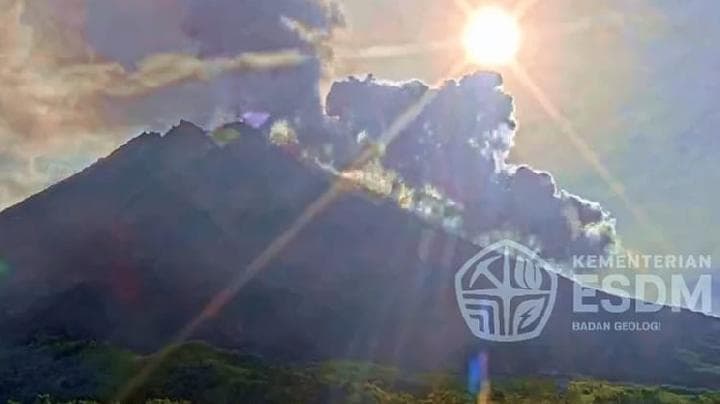
Mount Merapi sent three hot ash-cloud flows down its slopes Saturday morning, with incandescent material and ash moving toward the Boyong River and reaching as far as 3 kilometers. The bursts came as Indonesia’s volcanology authorities kept the 2,910-meter volcano at Alert Level III, or Siaga, a status in place since November 5, 2020.
The Yogyakarta Volcanology and Geological Hazard Mitigation Center said the mountain’s activity had intensified in recent days, with repeated lava avalanches and pyroclastic flow events pointing to continued instability in the summit dome. Local monitoring for the 00:00 to 06:00 WIB window on April 12 recorded nine lava-avalanche events toward Kali Sat and Putih, with a maximum run-out of about 1,900 meters, along with an avalanche-type quake tied to a hot cloud event. Recent local reporting also noted eight pyroclastic flows in the previous week and nine lava avalanches in the preceding 24 to 48 hours.
Officials have kept residents in the danger paths on alert, especially in the Boyong, Bedog, Krasak and Bebeng river valleys, where fast-moving hot avalanches can descend with little warning. The warning also extends to Kali Sat and Putih, Woro and Gendol, where hazard assessments have identified potential pyroclastic and lava-flow distances of 5 to 7 kilometers in the south-southwest sector, and 3 to 5 kilometers in specific drainages. Disaster officials have urged people to stay out of riverbeds and to rely only on updates from observation posts and emergency agencies, since heavy rain can remobilize fresh volcanic debris into lahars.

The risk is not limited to the immediate slopes. Ash can disrupt aviation, damage aircraft engines, reduce air quality, harm crops and clog drainage channels, raising the chance of flooding and mudflows if rain follows. For communities north of Yogyakarta, where Merapi rises just beyond dense settlements and infrastructure, repeated pyroclastic flows are a warning sign that the dome remains oversteepened and capable of further collapse, even if the activity does not automatically mean a larger explosive eruption is imminent.
Merapi’s history gives the present alerts added weight. The November 1994 dome-collapse flows killed scores of people in nearby drainages, and the late-October to November 2010 crisis produced one of the volcano’s deadliest modern eruptions, with hundreds of deaths and mass evacuations. That record is why Indonesian authorities keep a tight watch on seismicity, deformation and gas emissions, ready to widen evacuation zones if those markers worsen.
This article was produced by Prism’s automated news system from verified source data, official records, and press releases, then run through automated quality and moderation checks before publishing. The system is built and supervised by the people who set the standards it runs under. Read our full AI policy.
Did this article answer your question?