NASA Artemis II Crew Prepares for First Lunar Flyby in 50 Years
Four astronauts are set to become the most distant humans in history tonight when Artemis II launches toward the Moon for the first time in over 50 years.
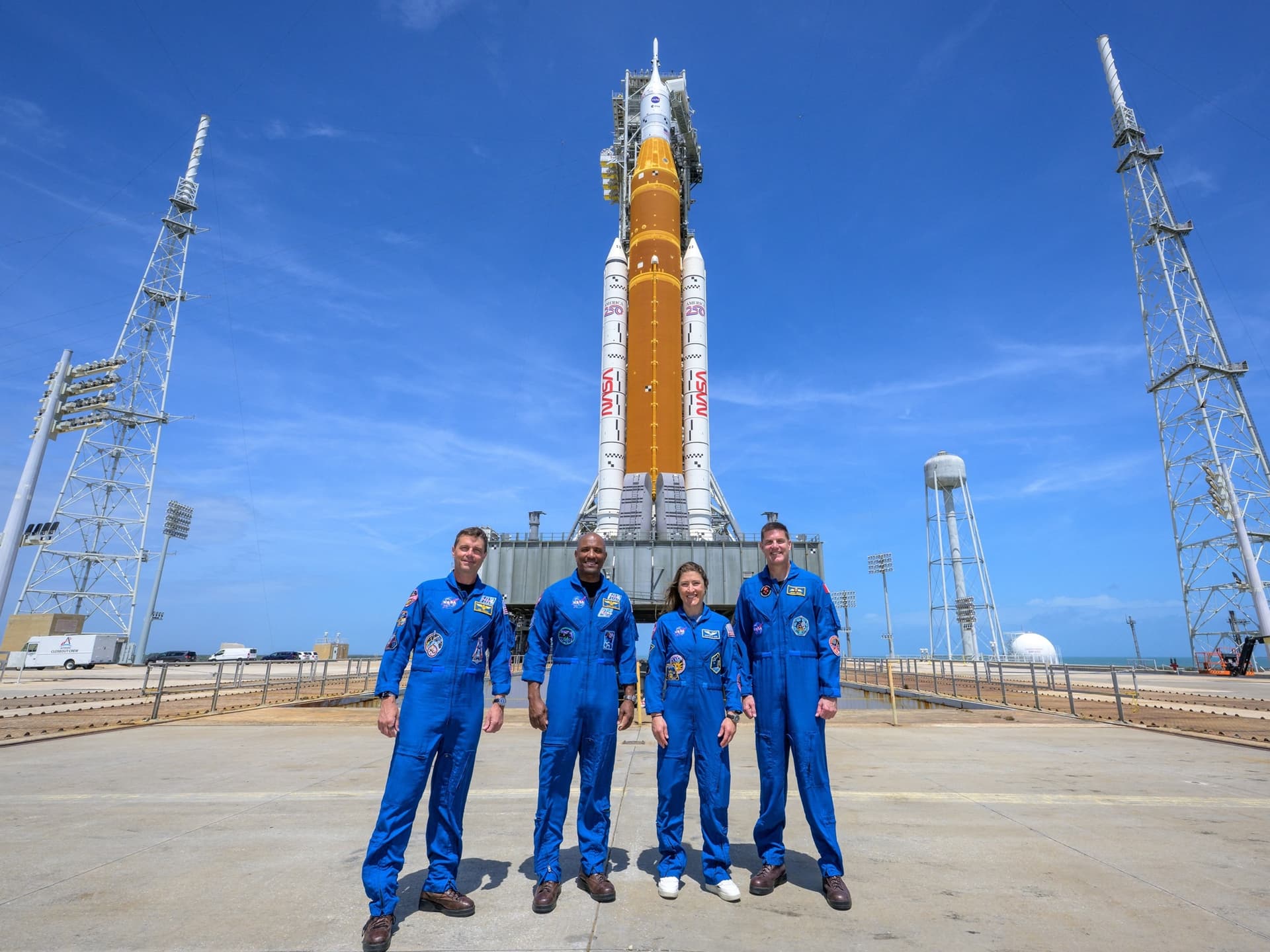
Four astronauts are poised to break records set during the Apollo era when NASA's Artemis II spacecraft lifts off tonight from Launch Complex 39B at Kennedy Space Center on Merritt Island, Florida. Liftoff is targeted for 6:24 p.m. EDT, with a two-hour window running until 8:24 p.m. EDT.
Weather forecasters are giving an 80% chance of favorable conditions, with primary concerns around cloud coverage and potential high winds. The countdown has been proceeding smoothly after weeks of delays tied to fuel leaks and other technical issues that pushed the mission into April.
The 10-day, 685,000-mile journey marks the first time humans have flown toward the Moon since the Apollo 17 mission in December 1972. Following a figure-8-shaped trajectory around Earth and Moon, the Orion spacecraft is scheduled on flight day six, around April 6, to circle the Moon and then sail approximately 5,000 miles beyond the lunar surface. That point will surpass Apollo 13's 1970 distance record of 248,655 miles from Earth, making Commander Reid Wiseman, Pilot Victor Glover, and Mission Specialists Christina Koch and Jeremy Hansen the most remote human travelers in history.
The mission carries multiple historical firsts. Glover will become the first person of color to travel beyond low Earth orbit; Koch will be the first woman to fly to the Moon's vicinity; Hansen, representing the Canadian Space Agency, will be the first non-U.S. citizen to reach beyond low Earth orbit; and Wiseman will become the oldest person to leave low Earth orbit.
Apollo 13 astronaut Fred Haise, whose crew set the distance record Artemis II is set to eclipse, sought out Koch ahead of the launch. "I heard you're going to break our record," he told her. In a NASA video filmed before tonight's liftoff, Koch answered: "We are ready." Hansen added, "We are going," and Glover said simply, "To the Moon."

The enthusiasm extends to veterans of the original lunar program. Charlie Duke, who walked on the Moon during Apollo 16 in 1972 and, at 90 years old, remains the youngest person ever to have done so, offered his blessing: "I'm excited about that, finally getting going on Artemis. I think it's gonna be a great programme." Lori Glaze, acting associate administrator for NASA's Exploration Systems Development Mission Directorate, told reporters at a pre-launch briefing: "We are getting very, very close, and we are ready."
Artemis II is the first crewed flight of both NASA's Space Launch System rocket and the new Orion spacecraft. It builds directly on Artemis I, an uncrewed November 2022 test flight that sent an Orion capsule to within 60 miles of the Moon. The data gathered from this mission will shape planning for Artemis III, which aims to land astronauts on the lunar surface as early as 2028.
For those following from home, NASA's main launch broadcast begins at 12:50 p.m. EDT on NASA YouTube and the free NASA+ streaming service, which will also carry separate 4K live views from inside the Orion capsule throughout the mission. CNN's special coverage, titled "Mission to the Moon: Artemis II Launch," begins at 5:00 p.m. EDT with anchor Boris Sanchez reporting live from Kennedy Space Center. Coverage is also available on ABC News Live, Disney+, Hulu, Netflix, Amazon Prime Video, and Twitch. Backup launch dates run April 2 through April 6 if tonight's attempt is scrubbed.
Sources:
Know something we missed? Have a correction or additional information?
Submit a Tip