NASA ends MAVEN Mars mission after 11 years in orbit
NASA has ended MAVEN after 11 years at Mars, leaving behind the clearest record yet of how the planet lost its air. The dataset now becomes a blueprint for future robotic explorers and human safety planning.
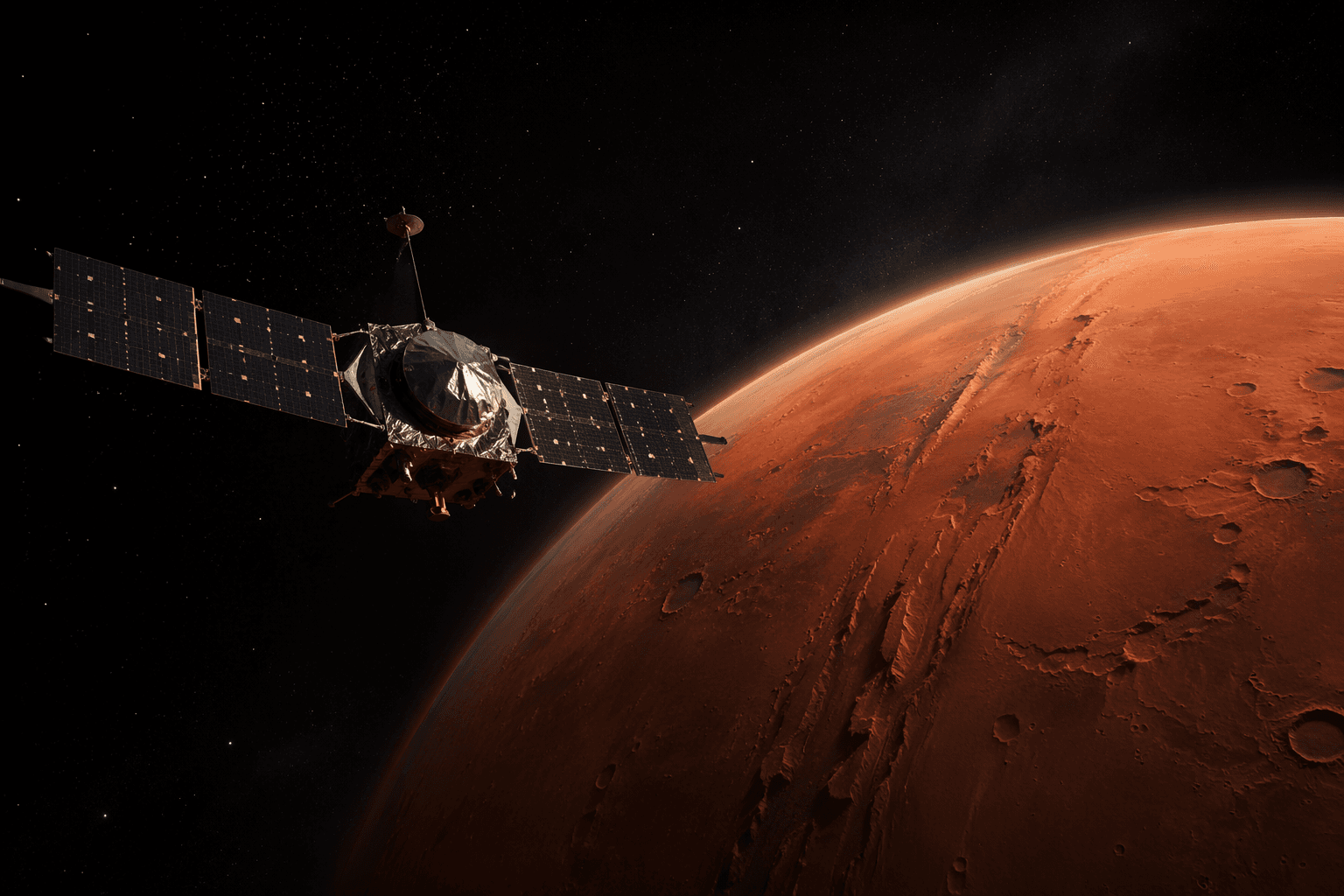
NASA has closed the mission that transformed Mars from a distant red world into a case study in atmospheric escape. After more than 11 years in orbit and a decade beyond its planned one-year lifespan, MAVEN, short for Mars Atmosphere and Volatile Evolution, was declared unrecoverable and taken out of active service on June 3, 2026.
The spacecraft launched on Nov. 18, 2013, from Cape Canaveral Air Force Station in Florida and entered orbit around Mars on Sept. 21, 2014. It was the first mission devoted to understanding the Martian upper atmosphere, ionosphere and their interaction with the Sun and solar wind, a line of study that helped explain how Mars lost much of its air to space.
NASA last heard from MAVEN on Dec. 6, 2025, after an unexpected loss of signal when the orbiter passed behind Mars. Telemetry before that occultation showed all subsystems working normally. A fragment of radio telemetry later indicated the spacecraft had emerged in safe mode and was rotating at an unusually high rate, a sign that something had gone wrong with the orbit trajectory or the systems supporting it. NASA had been trying to restore contact through the Deep Space Network and the U.S. National Science Foundation’s Green Bank Observatory, but the agency’s anomaly review board, which convened in February 2026, concluded the craft could not be recovered.
NASA said battery drain likely caused the communications system to lose power, ending MAVEN’s science and data relay role. The agency has begun decommissioning the mission and archiving its full dataset for researchers across the science and exploration community. Officials said the information will remain valuable for decades.
That legacy matters far beyond one spacecraft. MAVEN’s measurements helped quantify how Mars continues to bleed atmosphere into space, and the mission identified sputtering, an escape process observed for the first time on any planet. That work sharpened the picture of Mars’ past habitability, when a thicker atmosphere may have helped the planet hold onto liquid water for longer periods.
NASA’s Planetary Science Division said MAVEN’s findings will help shape radiation protection and safety measures needed before humans go to Mars. For robotic missions, the archive offers a reference point for studying the upper atmosphere, the solar wind and the conditions future landers, orbiters and communications systems will face. With MAVEN ended, the data it gathered now becomes part of the foundation for the next phase of Mars exploration.
This article was produced by Prism’s automated news system from verified source data, official records, and press releases, then run through automated quality and moderation checks before publishing. The system is built and supervised by the people who set the standards it runs under. Read our full AI policy.
Know something we missed? Have a correction or additional information?
Submit a Tip