NASA Plans Moon Base and Nuclear Mars Spacecraft in New Space Road Map
NASA named its new space road map "Ignition" and announced a $20 billion moon base plan and a nuclear-powered Mars spacecraft called Space Reactor-1 Freedom, set to launch by 2028.
NASA Administrator Jared Isaacman stood before an auditorium packed with aerospace executives, international space agency officials and members of Congress at the agency's Washington headquarters Tuesday and announced that, after years of vague promises, a permanent base on the moon is now formally on NASA's road map.
NASA's ambitious plans to build a space station in orbit of the Moon are officially on hold, with the space agency instead skipping the orbital habitat in favor of building a permanent base on the lunar surface. Isaacman announced his agency is rapidly progressing toward building a $20 billion base on the moon. "It should not be much of a surprise that we intend to pause Gateway in its current form and focus on building lunar infrastructure that supports sustained operations on the surface," Isaacman told attendees.
Both projects are meant to satisfy an executive order President Donald Trump signed in December, calling on the United States to land astronauts back on the moon by 2028 and begin building a permanent lunar outpost by 2030. The geopolitical urgency behind the timetable was made explicit. "The clock is running in this great-power competition, and success or failure will be measured in months, not years," Isaacman said in a press release about the agency's "Ignition" event.
The name Isaacman chose for Tuesday's event underscored the ambition of the moment. "We are calling today's event Ignition because it represents the start of a transformative journey for NASA," he said. Carlos Garcia-Galan, program executive for NASA's Moon Base, outlined plans for the new lunar outpost at the conference, which will be built in three main phases and fold in components and partnerships of the now-defunct Gateway station. The first phase, which started Tuesday, consists of learning how to get to the moon more frequently with robotic landers and experimenting with new technologies for infrastructure, including new satellite networks to allow for better communication on the lunar surface.
The Mars announcement may prove even more consequential. NASA plans to launch its first nuclear-powered interplanetary spacecraft in 2028, a probe called Space Reactor-1 Freedom that will carry a fleet of tiny helicopters to Mars. The effort would mark a world first: no interplanetary spacecraft mission has ever been powered by nuclear propulsion before, and it represents a potential boost for missions that would go farther out into space and travel faster than traditional liquid-fueled craft could manage. Once it reaches the Red Planet, the SR-1 Freedom mission will deploy three helicopters roughly the same size as NASA's groundbreaking Ingenuity, to continue exploring Mars.
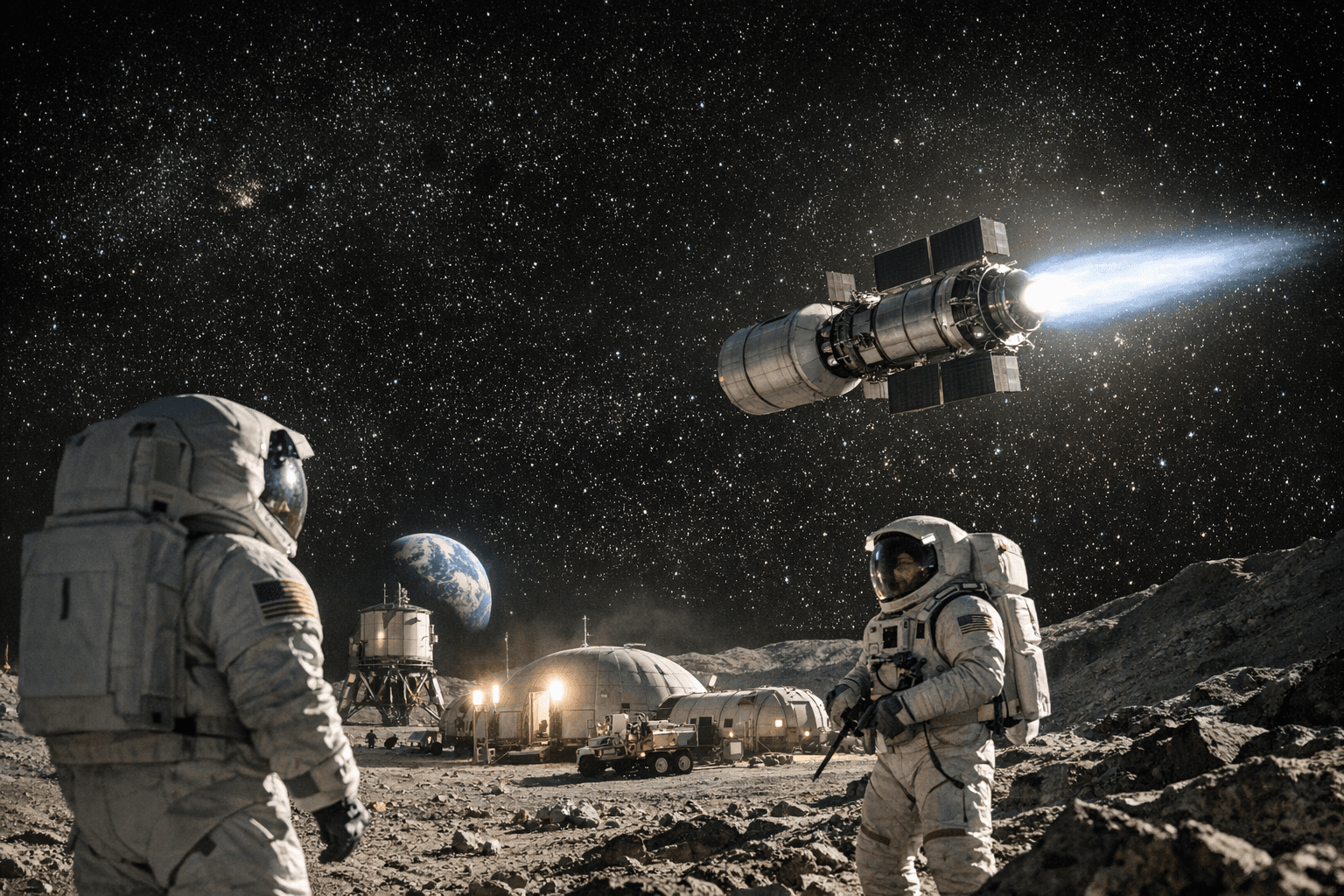
NASA announced that the mission will journey to the Red Planet on a spacecraft that uses nuclear electric propulsion, what NASA is referring to as "the first nuclear powered interplanetary spacecraft." With Space Reactor-1 Freedom, the agency is "finally putting nuclear propulsion on a trajectory out of the laboratory and into deep space," according to remarks at the event.
On the Artemis front, the cadence shift is striking. Isaacman said the goal is to work with at least two companies to launch crewed missions to the moon once every six months in the future, a sharp acceleration from the current pace of roughly one mission every few years. NASA has tapped SpaceX and Jeff Bezos' Blue Origin to develop lunar landers that can safely carry astronauts. However, both companies must overcome significant engineering hurdles, and a recent report from NASA's inspector general said that more delays are likely for SpaceX's Starship rocket, which the company is developing into a lunar lander.
Isaacman said NASA will deploy $20 billion over seven years to ensure America leads the moon and Mars missions. The NASA chief said the Trump administration's priority for its national space policy is to "never again give up" the moon as the United States races China to establish a presence there first. The plans and timelines for the coming decade, the agency's leader said, were designed to make Americans "start believing again" in the mission of space exploration. Whether that ambition can outpace the budget pressures and engineering hurdles already documented by NASA's own inspector general will define whether Ignition becomes a launchpad or another delayed countdown.
This article was produced by Prism’s automated news system from verified source data, official records, and press releases, then run through automated quality and moderation checks before publishing. The system is built and supervised by the people who set the standards it runs under. Read our full AI policy.
Did this article answer your question?