NASA shuts down Voyager 1 instrument to extend interstellar mission
NASA cut one of Voyager 1’s last working sensors to save power as the probe fights to stay alive 15 billion miles from Earth.
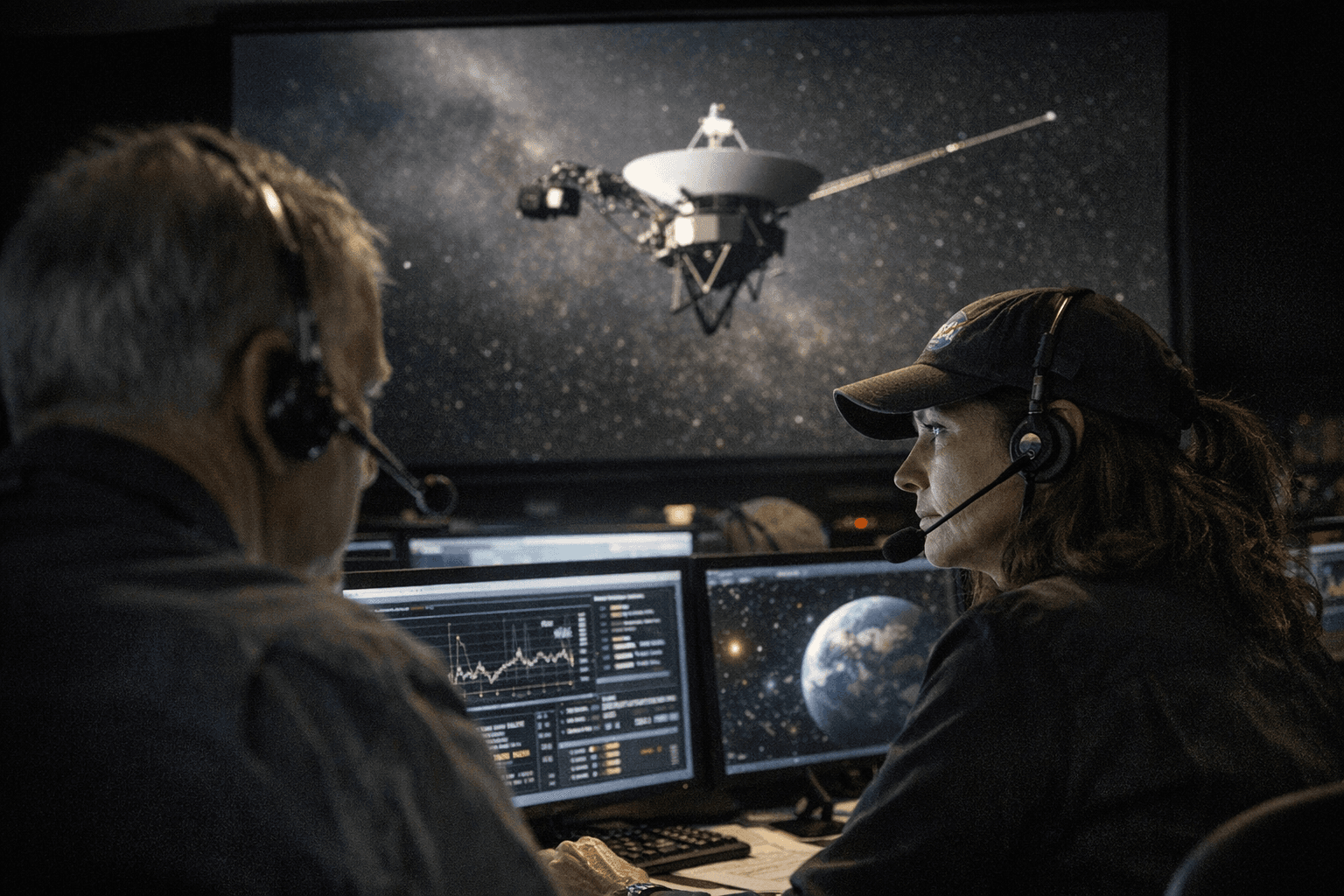
NASA has shut down one of Voyager 1’s remaining science instruments to buy the spacecraft more time, a stark engineering tradeoff on a probe that has outlived every president since Jimmy Carter. On April 17, engineers at NASA’s Jet Propulsion Laboratory in Southern California sent commands to turn off the Low-energy Charged Particles experiment, or LECP, trimming back the science return so the 48-year-old spacecraft can keep operating.
The sacrifice is specific. LECP measured low-energy charged particles, including ions, electrons and cosmic rays from both the solar system and the galaxy. With the instrument offline, Voyager 1 will lose one of its ways of sampling the space beyond the Sun’s reach. But NASA says that loss is the price of survival. The nuclear-powered spacecraft is running low on electricity, and engineers judged LECP the best instrument to shut down if the goal is to keep humanity’s first interstellar explorer alive a little longer.
That power shortage is built into the design. Voyager 1 and Voyager 2 run on radioisotope thermoelectric generators powered by decaying plutonium, and NASA says both spacecraft lose about 4 watts of power each year. At more than 15 billion miles, or about 25 billion kilometers, from Earth, even a command takes about 23 hours to arrive. The shutdown itself takes about 3 hours and 15 minutes to complete, a reminder that every adjustment to Voyager now unfolds at the edge of human patience and technical control.
Voyager 1 launched on September 5, 1977, and entered interstellar space in August 2012 after crossing the heliosphere boundary. It remains the most distant human-made object in existence, still sending back data from a region no spacecraft had reached before. The mission’s scientific record stretches from the discovery of a thin ring around Jupiter and two new Jovian moons, Thebe and Metis, to five new moons and the G-ring at Saturn. Even as power fades, that legacy still matters because the spacecraft is not only measuring a frontier, it is defining what long-duration federal science can look like when the country chooses patience over speed.
NASA has already been working down the same list of power-saving measures across both Voyagers. It turned off Voyager 1’s cosmic ray subsystem experiment on Feb. 25, 2025, and shut down Voyager 2’s LECP on March 24, 2025. With the latest cut, Voyager 1 still has two science instruments operating. NASA said last year that with conservation, the Voyagers could potentially keep working with at least one science instrument into the 2030s, and the agency’s FAQ says both probes could remain within range of the Deep Space Network through about 2036, depending on power. For U.S. space policy, Voyager still carries unusual weight: it is evidence that a mission can keep producing value long after its launch date, and that preserving a thin thread of contact with deep space can be an act of national resolve.
This article was produced by Prism’s automated news system from verified source data, official records, and press releases, then run through automated quality and moderation checks before publishing. The system is built and supervised by the people who set the standards it runs under. Read our full AI policy.
Did this article answer your question?