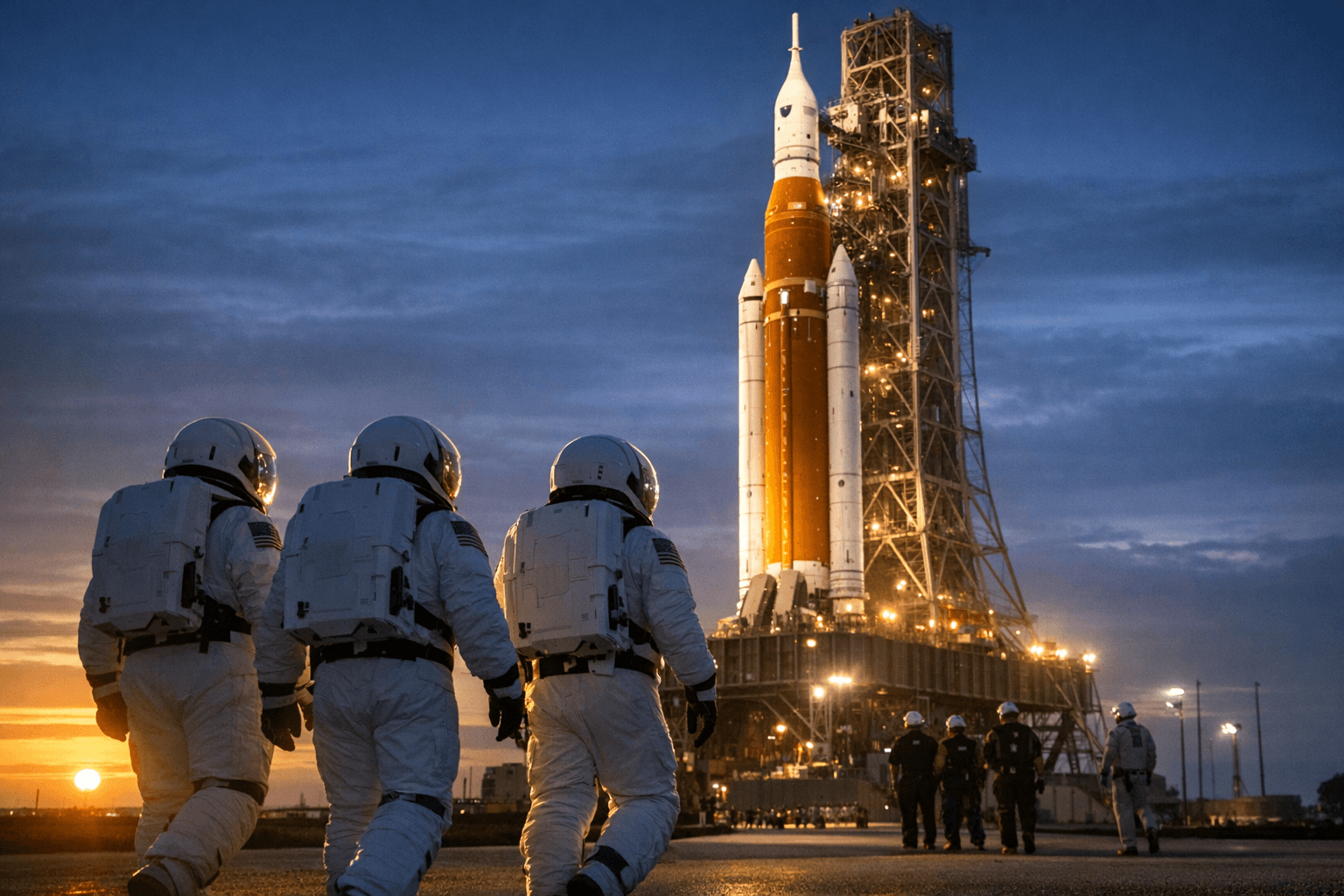
NASA's Artemis II Crew Prepares for Historic Lunar Flyby Mission
Four astronauts are in quarantine at Kennedy Space Center as NASA counts down to an April 1 launch that will test Orion's life-support systems for the first time with crew aboard.

Four astronauts are sealed in quarantine at Kennedy Space Center, days from a lunar flyby that NASA needs to succeed more than perhaps any mission it has attempted in decades. Commander Reid Wiseman, pilot Victor Glover, and mission specialists Christina Koch and Jeremy Hansen arrived March 27 and have been isolated since, a precaution against illness before a two-hour launch window opens at 6:24 p.m. EDT on April 1.
Artemis II carries weight well beyond its 10-day free-return trajectory around the Moon. The program has accumulated years of delays and costs approaching $93 billion by some estimates, and a slip now ripples into every downstream commitment NASA has made to partners, commercial contractors, and Congress.
Exploration Ground Systems program manager Shawn Quinn confirmed at Sunday's L-3 countdown briefing that "all final tests for the mission, including radio-frequency tests with the launch vehicle and spacecraft, have passed as we rapidly approach the official launch countdown." On Monday afternoon, NASA will hold another status conference following a key mission management meeting, with launch director Charlie Blackwell-Thompson and chief flight director Emily Nelson among the participants.
What Artemis I, the uncrewed 2022 test flight, settled is that the 322-foot Space Launch System can reach lunar distance and that Orion can survive reentry from deep space. What it left open is more complicated. Post-flight inspections found that chunks of the AVCOAT ablative material on the heat shield eroded more than preflight models predicted, with gases building up inside the outer layer rather than escaping as designed. Temperatures within the crew module stayed within limits, and NASA opted not to modify the Artemis II shield since it was already assembled.
Beyond the heat shield, Artemis II will be the first Orion flight carrying a complete life support system, providing no prior data on how those systems perform beyond low Earth orbit with crew aboard. Orion program manager Howard Hu addressed that readiness gap directly in prelaunch briefings. Tanking operations will begin at 7:45 a.m. on launch day, nearly 12 hours before the window opens. "There's always concern about something that may pop up," said Don Platt, department head for the College of Engineering and Science at the Florida Institute of Technology. "There's always a concern about weather."

The downstream consequences of a significant slip are concrete. Artemis III has already been redefined: rather than a lunar landing, it will launch in mid-2027 for a docking demonstration that depends on validated SLS and Orion performance from Artemis II. SpaceX's Starship lander is behind schedule by "at least two years," according to NASA's Office of Inspector General, with additional delays expected. The cancellation of the Gateway lunar outpost has strained relations with European partners, including Thales Alenia Space, which had completed the primary structure of the HALO module before the program shifted.
On April 6, if the launch proceeds as scheduled, NASA coverage of the lunar flyby begins at 12:45 p.m. EDT, though video may be limited while Orion passes through an eclipse, and the crew will temporarily lose communications with Earth as the spacecraft crosses behind the Moon's far side. The mission is expected to surpass the Apollo 13 record of 248,655 miles for the farthest any human has traveled from Earth, with splashdown in the Pacific Ocean scheduled for April 10.
NASA is targeting a crewed lunar landing with Artemis IV in 2028. Whether that calendar survives depends considerably on what the rocket standing on Pad 39B does starting April 1.
Know something we missed? Have a correction or additional information?
Submit a Tip