NASA’s seamstresses kept shuttle astronauts safe on reentry
A hidden crew of 18 women stitched the shuttle’s heat shield by hand and machine, helping astronauts survive reentry and leaving a legacy that outlived the program.
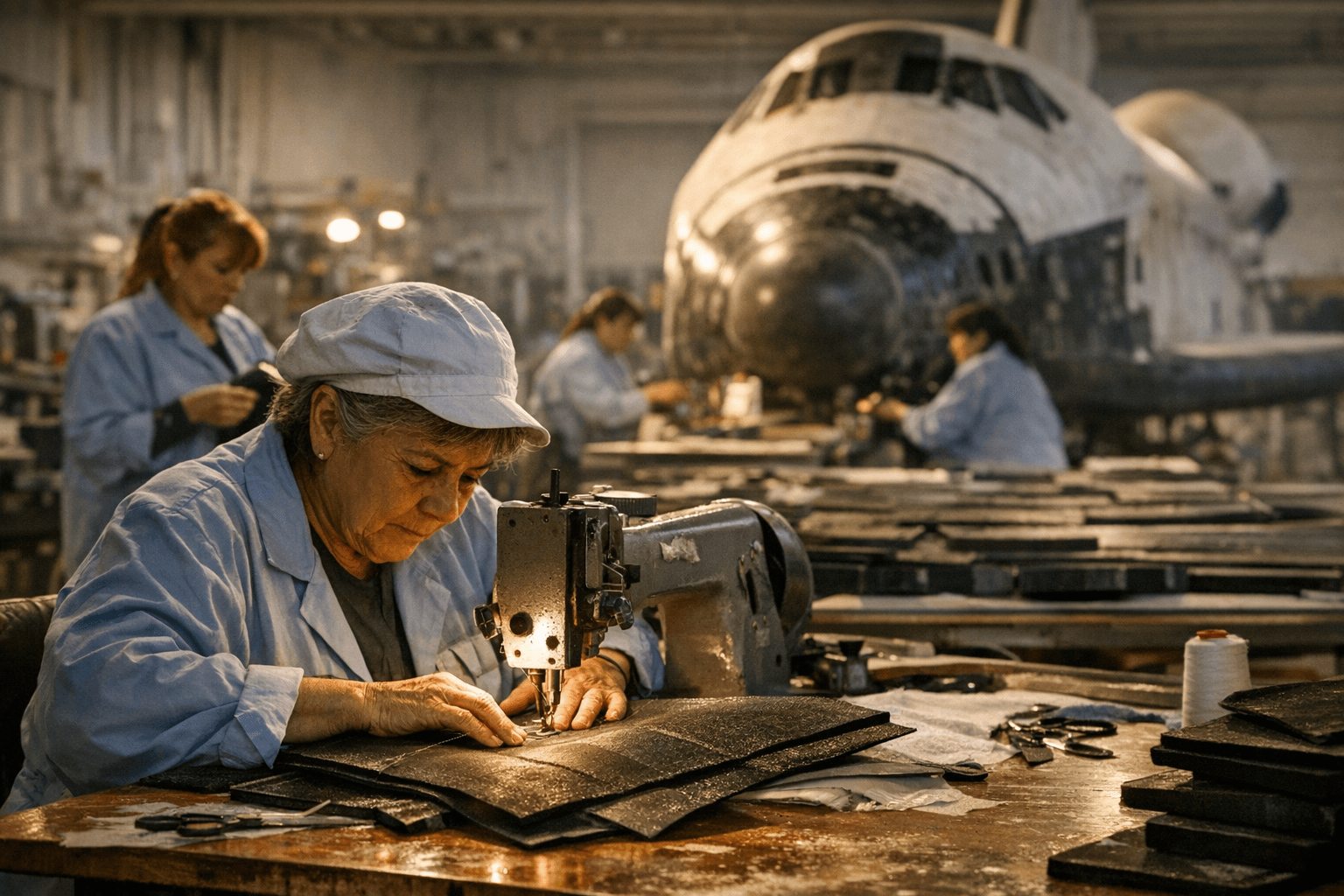
The people behind the heat shield
The space shuttle’s dramatic return to Earth depended on far less glamorous work than the rocket launches that drew the cameras. Jean Wright was one of 18 women in NASA’s informal Sew Sisters group, a team of female aerospace composite technicians who sewed the shuttle’s thermal protection system with hand and machine work.
Their job sat at the intersection of craft and engineering. These women did not simply mend fabric, they helped build the extreme heat-resistant covering that wrapped the orbiter’s exterior and made reentry survivable. Wright’s career reached across shuttles including Discovery, Endeavour, and Atlantis, placing her inside the everyday mechanics of a program that often celebrated only the astronauts.
Why the blankets mattered
The shuttle’s exterior needed protection from searing heat, and the Sew Sisters helped produce insulation blankets that were part of that reusable system. One account describes the Flexible Insulation Blankets as capable of withstanding temperatures of about 1,300 degrees Fahrenheit, while also reducing weight compared with tiles. That combination mattered because every pound carried into space affected performance, cost, and mission design.
These blankets were not decorative layers. They were functional hardware, sewn into place for a vehicle that had to endure the most punishing part of a mission on the way home. When the shuttle came back through the atmosphere, the thermal protection system was part of the line between a controlled landing and catastrophe. The women who built it helped make the orbiter a reusable spacecraft rather than a one-time capsule.
A skilled workforce hidden in plain sight
The Sew Sisters are a reminder that major engineering programs rely on specialized labor that rarely gets public recognition. Their work blended precision, repetition, and judgment, the kind of expertise that often gets described as support rather than leadership even when the mission cannot proceed without it.
That lack of visibility also reflects a broader pattern in aerospace and other technical fields, where women have historically done critical work without receiving equal credit. Calling the group seamstresses can flatten the complexity of what they did, but it also points to a truth that deserved more attention all along: their hands helped shape a machine that carried people safely through one of flight’s most dangerous phases. The skill was technical, the stakes were life and death, and the labor was deeply consequential.
Jean Wright’s path through the shuttle era
Wright’s work on Discovery, Endeavour, and Atlantis tied her to some of the program’s most recognizable orbiters. Those names became symbols of American spaceflight, but the people who maintained the thermal protection system were just as essential to the story. Wright’s contribution was not a single dramatic moment. It was a sustained role in the careful construction of hardware that had to perform every time the shuttle reentered the atmosphere.
After the program ended, she later served as a docent at the Kennedy Space Center Atlantis exhibit in Florida, bringing firsthand experience to visitors who wanted to understand what the shuttle program really took. That role turned a hidden part of aerospace history into something legible to the public. Instead of letting the work vanish with the orbiters, she helped explain it in a place where the final shuttle years could still be seen and remembered.
The end of the shuttle program, and the end of an era of labor
The shuttle program ended in 2011 after the final flight of Atlantis, closing a chapter that had depended on a wide network of engineers, technicians, and fabric workers. For the Sew Sisters, that ending marked more than the retirement of a vehicle. It also marked the disappearance of a very specific kind of skilled workforce, one that had kept evolving alongside the spacecraft it served.
The program’s end makes the story feel especially important now. When a technological system disappears, the people who maintained it are often lost to history faster than the hardware itself. The shuttle still appears in museums and exhibits, but the labor that made it work can fade unless it is deliberately preserved.
How the story survives today
Wright’s legacy did not disappear with the program. Her story became the subject of the 2023 children’s book Sew Sister: The Untold Story of Jean Wright and NASA’s Seamstresses, giving younger readers a way to see aerospace history through the people who stitched it together. That matters because representation is not only about who gets to fly. It is also about who gets remembered for building the systems that make flight possible.
The book and the exhibit both do the same work in different ways. They pull the Sew Sisters out of the margins and place them where they belong, inside the history of the shuttle itself. Their contribution was practical, precise, and indispensable, and it helped ensure that astronauts could come home safely after the violence of reentry.
The deeper lesson of the Sew Sisters is that space exploration was never only about rockets or the faces inside the cockpit. It also depended on patient, expert labor from people like Jean Wright, whose stitches helped carry astronauts home.
This article was produced by Prism’s automated news system from verified source data, official records, and press releases, then run through automated quality and moderation checks before publishing. The system is built and supervised by the people who set the standards it runs under. Read our full AI policy.
Did this article answer your question?