Apple extends US smartphone dominance as Samsung loses ground
Apple’s US share hit 69% as Samsung fell to 13%, while the average phone price climbed to $647.53 and lower-cost choices kept shrinking.
Apple deepened its grip on the US smartphone market as Samsung lost ground, leaving American buyers with fewer mainstream options and less price pressure in a market already shaped by carriers, repair limits and locked devices.
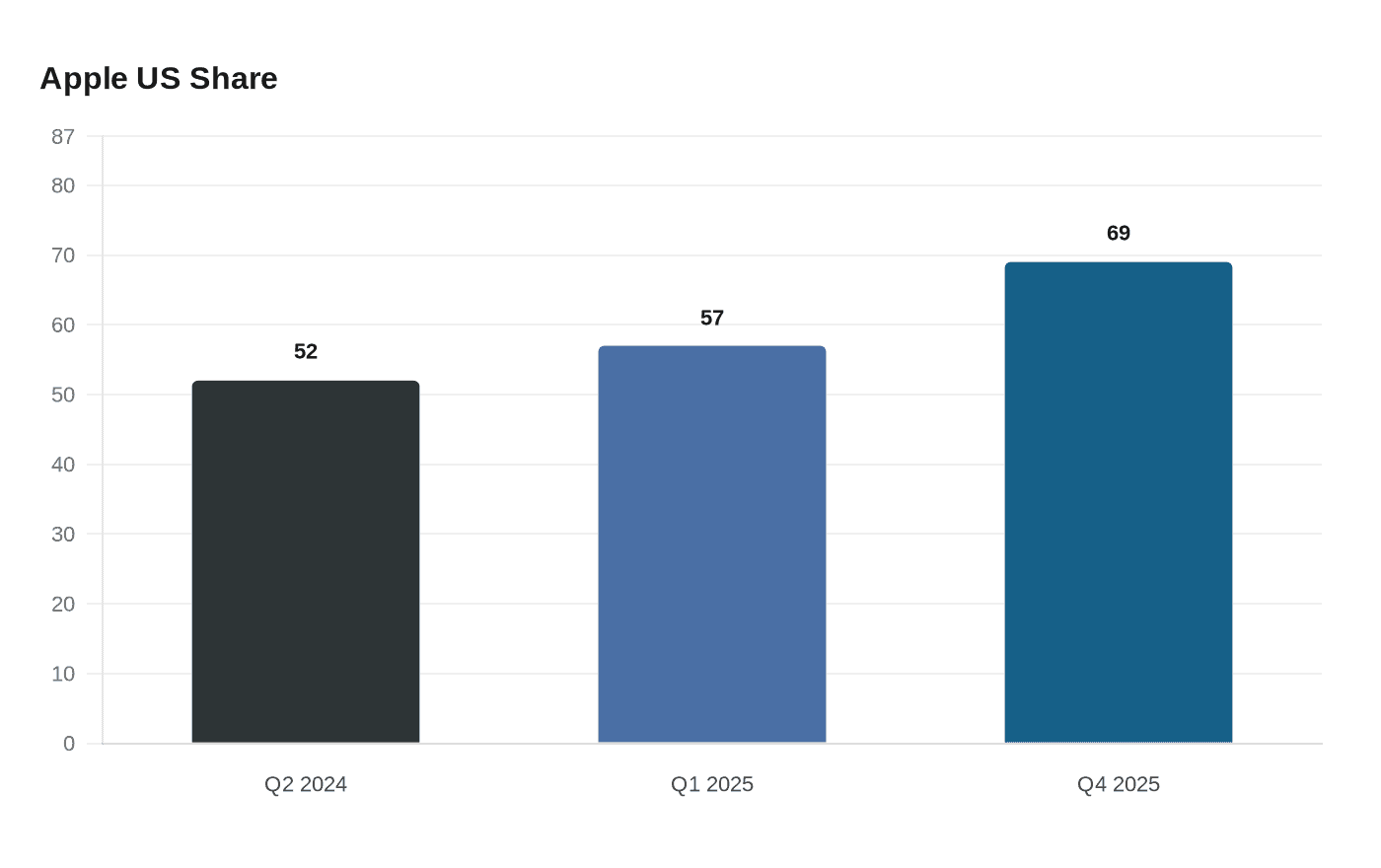
Counterpoint Research said Apple held 52% of US smartphone shipments in the second quarter of 2024, rose to 57% in the first quarter of 2025 and reached 69% in the fourth quarter of 2025, its highest level on record. Samsung’s share fell from 24% in the second quarter of 2024 to 13% by the end of 2025. The shift came as the broader market remained weak at the low end and increasingly concentrated in the middle and premium tiers.
That narrowing was especially visible below $300. Counterpoint said sales in that segment fell 7% year over year in the fourth quarter of 2025, while the $300 to $600 band grew 27%. HMD, the maker of Nokia-branded phones, exited the US market in 2025, removing another name from the low-price shelf and potentially giving Motorola and TCL even less room to compete.
The market did not collapse, but it became more expensive. US smartphone shipments were up 9% year over year in the second quarter of 2025, revenue rose 11% to $17.5 billion, and the average selling price climbed to $647.53 from $632.59 a year earlier. Apple’s iPhone 16e helped lift mid-range and prepaid sales, while Samsung’s Galaxy S25 and S25 Edge benefited from premium promotions. Carrier incentives periodically boosted demand, but they also reinforced a system in which the biggest operators, including T-Mobile, AT&T and Verizon, decide which models get pushed hardest.
That carrier control extends beyond pricing. iFixit said the Federal Communications Commission proposed limiting phone locks to 60 days in 2024, but argued that all major US carriers still lock phones and that the campaign against locking has been underway since 2013, when a DMCA-related unlocking exemption lapsed. For consumers, that means buying a phone can still come with network restrictions that make switching harder and competition thinner.
Repair rights have moved faster than carrier policy. MIT Sloan Management Review said right-to-repair laws have passed in California, Colorado, Maine, Massachusetts, Minnesota, New York and Oregon, with bills active in 30 state legislatures in 2025. The European Union adopted new right-to-repair rules in 2024. Together, those changes point to the same problem from a different angle: in the United States, the smartphone market often looks like a flagship race, but many buyers still face a narrower, more controlled marketplace than consumers in other rich tech markets.
This article was produced by Prism’s automated news system from verified source data, official records, and press releases, then run through automated quality and moderation checks before publishing. The system is built and supervised by the people who set the standards it runs under. Read our full AI policy.
Did this article answer your question?