NATO Turns 77 Amid Trump Withdrawal Threats and Alliance Uncertainty
Trump declared "disgust" with NATO and said he was "absolutely" considering withdrawal as the alliance marked 77 years, putting Article 5's reliability in sharper doubt than at any point since 1949.
NATO's seventy-seventh anniversary arrived Saturday freighted with a question the alliance has never seriously had to answer in its own founding capital: can Article 5 be trusted if Washington decides to leave?
The moment was sharpened by President Donald Trump, who told reporters of his "disgust with NATO" over the alliance's refusal to help the United States reopen the Strait of Hormuz amid the widening Iran war, and confirmed he was "absolutely" considering withdrawing the United States from the pact signed on April 4, 1949. A Council on Foreign Relations analysis published on the anniversary characterized any such move as an "epic strategic blunder," arguing that NATO remains an essential pillar of collective security in a fracturing global order. The CFR's James M. Lindsay, writing as the anniversary arrived, framed the occasion as one of existential reflection for an institution that helped deter Soviet aggression for four decades and has anchored U.S. strategy in Europe ever since.
Trump's language was not entirely without context. His sustained pressure on allies did produce results: all 32 NATO members now spend at least 2 percent of GDP on defense, up from just three countries meeting that threshold in 2014. At the June 2025 summit in The Hague, allies agreed to a new target of 5 percent of GDP by 2035, with Secretary General Mark Rutte calling it a "transformational leap" for collective defense. But Trump has since moved further, reportedly considering a "pay to play" framework that would strip Article 5 protections from members failing to meet the 5 percent benchmark, a proposal that would transform the mutual defense guarantee from an unconditional commitment into a tiered arrangement.
Europe has responded with accelerating rearmament. Germany plans to raise its defense budget from 86 billion euros in 2025 to 152 billion euros by 2029. The European Union launched its Security Action for Europe instrument, a 150 billion euro fund designed to underpin European defense procurement and reduce dependence on outside suppliers, with at least 65 percent of production required to occur within the EU or EEA. McKinsey analysis noted that equipment deliveries from recent orders are expected to accelerate through 2026 and 2027, even as overall European equipment stocks remain below 2021 levels due to transfers to Ukraine.
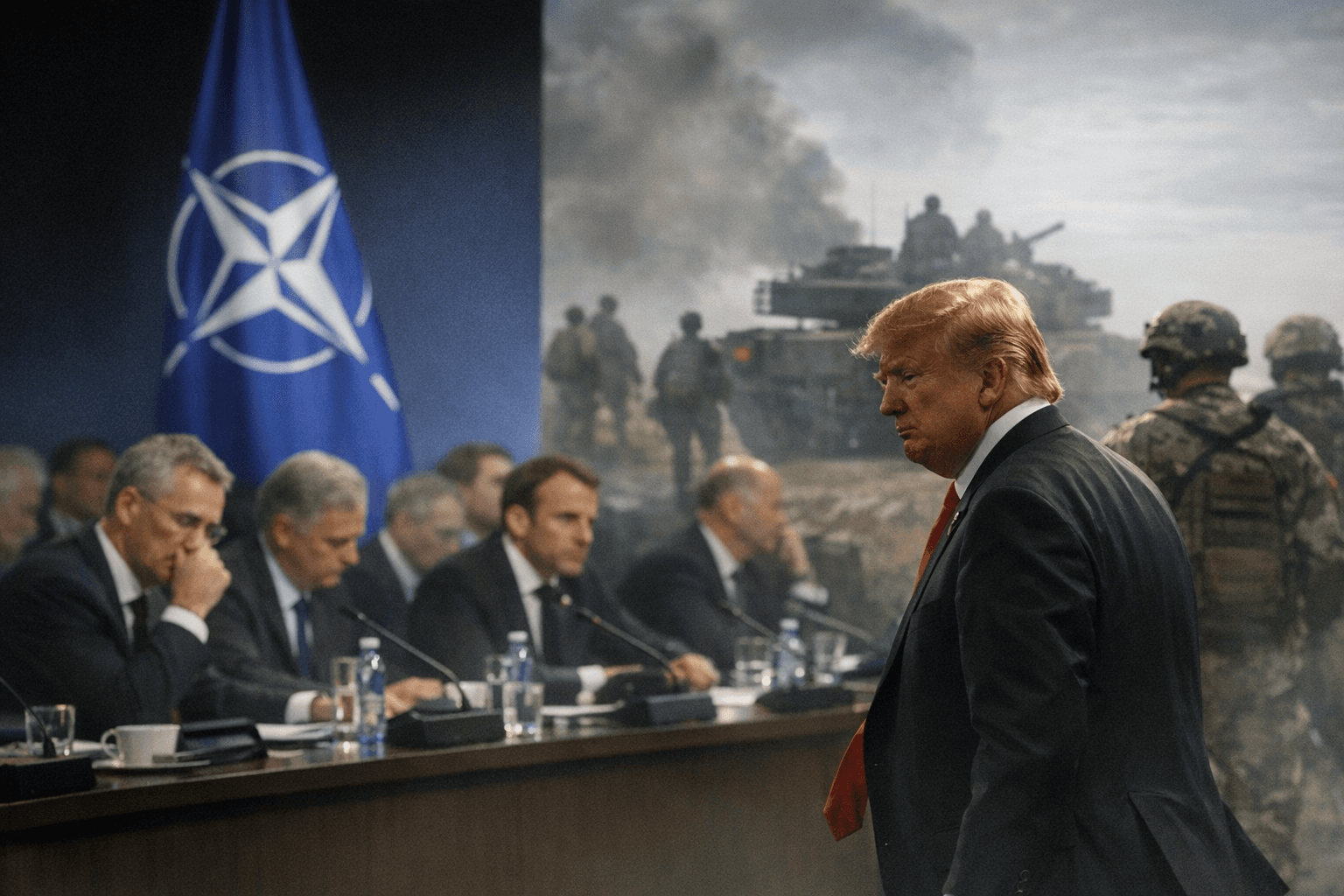
None of that rearmament is moving fast enough to close the gap quickly. Analysts warn that reduced U.S. interoperability would lower deterrent credibility and force a recalibration of European defense responsibilities that most countries are structurally unprepared to absorb on short timelines. The Iran war has added urgency and friction simultaneously: the UK convened a virtual meeting of 35 countries to coordinate Hormuz shipping security, but European opposition to the broader Iran campaign has opened new fault lines. Missiles and drones have already been fired toward NATO member Turkey and a British military base, testing the alliance's cohesion in real time while Trump expresses frustration that allies have not joined his campaign.
Rutte has publicly pushed back, stating he has no doubt about Article 5's durability and arguing that Trump's pressure has ultimately made the alliance stronger. Betting markets have placed the probability of a U.S. NATO withdrawal at around 15 percent, a figure that would have seemed implausible at any previous anniversary. NATO's next summit is scheduled for Ankara on July 7 and 8, where member states are expected to submit national roadmaps detailing how they intend to reach the 5 percent target. That meeting will offer the clearest read yet on whether the alliance can navigate the distance between Trump's rhetoric and the institutional architecture seventy-seven years in the making.
This article was produced by Prism’s automated news system from verified source data, official records, and press releases, then run through automated quality and moderation checks before publishing. The system is built and supervised by the people who set the standards it runs under. Read our full AI policy.
Did this article answer your question?


