Nature review says de novo protein design nears biotech breakthrough
AI-designed proteins are moving from theory to products as Nature says key design problems are nearly solved. The sticking points now are proof, manufacturability and cost.
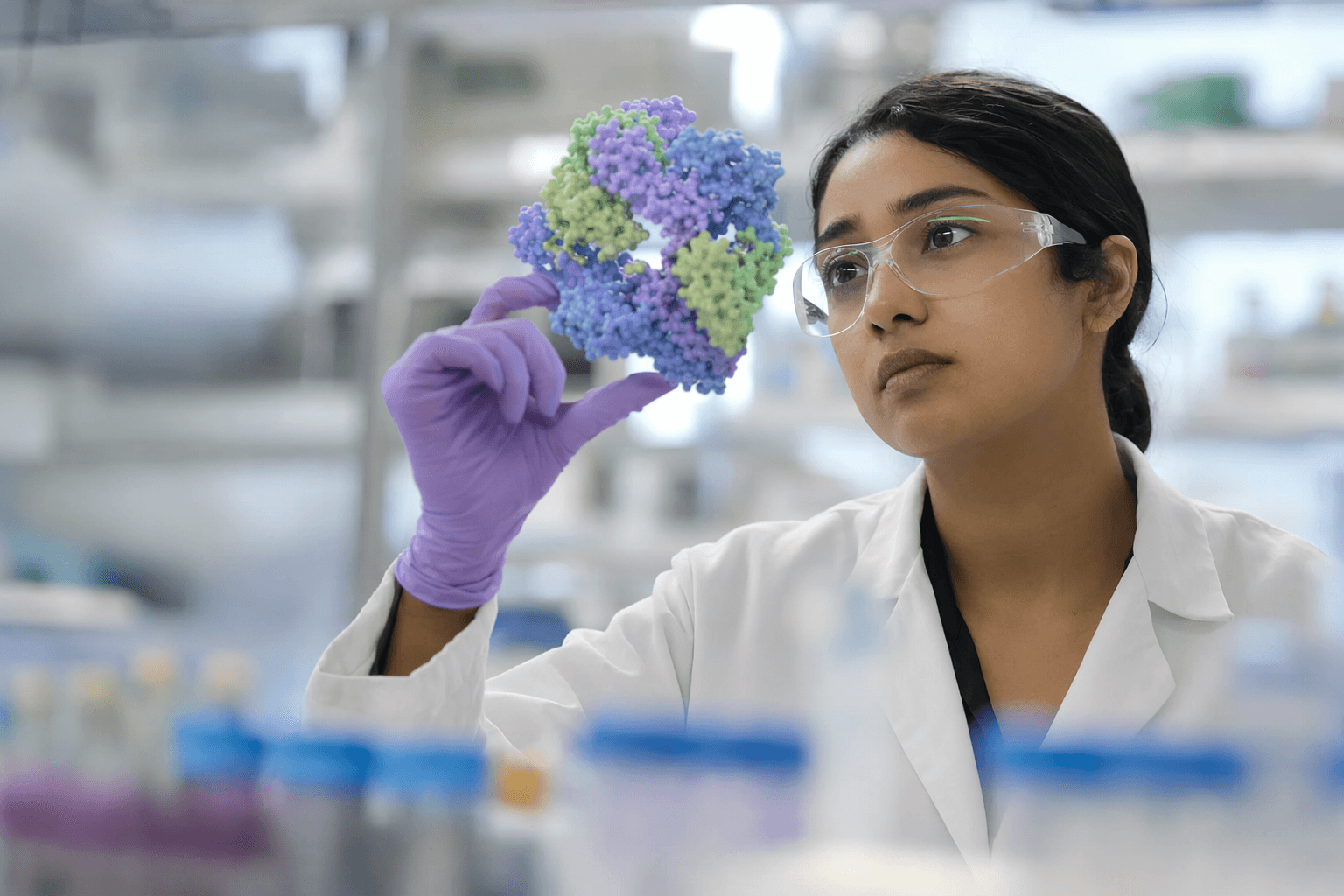
The commercialization question in de novo protein design has changed from whether computers can invent new folds to which designs can clear the final hurdles of lab validation, manufacturing and price. Nature’s April 29, 2026 review says the long-standing challenge of designing new protein structures, assemblies and protein binders is now close to being solved, even as success rates and activity still need work.
That shift marks a clean break from the old playbook of pulling from nature’s catalog. Deep-learning tools and open-source systems such as RFdiffusion and ProteinMPNN, paired with structure-prediction software, are pushing the field toward intentional computational design. A 2025 Nature paper already showed atomically accurate de novo antibody design with RFdiffusion and yeast display screening, a sign that binders may be the first category to move fastest toward products.
The field’s roots go back to the 1980s and 1990s, when researchers used early rational and minimal designs to ask how sequence determines structure and function. David Baker’s lab at the University of Washington in Seattle turned that question into an engine for invention. In 2003, Baker and his team produced Top7, the first completely new protein, a 93-amino acid design. Rosetta began as an ab initio structure-prediction project and later expanded into protein design and docking, helping build the modern design stack around the Institute for Protein Design and the wider Rosetta Commons community.
The scientific mainstream now sits squarely behind that arc. The 2024 Nobel Prize in Chemistry went to David Baker for computational protein design, while Demis Hassabis and John Jumper shared the other half for protein structure prediction. That split mirrors the field’s current reality: prediction and design are now tightly linked, with one feeding the other as researchers move from theoretical folds to testable molecules.
The obstacle course has not disappeared. A 2026 clinical review said protein biologics still face long development timelines, limited tunability, manufacturing consistency problems and high production costs. Those are the barriers that will separate a clever design from a commercial asset. Structure generation is advancing quickly; the next test is whether designed proteins can be made reproducibly, validated in the lab, and delivered at a cost that beats existing biologics. For now, binders and antibody-like molecules look closest to market, while enzymes and broader protein therapeutics will need the same mix of precision, potency and scalable manufacturing before the hype turns into routine industry practice.
Sources:
Know something we missed? Have a correction or additional information?
Submit a Tip