New Hampshire Remains Among Few States Without a Dedicated School for the Deaf
New Hampshire has never built a school for the deaf, leaving families to navigate a patchwork of local programs — a gap that stretches back to efforts derailed by World War II.
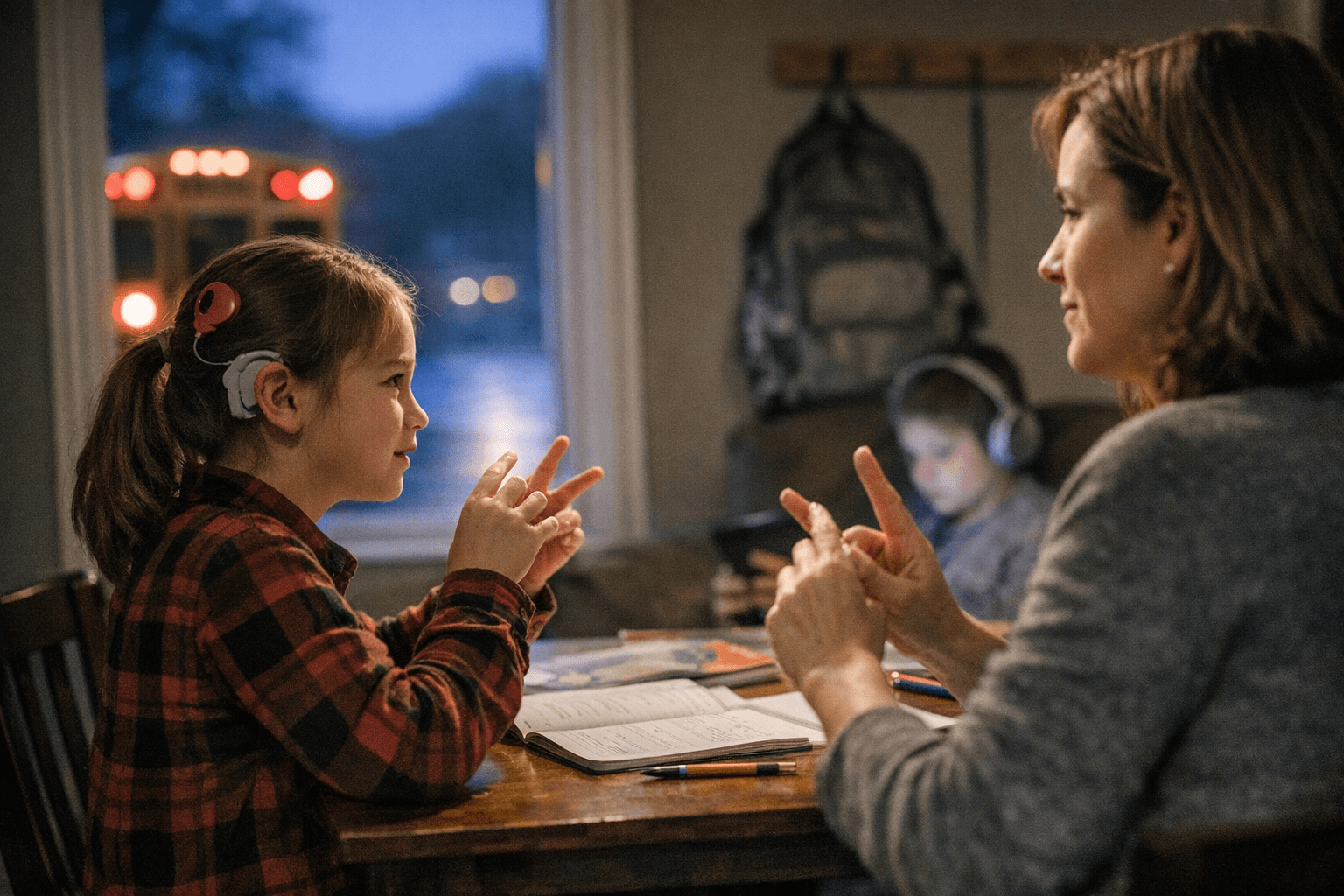
New Hampshire has never had a dedicated school for the deaf. That gap, stretching back to at least the 1930s when a state school was actively pursued and ultimately derailed by the economic demands of World War II, places the Granite State among a small group of outliers in the nation. As of the early 2000s, New Hampshire and Nevada stood as the two states without state-operated schools for the deaf. Nebraska, for comparison, closed its residential deaf school in 1998 after enrollment fell below 40 students. New Hampshire never opened one.
The consequences for families have been structural and persistent. Before localized programs existed, deaf children in New Hampshire were educated as far away as Canada. Those deemed to have lesser potential were sometimes placed at the Laconia State School, a blunt and inadequate substitute for specialized education. What replaced that history was not a state school but a patchwork: district-level programs, nonprofit support organizations, and a reliance on the goodwill of individual communities to fill what state infrastructure never provided.
Two of the most established programs operating today are the Manchester Program for the Deaf and Hard of Hearing and Nashua's Signs of Learning, housed at New Searles Elementary School on Shady Lane in Nashua. These programs serve deaf and hard-of-hearing students from their respective districts and surrounding communities, but their reach is inherently local. A family in a rural part of the state has no equivalent option close to home.
Statewide coordination runs largely through Northeast Deaf and Hard of Hearing Inc., which operates New Hampshire's Deaf and Hard of Hearing Education and Resource Center. The ERC provides outreach to families, students, and school districts across the state, offering direct sign language instruction through a Family Sign Language Program funded by the NH Bureau of Developmental Services, Northeast Deaf and Hard of Hearing Services, and participating local school districts. Classes are available at no cost to qualifying families, but access depends on geography and district participation.
Federal law complicates the state's inaction. The Individuals with Disabilities Education Act requires that every deaf and hard-of-hearing student receive a free appropriate public education in the least restrictive environment and that a continuum of placement options, including schools for the deaf, be available. The National Association of the Deaf has stated plainly that schools for the deaf "are not optional, but are a mandated placement under law" under federal regulation. New Hampshire's response to that mandate has been to delegate responsibility to local districts with uneven resources, differing levels of training, and no centralized staffing pipeline for qualified interpreters or educators.
That delegation showed up in Concord in January 2026, when the legislature deemed inexpedient a bill that would have transferred administration of the state's deaf and hard-of-hearing program and interpreter licensure board to a different office. The bill stalled without advancing any structural expansion of services. The underlying policy gap it might have addressed remains unchanged.
For deaf students in New Hampshire today, the quality of their education still depends heavily on which town they happen to live in and whether that town has chosen to invest in a program. Without a state school anchoring a centralized approach, the burden of building competency in sign language instruction, sourcing certified interpreters, and training general education staff falls to individual districts, some of which carry it well and some of which do not. What works in Manchester or Nashua does not automatically translate anywhere else.
This article was produced by Prism’s automated news system from verified source data, official records, and press releases, then run through automated quality and moderation checks before publishing. The system is built and supervised by the people who set the standards it runs under. Read our full AI policy.
Did this article answer your question?