Trump Signs Second Executive Order Targeting College Sports Compensation Rules
Trump's second college sports executive order threatens universities' federal funding, setting an August 1 deadline for the NCAA to overhaul its rules.
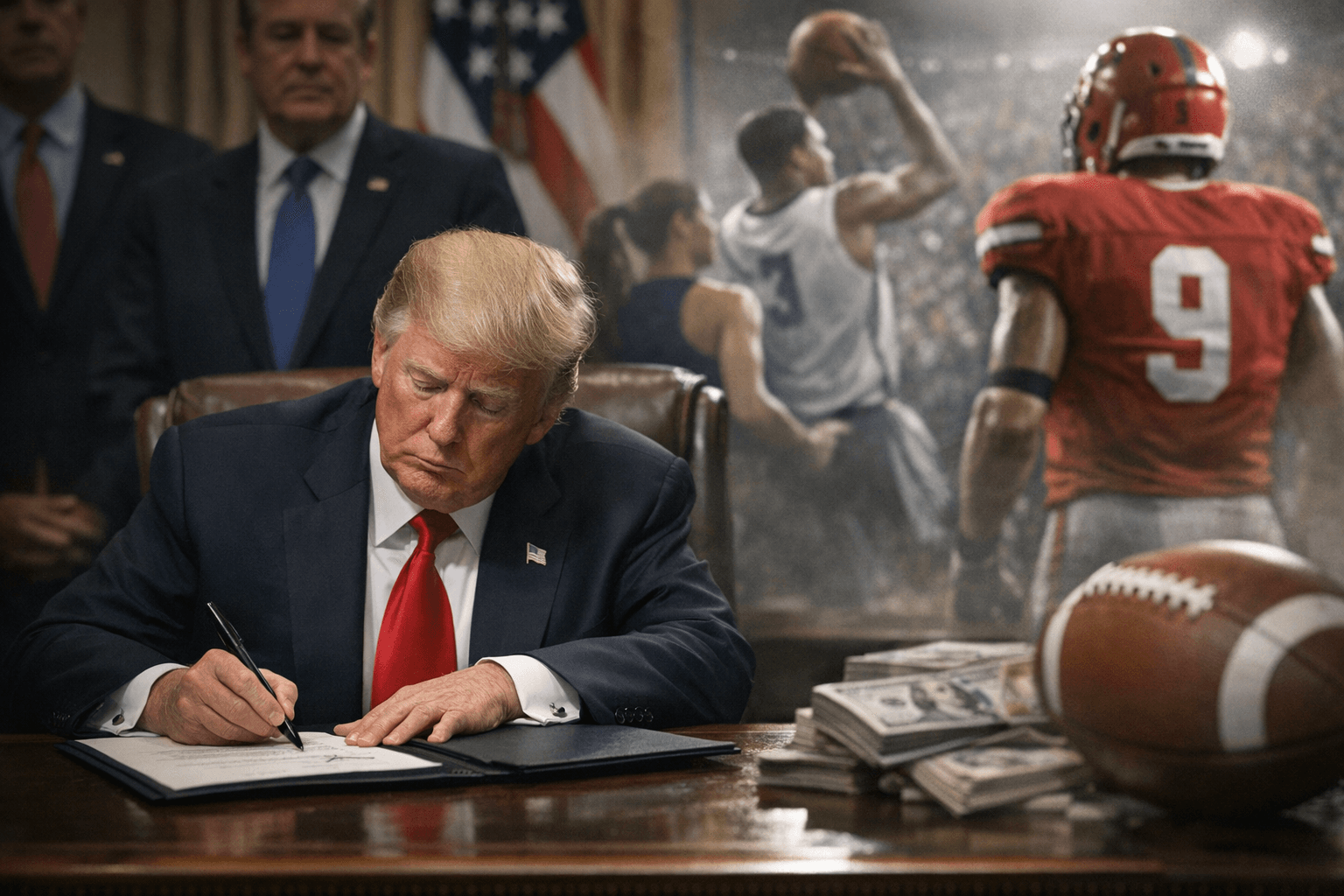
President Trump signed "Urgent National Action to Save College Sports" on April 3, threatening to review or revoke federal grants and contracts from any university that fails to comply with new NCAA rules, deploying the administration's sharpest enforcement mechanism yet in its effort to reshape a college athletics landscape the president has publicly called a "mess."
The order, Trump's second on college sports, sets an August 1, 2026 deadline for the NCAA to update its bylaws. It caps athlete eligibility at five years, with exceptions for military and missionary service, limits transfers to one penalty-free move as an undergraduate and one more after earning a four-year degree, bans NIL collectives, and prohibits what it labels "fraudulent NIL schemes," defined as compensation above fair-market value. The order also bars higher education institutions from using federal funds for NIL payments, revenue-sharing arrangements, or coaching and athletic compensation.
Enforcement falls to the General Services Administration, the Department of Education, the Federal Trade Commission, and the Attorney General, all directed to increase data collection and compliance monitoring. The White House fact sheet states the order directs federal agencies to evaluate whether violations of college sports rules render a university "unfit for Federal grants and contracts."
The backdrop is a college sports economy transformed by cascading legal decisions. Following the Supreme Court's 2021 ruling in NCAA v. Alston, which first permitted NIL rights, a federal judge approved the House v. NCAA antitrust settlement on June 6, 2025, establishing a $2.8 billion retroactive payment to athletes denied NIL earnings from 2016 through 2025 and allowing Division I schools to directly pay athletes up to $20.5 million annually. Roster spending at top programs climbed to between $20 million and $30 million; Ohio State Athletic Director Ross Bjork acknowledged spending $20 million for the Buckeyes' 2024 national championship roster. Roughly 25 percent of all FBS football players entered the transfer portal during the 2026 cycle's January 2-16 window.
Trump's first executive order on college sports, titled "Saving College Sports" and signed July 24, 2025, had no measurable impact on NCAA governance. At a White House roundtable on March 6, 2026, Trump said he wanted to revert to the old system and "ram it through a court," while predicting any executive order would face legal challenges and adding that he "hoped" for a favorable judge.
Courts have already struck down multiple Trump orders involving college sports, and legal experts warn the new order could force schools and the NCAA into direct conflict: existing federal court rulings currently bar the NCAA from enforcing certain eligibility and transfer restrictions, meaning institutions may be forced to choose between following the White House or a standing federal court order.
NCAA President Charlie Baker called the new order "a significant step forward" but said stabilizing college athletics "still requires a permanent, bipartisan federal legislative solution." Texas Tech regent Cody Campbell was more direct, saying he was "extremely supportive of the President's order" and looked forward to continued congressional work.
That path runs through the SCORE Act, which would grant the NCAA a limited antitrust exemption shielding it from compensation and eligibility lawsuits. The bill, backed by the NCAA and the U.S. Olympic & Paralympic Committee, has not passed despite White House support. Speaker Mike Johnson of Louisiana supports it; Democrats have largely opposed it.
How quickly courts act on the new order may determine whether the August 1 deadline carries any weight at all.
This article was produced by Prism’s automated news system from verified source data, official records, and press releases, then run through automated quality and moderation checks before publishing. The system is built and supervised by the people who set the standards it runs under. Read our full AI policy.
Did this article answer your question?