Newsom Regrets Calling Israel Apartheid State, Cites Friedman Column as Context
Newsom told Politico "I do, in this context" when asked if he regrets the word "apartheid," pointing to a Thomas Friedman column warning Netanyahu could make Israel an apartheid-like state.
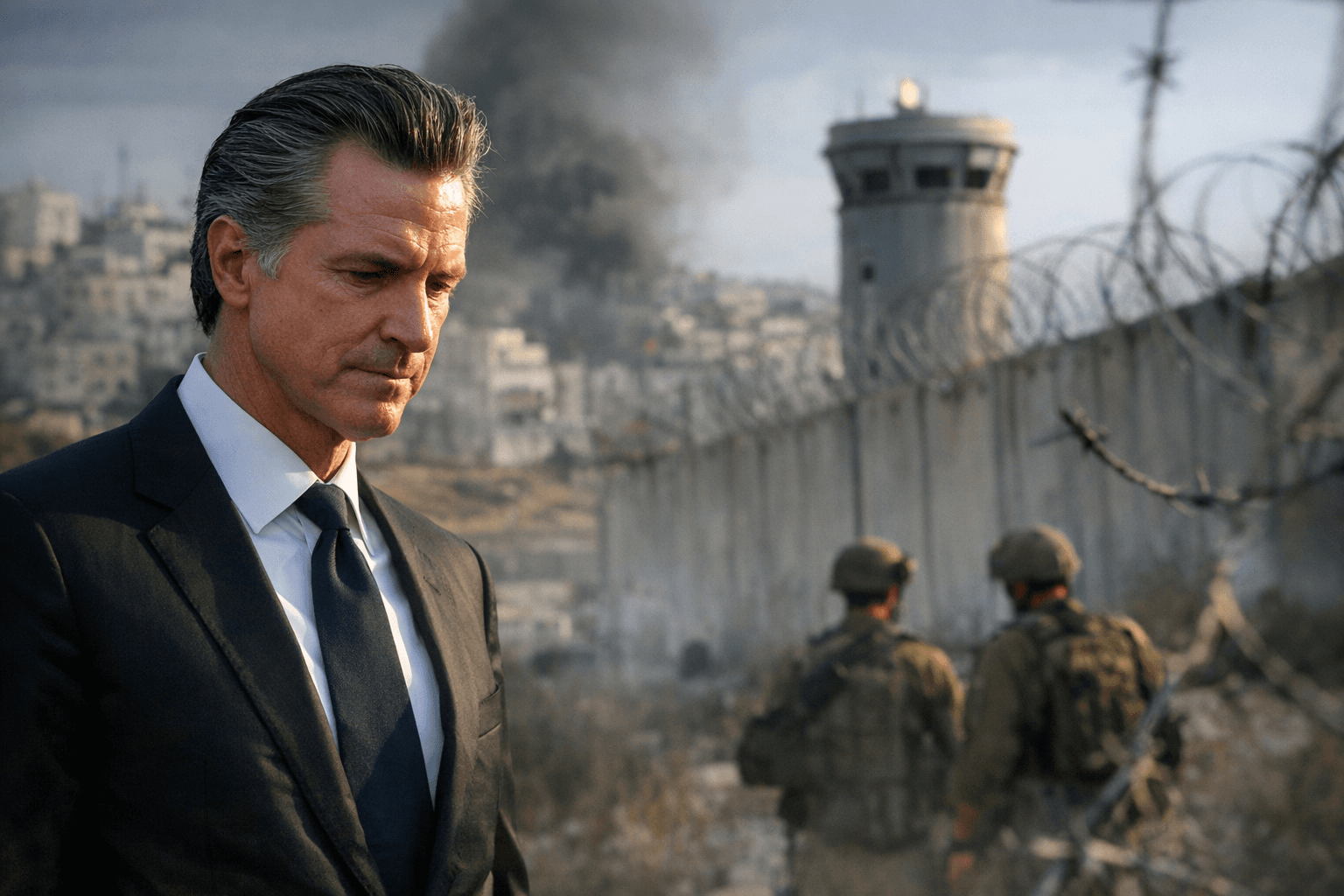
California Gov. Gavin Newsom said he regretted using the word "apartheid" to describe the Israeli government's treatment of Palestinians, though he warned "that's a word you may hear others use" if Prime Minister Benjamin Netanyahu pushes for territorial gains. The clarification came in a Politico interview published Tuesday, three weeks after the remark ignited a public backlash from Jewish community organizations and Democratic allies who had long regarded Newsom as a reliable friend to Israel.
Newsom said on March 3 on a podcast that Israel had been talked about "appropriately as sort of an apartheid state," and suggested that a time may come when the U.S. should reconsider its military aid to Israel. He made those remarks during an event in Los Angeles to promote his new memoir, speaking to Pod Save America's Jon Favreau and Tommy Vietor of Crooked Media.
When Politico's Jonathan Martin asked him directly, "Do you regret using the word apartheid to describe Israel?" Newsom answered, "I do, in this context," pointing to a February piece by New York Times columnist Thomas Friedman, who wrote that "Israel by default could become some kind of apartheid-like state in permanent control over the 2.5 million Palestinians." Martin then pressed him: "Not the current state?" Newsom replied "Correct," and added that "if that vision and that direction of the far right, that Bibi is indulging, that if they see the full annexation of the West Bank, then that's not something — that's a word you may hear others use."
In using the word "apartheid," Newsom was referencing a Feb. 17 opinion piece by Thomas Friedman in the New York Times that described threats by the Israeli right to annex the West Bank. The op-ed Newsom references was published on March 2, in which Friedman warned: "If the war in Iran enables Netanyahu to win the Israeli elections planned for this year, it will be a major propellant to his efforts to annex the West Bank, cripple the Israeli Supreme Court and make Israel an apartheid state, which would be a major blow to American interests in the region beyond Iran."
Newsom said in a subsequent live appearance March 5 that he was referencing Friedman's recent assertion that Israel annexing the West Bank without giving Palestinians equal rights would create an apartheid system. "I was specifically referring to a Tom Friedman column last week, where Tom used that word, 'apartheid,' as it relates to the direction Bibi is going, particularly on the annexation of the West Bank," he said.
When asked in the Politico interview whether he considered himself a Zionist, Newsom said: "Do I consider myself Zionist? I revere the state of Israel. I'm proud to support the state of Israel. I deeply, deeply oppose Bibi Netanyahu's leadership, his opposition to the two-state solution and deeply oppose how he is indulging the far right as it relates to what's going on in the West Bank."
The remarks rattled Jewish organizations with deep institutional ties to the California governor. Newsom's apparent willingness to break from pro-Israel orthodoxy sent heads spinning. Jewish Insider described the interview as a "hard left" shift. A column in the Jewish Journal of Greater Los Angeles assailed Newsom for "finger-in-the-wind politics," and even organizations that have historically enjoyed a collaborative relationship with Newsom publicly condemned the remarks. Jewish California, whose member groups include the state's local Jewish federations, took to Instagram to call them "inflammatory."
David Bocarsly, executive director of Jewish California, a group that represents more than 30 Jewish community organizations in the state, said the initial comments were "disappointing and painful" for many in the community. His group asked for a definitive public statement from the governor that he "continues to support Israel and the U.S.-Israel relationship," including funding for Israel's defense, and that he "doesn't believe that a thriving, pluralistic and democratic society, as it is in its current state, is an apartheid state."
Halie Soifer, chief executive of the Jewish Democratic Council of America, offered a more measured response. She agreed the "apartheid" phrase had originally been taken out of context and said she was satisfied by Newsom's subsequent attempt to clarify the remarks. Her residual concern centered on Newsom's suggestion that the U.S. may have "no choice" but to reconsider military aid to Israel, a position the JDCA explicitly rejects in its platform.
Israel's supporters stridently reject claims that the country practices apartheid, pointing to protections for freedom of religion, non-Jewish representation in Israel's Knesset, and the presence of non-Jews in positions of high authority in the country, among other factors.
Many in the Democratic Party have distanced themselves in recent months from the Israeli government and allied groups like the American Israel Public Affairs Committee, but Newsom, a top potential contender for the 2028 nomination, drew attention for suggesting Israel's treatment of Palestinians in territories it has controlled since 1967 amounted to "apartheid" — a claim Israel strongly rejects. Coming from a leader seen by some as a Democratic party bellwether, the comments had appeared to shift the conversation leftward, alarming Jewish Democrats who viewed Newsom as a longtime ally. His Politico interview, in which he praised Israel while sharply criticizing Netanyahu, drew a line he had not previously stated so explicitly in public: the country's trajectory under its current prime minister, not its present condition, is what he meant to put on notice.
Know something we missed? Have a correction or additional information?
Submit a Tip

