Next boss warns UK entry-level jobs will shrink as AI grows
Simon Wolfson said Next now gets twice as many applicants per role as two years ago, a sign that UK entry-level jobs are tightening fast.

Britain’s entry-level job market is looking thinner, and Next’s boss says the squeeze is already visible in the queue for a retail job. Simon Wolfson said Next now gets about twice as many applicants per role as it did two years ago, as vacancies at the group fell by 35% and applications rose 76%, lifting applicants per vacancy to 2.7 times their level two years earlier.
Wolfson said the UK economy will see a dramatic decline in job opportunities, especially at the entry level, and tied the pressure to higher employer costs, tougher regulation, mechanisation and AI. He also said the medium- to long-term outlook for the economy did not look favourable and that growth would be anaemic, a bleak view from the head of one of Britain’s biggest employers. Next reported group sales of £6.3bn and profit before tax of £1.011bn for the year ended January 2025, while Wolfson’s pay for that year was reported at £4.72m.
The wider labour market data points in the same direction. The Office for National Statistics said total UK vacancies were down by 54,000, or 7.1%, year on year in February to April 2026. It also said there were 2.5 unemployed people per vacancy in January to March 2026, underscoring how much tougher the search has become for school leavers and recent graduates. Next, which has more than 400 stores across the country and recruits in retail, tech, logistics and early-careers roles, sits near the front line of that shift.
Pressure on employers has been intensifying for months. The British Retail Consortium said on 6 April 2025 that the cost of employing people into entry-level jobs rose by more than 10%, and by 13% for part-time workers, after increases in employer National Insurance contributions and the National Living Wage. The group said those measures would cost retail more than £5bn a year, rising to £7bn when the packaging tax starts. Kris Hamer, the consortium’s director of insight, has argued that higher labour costs will harm employment.
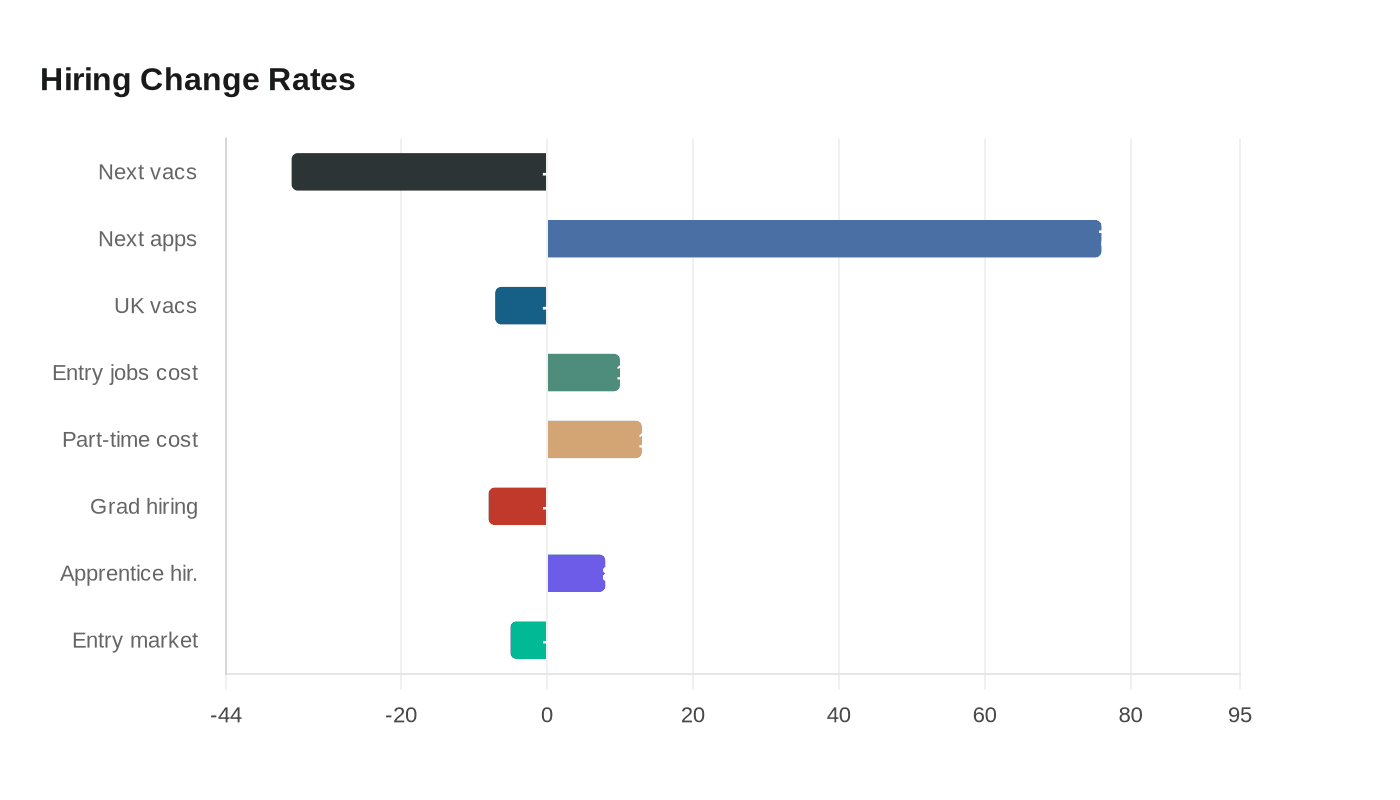
The student-recruitment market is weakening too. The Institute of Student Employers said in October 2025 that graduate hiring had fallen 8% year on year, apprentice hiring had risen 8%, and the overall entry-level market was down 5%. Its survey covered 155 large employers that recruited more than 31,000 students in the 2024-25 cycle. Taken together, the figures suggest that the first rung of the labour ladder is narrowing just as the number of jobseekers is rising, leaving young workers to compete for fewer openings in a slower, costlier market.
Know something we missed? Have a correction or additional information?
Submit a Tip