Northumberland Rangers Urge Visitors to Clean Up Along Hadrian's Wall
Dog walkers are wedging plastic poo bags into the ancient stones of Hadrian's Wall, a UNESCO World Heritage Site drawing 750,000 visitors a year, rangers warn.

Step out of the Steel Rigg car park on any given morning and Margaret Anderson, Northumberland National Park's head ranger, will likely spot the problem before she reaches the footpath. Dog mess sits metres from a sign explicitly asking walkers to dispose of waste responsibly. Worse, in her view, are the bags that do get picked up only to be poked into the Roman stonework itself, tucked into crevices and left perched on top of a structure nearly 1,900 years old.
"It's a real sense of frustration," Anderson said. "We have this amazing structure here which so many people want to come and enjoy. For somebody to think it's acceptable to wedge poo bags into a UNESCO World Heritage Site, well actually it makes you quite sad."
The wall, built on the orders of Emperor Hadrian in AD 122 as the northernmost frontier of the Roman Empire, draws roughly 750,000 visitors a year along its 73-mile span across northern England. Steel Rigg sits at the gateway to its most photographed and most walked central stretch, and it is here, across the crags that ripple between Peel Gap and Sycamore Gap, where the misuse is most visible. Rangers report finding bags stuffed inside the wall's interior and balanced along its top course of stone.
The park faces a structural tension at the heart of the problem: there are virtually no bins along the central section of the wall, including at the Steel Rigg car park itself. Anderson is not calling for more infrastructure. "The last thing we want are more and more structures along here," she said. "And let's face it, it's really not hard to carry your poo bag. You can get little pouches to put it in, pop it in your pocket or your backpack until you get somewhere where you can dispose of it."
That calculus shifts the burden entirely onto visitor behavior, and it is a calculation that Gary Pickles, ranger for the Hadrian's Wall Path National Trail, sees play out across the wider landscape. "The countryside is not just a place of leisure; it's also a workplace for staff from the National Park Authority and our partners, farmers, and small businesses," Pickles said. "Proper disposal of dog waste in public bins, or taking it home if no bin is available, prevents health risks, environmental damage, and unsightly litter in our beautiful landscapes."
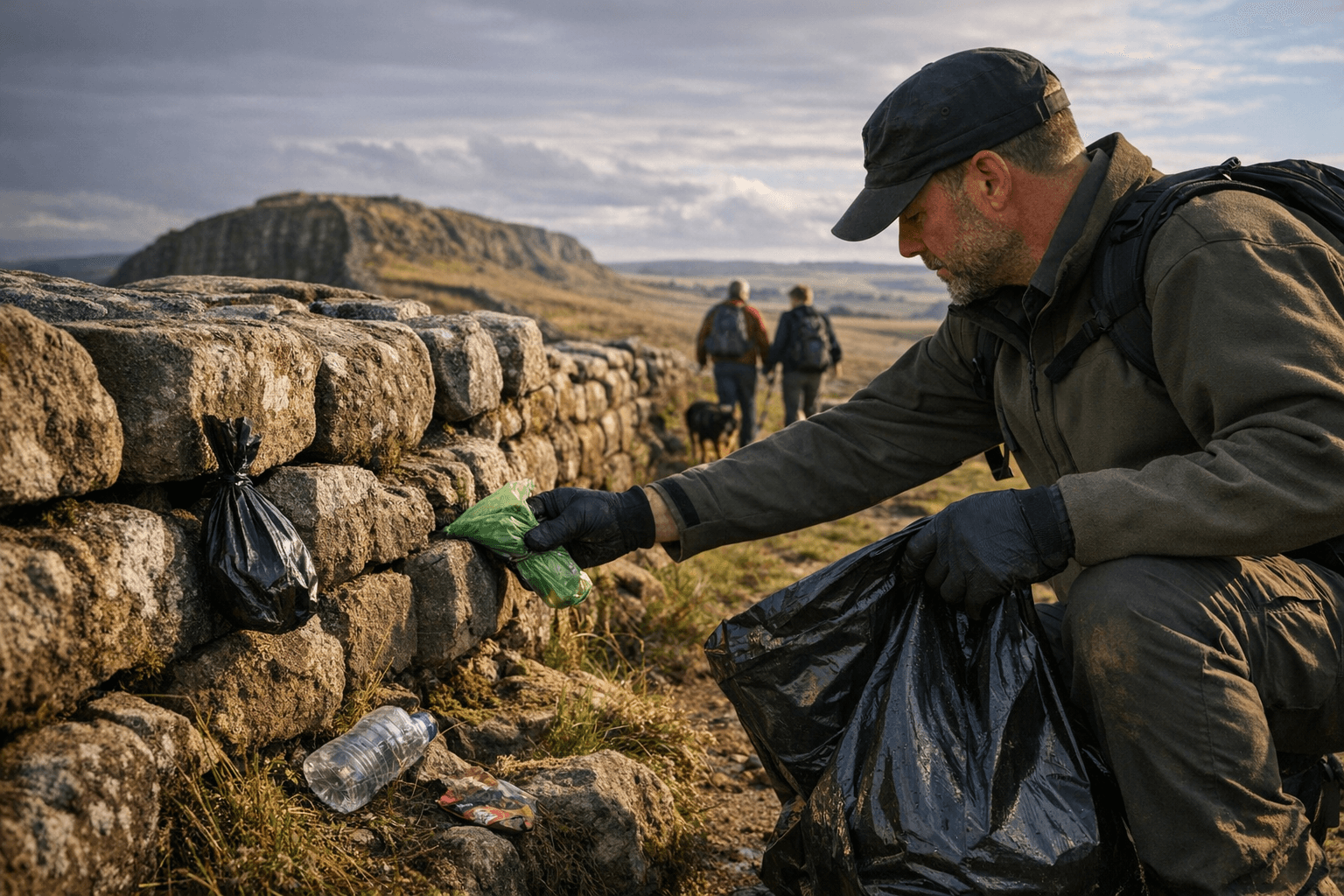
The National Park Authority has deployed its "Take the Lead" campaign, using signage at popular trailheads and social media to reinforce the message at peak walking periods, particularly during spring when visitor numbers climb and livestock are in the fields. The campaign encourages dog owners to keep animals on leads, stick to designated paths, and carry waste out rather than abandon it.
The harm extends beyond the visual. Dog waste contains bacteria and nitrogen compounds that, at concentrated levels, can damage the soil microbiome around heritage stonework and suppress the rare plant communities that grow along the Whin Sill escarpment. The wall's UNESCO designation, awarded in 1987, places additional obligations on its custodians to demonstrate active protection, and each season of accumulated neglect tests that commitment against the scale of the visitor footfall it cannot realistically police.
Enforcement options along a 73-mile open-access corridor are limited. Ranger presence is episodic rather than continuous, and fixed-penalty notices for fouling offences depend on an officer witnessing the act. The practical reality leaves education and social pressure as the primary tools, a fact Anderson's morning walk along Steel Rigg makes plain every time she passes a bag wedged where a Roman stone once sat unmolested for nearly two millennia.
This article was produced by Prism’s automated news system from verified source data, official records, and press releases, then run through automated quality and moderation checks before publishing. The system is built and supervised by the people who set the standards it runs under. Read our full AI policy.
Did this article answer your question?