NTSB finds geese likely struck helicopter before Hudson River crash
Geese remains on the rotor blades point to a bird strike in the Hudson River helicopter crash, not just a midair breakup. The Bell 206 L-4 carried six people, and none survived.
Remains from at least two birds were found on the helicopter’s rotor blades, and investigators also found several geese on the left horizontal stabilizer of the Bell 206 L-4 that went into the Hudson River near Jersey City, New Jersey. One witness told investigators that a large flock of geese took flight just minutes before the crash.
The sight-seeing helicopter crashed on April 10, 2025, carrying a single pilot, two adults and three children. All six people aboard were killed, including a family of five from Spain. The National Transportation Safety Board said the aircraft was not equipped with flight recorders, leaving investigators to piece together the sequence from wreckage, witness accounts and photos on the board’s investigation page, including an image of the main rotor from the crashed helicopter.
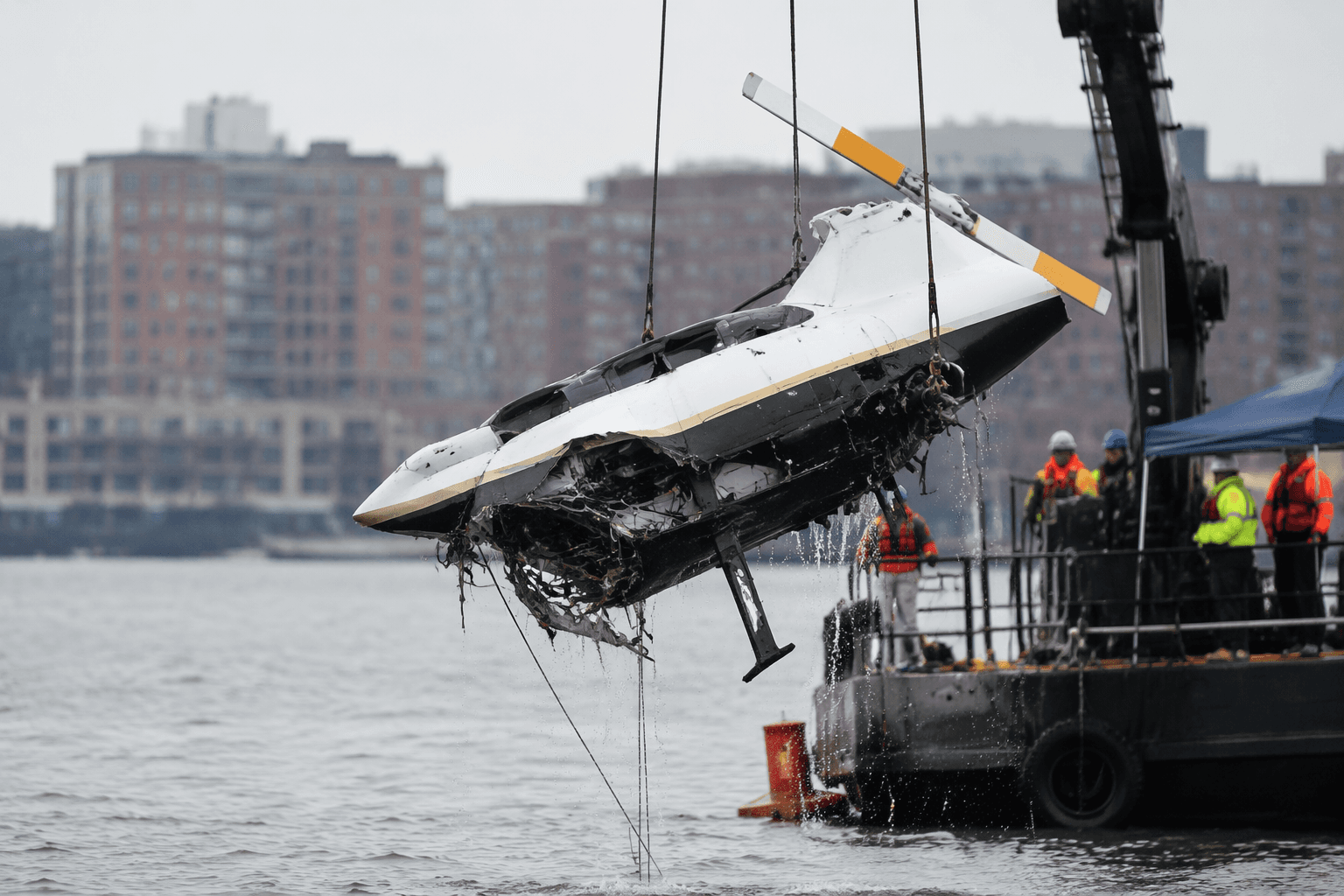
The FAA’s wildlife strike database logged 14,496 strike reports in 2017, nearly 17,000 in 2022 and about 19,400 in 2023 at 713 U.S. airports. In the New York area, where helicopters share low-altitude airspace with dense traffic, bridges, waterways and migratory birds, the Hudson corridor has long been managed as a tightly controlled flight environment.
Those controls are built mainly around aircraft separation and operating discipline. The FAA’s Hudson River and East River Special Flight Rules Area requires pilots to stay familiar with current charts, keep airspeed at no more than 140 knots and use anti-collision, navigation and landing lights under the published procedures. The rules help manage congestion, but the wildlife risk remains on sightseeing flights skimming the river and shoreline, where large birds can lift off without warning.
New York Helicopter later shut down after the deadly crash. The board has not yet announced a final cause.
This article was produced by Prism’s automated news system from verified source data, official records, and press releases, then run through automated quality and moderation checks before publishing. The system is built and supervised by the people who set the standards it runs under. Read our full AI policy.
Did this article answer your question?