NYFW Fall 2026 Introduces Rising Talent Including Andrew Curwen, YH Studios
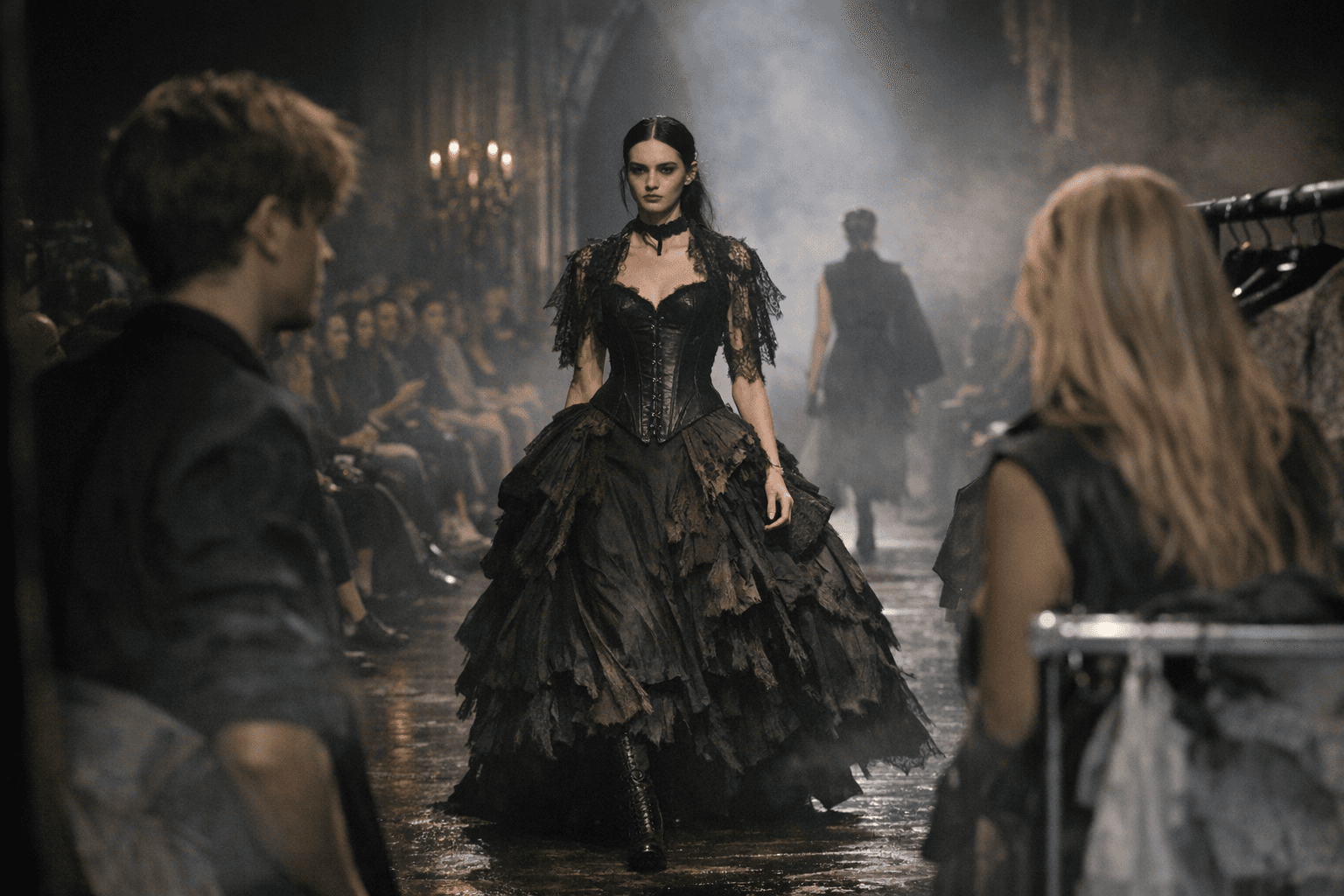
Andrew Curwen staged his first official NYFW show with a Gothic, moth-eaten aesthetic - bustle-back skirts, kidskin corsets, wool-forward tailoring and a poem titled "Sonnet No. 2."

WWD’s Ones-to-Watch roundup singled out Andrew Curwen and YH Studios among six emerging names, and Curwen’s Fall/Winter 2026 presentation delivered the kind of dark, exacting vision that earns that attention. WWD wrote that “creatures of the night” would stalk his runway, from “the warden to the widow,” and the show leaned hard into decay and Gothic romance with moth-eaten tulle and taffeta sculpted into bustle-back skirts snatched by kidskin corsets.
Curwen leaned materiality against narrative. Officemagazine reported that wool was brought to the forefront for Autumn-Winter 2026, balanced by silk tulle, taffeta, and kid skin to lend softness to aggressive shaping. The collection was accompanied by a poem titled “Sonnet No. 2,” and Officemagazine described imagery of “waking wounds, sown starlight, and a resounding pulse.” Curwen framed his construction precisely in Officemagazine’s words: “My ongoing fascination with re-proportioning the human form continues: shoulders sharpen and peak, waists draw inward, and the bustle reemerges, an echo pulled forward from 1887.”
The tonal palette matched the tailoring. W Magazine noted that Curwen’s clothes “don’t necessarily feel optimistic,” calling out a color story of black, gray, and oxblood red, and reporting Curwen saying, “We’re going more extreme,” and “It’s a little tense.” Harper’s Bazaar captured smaller details in the offering, including trousers and a red silk skirt trimmed with a white ruffle, evidence that Curwen mixes Victorian echoes with modern suiting and a keen eye for trim.
Curwen’s rise is personal as well as aesthetic. W Magazine traced his decision to start his own label to John Galliano’s final Maison Margiela show in 2024, writing that Curwen feared he had become “some jaded, bitter queen who wasn’t inspired by fashion anymore” before that moment and then “realized the hunger was still there.” Born in Lake Placid and moved around by a parent’s military postings, Curwen began last year with an 11-piece collection, worked shifts at Beacon’s Closet, and assisted Parsons contemporaries Jane Wade and Elena Velez. His debut included a tiered cotton voile ruffle skirt and a sheer corseted top bearing his family crest; Curwen said of his research into family history, “I never felt like I had a home... The research helped me place my roots.”
Behind the scenes the show nearly unraveled. Harper’s Bazaar reported that a venue fell through a week out and that Curwen and his team rallied to find something better. WWD captured his backstage sentiment: “My favorite part is the electric atmosphere backstage with my team, seeing months of hard work finally come to life.” Harper’s Bazaar further noted Curwen’s reliance on a support system and rituals to manage pressure, including calls to mentor Jane Wade and, in his words, “the Hail Mary is to always call mom.” W Magazine also observed industry notice, writing that Lady Gaga “was seen wearing an Andrew Curwen last year.”
WWD’s Ones-to-Watch list names YH Studios alongside Curwen but the excerpt supplies no descriptive context beyond a fragment that reads, verbatim, “Containers at the Port of Southampton in England.” TeenVogue’s Fall/Winter 2026 roundtable framed Curwen among four designers breathing life back into NYFW—Meruert Tolegen, Andrew Curwen, Zoe Gustavia Anna Whalen, and Keith Herron of Advisry—underscoring that this season’s momentum favors designers willing to marry narrative, craft, and risk. If his February 11 presentation was any indication, Curwen intends to push corsetry, reworked tailoring, and Gothic storytelling further into the spotlight.
Know something we missed? Have a correction or additional information?
Submit a Tip