Olivia Munn's Breast Cancer Story Inspires Other Women to Get Life-Saving Screenings
Olivia Munn's 37% lifetime cancer risk score, flagged after a clean mammogram, has since triggered diagnoses in both her mother and a TV reporter preparing to cover Munn's story.
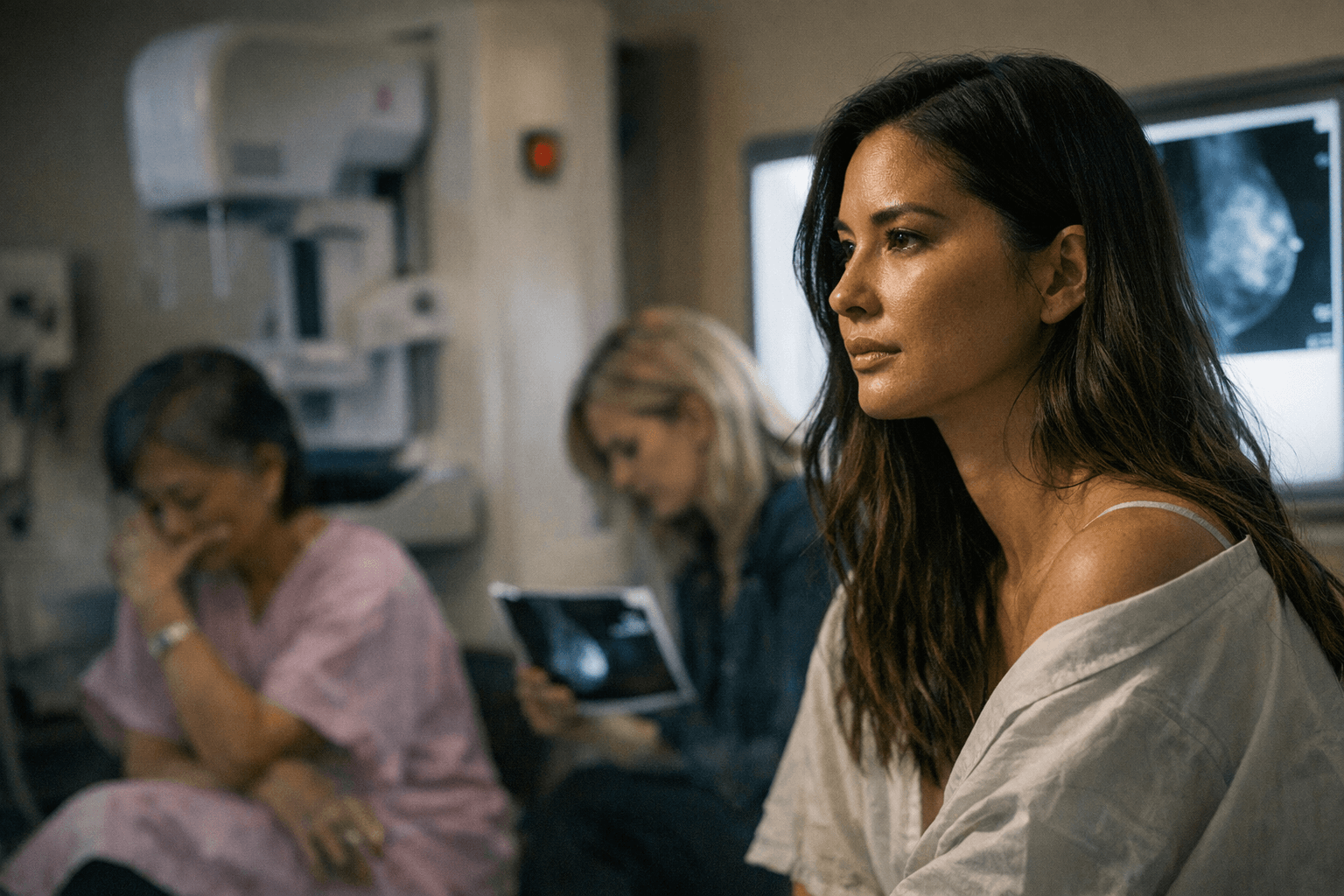
Alison Hall was preparing the segment when she became the story. The "Inside Edition" correspondent had decided to take a breast cancer risk assessment, planning to use it as a reporting prop to raise awareness about Olivia Munn's cancer battle. The test led to a six-month screening schedule of mammograms and MRIs; an MRI flagged an abnormality; biopsies confirmed what Hall described as "surreal" news. Her doctor framed it as the best possible version of a bad result: "This is actually good news. It's stage zero, the earliest it could possibly be caught."
Hall announced in January 2025 that she would undergo a double mastectomy. "By Olivia sharing her story, she had a direct impact on my life," she said.
That direct line from one woman's social media post to another woman's surgical suite is now a documented pattern. Munn was diagnosed with Stage 1 luminal B breast cancer in both breasts in April 2023, roughly two months after a clean mammogram and despite testing negative on multiple genetic screening tests. The diagnosis happened only because her OB/GYN, Dr. Thaïs Aliabadi, decided to calculate Munn's Breast Cancer Risk Assessment Score. The result came back at 37% lifetime risk. Aliabadi ordered an MRI and ultrasound; the imaging found tumors that would have been invisible on a standard mammogram for another full year. Munn had a double mastectomy 30 days after diagnosis. "In the past 10 months I have had four surgeries, so many days spent in bed I can't even count and have learned more about cancer, cancer treatment and hormones than I ever could have imagined," she said.
The risk assessment tool is a free online calculator built around a National Cancer Institute statistical model. It takes about five minutes and estimates a woman's probability of developing invasive breast cancer over the next five years and across her lifetime up to about age 90. A first-degree relative diagnosed with breast or ovarian cancer, a personal history of biopsies returning abnormal cells, or dense breast tissue are all reasons to ask a physician about getting scored. Munn's case makes one point especially clearly for women who have already received genetic testing: a negative BRCA result does not rule out elevated lifetime risk. She tested negative on several genetic screens before her score revealed a 37% threshold that standard annual scheduling would have missed entirely. A score above roughly 20% is generally sufficient to trigger supplemental MRI screening on a more compressed schedule, as it did for Munn, her mother, and Hall.
The ripple reached Munn's own household. After going public, she pressed her mother, Kim Munn, to take the assessment. Kim's score returned at 26.2%. Her mammograms were normal. But an MRI ordered because of that score found Stage 1 HER2-positive breast cancer, a fast-growing and invasive form of the disease. Kim Munn completed 12 rounds of chemotherapy and continued monthly Herceptin transfusions, with treatments running into fall. She underwent a double mastectomy as well.
Dr. Nicole Saphier, a board-certified breast imaging radiologist and associate professor at Memorial Sloan Kettering Cancer Center in New York City, said Dr. Aliabadi had done precisely what the broader system too often skips. "Olivia Munn's doctor may have saved her life by doing so," Saphier said, adding that she recommends individual risk assessments to her own patients and referring clinicians routinely.
The survival data shows exactly what is at stake in that five-minute calculation. When breast cancer is diagnosed at its earliest, localized stages, the five-year relative survival rate exceeds 99%, according to the American Cancer Society. At stage four, that figure falls to 33%. All three women in Munn's story were diagnosed at stage one or earlier. None would have been without the risk calculator.
John Mulaney said as much on CBS Sunday Morning in March 2025. "It is really the only reason her cancer was discovered," he said of the calculator. "Seeing so many women, publicly and privately, come to her that they discovered how high their risk was because of that. It's astonishing."
Munn had put it more personally on "The Kelly Clarkson Show" in May 2024: "I had no idea how healing it would be to come out with my story and to see how many women have gotten this test and how many women's lives this could save.
This article was produced by Prism’s automated news system from verified source data, official records, and press releases, then run through automated quality and moderation checks before publishing. The system is built and supervised by the people who set the standards it runs under. Read our full AI policy.
Did this article answer your question?