Pahalgam tourism struggles to recover a year after deadly attack
A year after the Baisaran meadow attack, Pahalgam is still fighting for trust, bookings, and livelihoods. The coming Amarnath yatra may decide how quickly tourism can recover.
A fragile reset in a valley built on movement
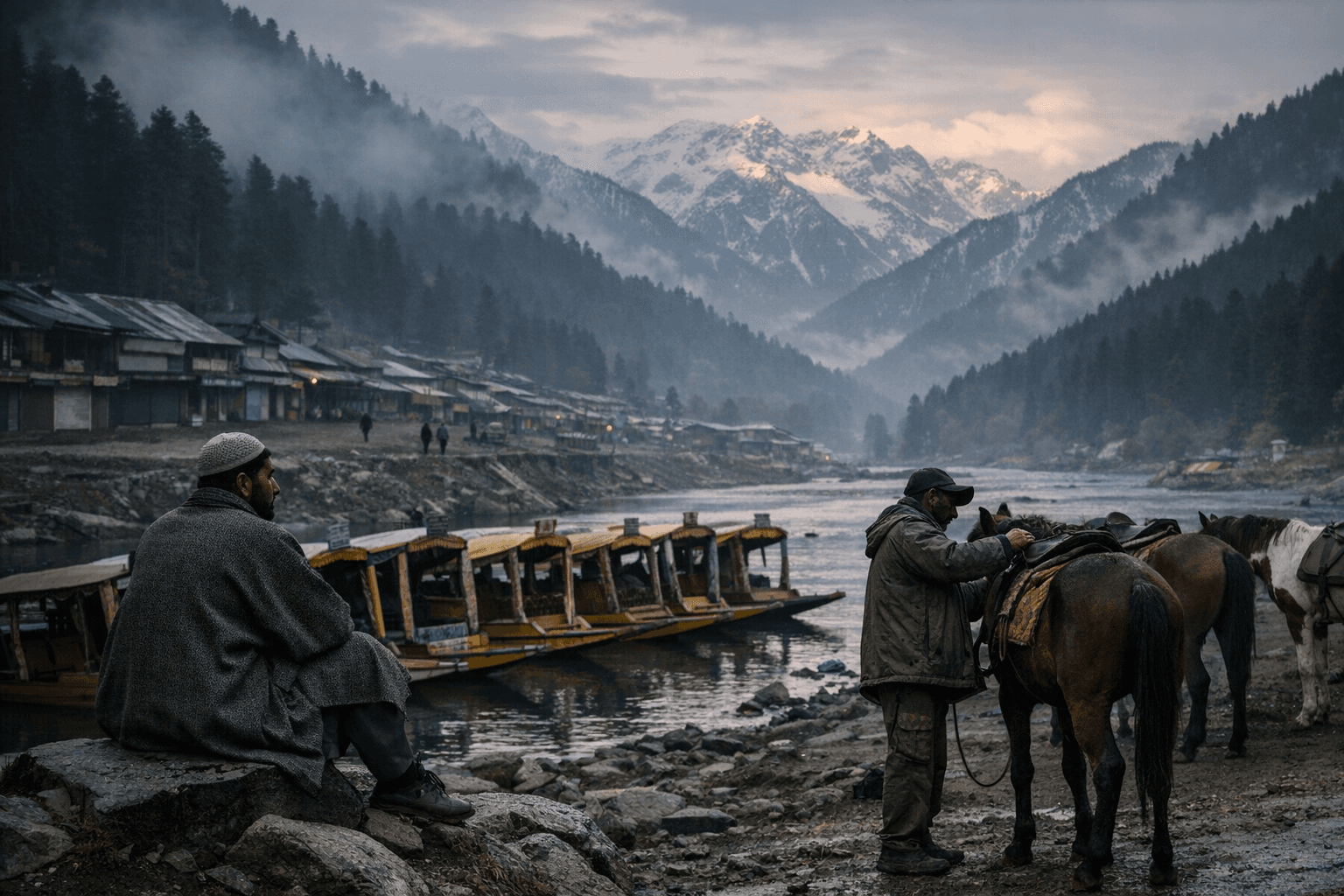
Pahalgam’s pine forests, grassy slopes and steep ravines still draw the eye, but the town’s economy remains stuck between promise and fear. A year after the April 22, 2025 attack in Baisaran meadow killed 26 people, including two foreign tourists, the question is no longer whether the shock was severe. It is whether visitors, transport workers, hotel owners and pilgrims believe enough safety has returned to make a trip worthwhile.
That uncertainty matters because Pahalgam is not just another resort town in Kashmir. It is a base for Hindu pilgrimages and a critical stop on the traditional route to the Amarnath cave shrine, with the Shri Amarnathji Shrine Board listing the path as Jammu, Pahalgam, Chandanwari, Pissu Top, Sheshnag, Panchtarni and the Holy Cave. In practical terms, that makes Pahalgam both a spiritual gateway and an economic hinge for hotels, taxis, pony services and roadside vendors.
Why the town’s recovery is tied to the pilgrimage economy
The recovery story in Pahalgam cannot be separated from the annual Amarnath yatra. When that route is crowded, the rest of the local tourism economy tends to move with it: rooms fill, taxi stands stay busy, and ponywallahs find work taking pilgrims and sightseers up the valley. When confidence breaks, the slowdown ripples through every link in the chain.
That is why the town’s tourism rebound is being watched so closely by the Jammu and Kashmir Tourism Department, the Travel Agents Association of Kashmir, and business operators such as Farooq A. Kuthoo. It is also why officials including Manoj Sinha and Vikram Misri remain part of the wider public conversation around security, reassurance and the reopening of normal travel routines. In Pahalgam, the difference between a strong season and a weak one is measured not in abstractions but in rooms booked, vehicles hired and pilgrims arriving on schedule.
The numbers show how sharp the fall has been
The scale of the disruption is visible in the visitor counts. Kashmir’s tourism sector reached a record 34,98,702 visitors in 2024, according to reports citing official data. By contrast, official data cited in March 2026 reports put 2025 arrivals at about 11.16 lakh, a drop that captures how deeply the attack and its aftermath hit confidence across the valley.
Pahalgam itself has seen the slowdown in even starker local terms. One report said the town recorded 4,30,495 domestic tourists from May 2025 to April 15, 2026. That is far below the earlier annual footfall of roughly 12 to 15 lakh visitors, and well under the pre-attack monthly average of about 1 to 1.1 lakh. In a destination that depends on constant movement through a short peak season, that gap has left a long shadow.
What the slump means on the ground
For many people in Pahalgam, the recovery has been uneven enough to feel stalled. Business operators say the attack triggered a sharp drop in bookings and a wave of cancellations across Pahalgam and nearby sightseeing circuits, with several spots temporarily closed and later reopened under tighter security. The scenery has not changed, but the feeling of ease has.
The livelihoods tied to tourism have borne the cost. Taxi drivers report idle vehicles, hotel owners face thinner occupancy, and ponywallahs are still counting on a rebound that has not fully arrived. One report said about 5,500 ponywallahs in the area depend on tourism, a reminder that the town’s visitor economy is not an abstract sector but a network of families and daily wages. When travelers hesitate, the impact lands immediately on people who cannot wait out a weak season.
The Amarnath yatra is the clearest test ahead
The annual Amarnath yatra remains the most important indicator of whether Pahalgam can move from trauma back toward routine. In 2025, the pilgrimage went ahead despite the attack and still crossed the four-lakh mark, a sign that some religious travel demand remained resilient even under extraordinary pressure. That resilience matters, but it does not erase the broader erosion in leisure and sightseeing traffic.
The 2026 yatra now carries even more weight. Registrations opened on April 15, and the pilgrimage is scheduled to begin on July 3 and end on August 28. For local businesses, that window is more than a calendar entry. It is the best chance to show that the security environment is stable enough for pilgrims and tourists to commit again, and that the town can host large flows of visitors without renewed fear.
Confidence, security and livelihoods remain linked
This is the central tension in Pahalgam’s recovery: official claims of normalcy have to compete with the day-to-day caution of travelers and the financial stress of local workers. A town that once depended on routine movement now depends on reassurance, and reassurance depends on visible security, predictable access and a steady stream of arrivals. That is why the next pilgrimage season is being treated as more than a religious event.
If the yatra proceeds smoothly and arrivals begin to recover, hotel owners, taxi operators and ponywallahs may finally see a broader turnaround. If hesitation persists, Pahalgam will continue to serve as a case study in how a single attack can reshape an entire tourism economy long after the immediate headlines fade. The year since Baisaran has shown that in this valley, recovery is not declared. It has to be earned, visitor by visitor.
This article was produced by Prism’s automated news system from verified source data, official records, and press releases, then run through automated quality and moderation checks before publishing. The system is built and supervised by the people who set the standards it runs under. Read our full AI policy.
Did this article answer your question?


