Pakistan’s Dadu district faces repeated floods, drought and displacement
In Dadu, shade is survival: floods, drought and record heat keep forcing families to rebuild, dig deeper for water and live with tents, disease and displacement.

In Dadu district, shade is not a comfort. It is the difference between a day that can be worked and a day that can push people toward illness, lost income, or displacement. On the western side of the Indus River in Sindh, where a mountain range separates the district from Balochistan, families have spent generations relying on agriculture and livestock, only to see floods, drought, sandstorms and soaring heat upend the routines that once held life together.
A district where the climate has become the hardest part of daily life
Dadu’s climate stress is not a single emergency, but a repeating cycle. Unpredictable rains can arrive after long dry spells, then disappear again, leaving cracked fields and empty wells. The district has faced particularly brutal floods in 2010, 2020 and 2022, and each one has left a deeper mark on housing, schools, hospitals, markets and the food economy that depends on them.
That pattern matters because it strips away the basics needed to stay put. When homes are damaged, classrooms close, clinics stop functioning and markets wash away, recovery is not only about rebuilding structures. It is about whether a farming family can still work the land, whether drinking water is nearby, and whether there is any place left to rest out of the sun.
When floodwater reaches every part of life
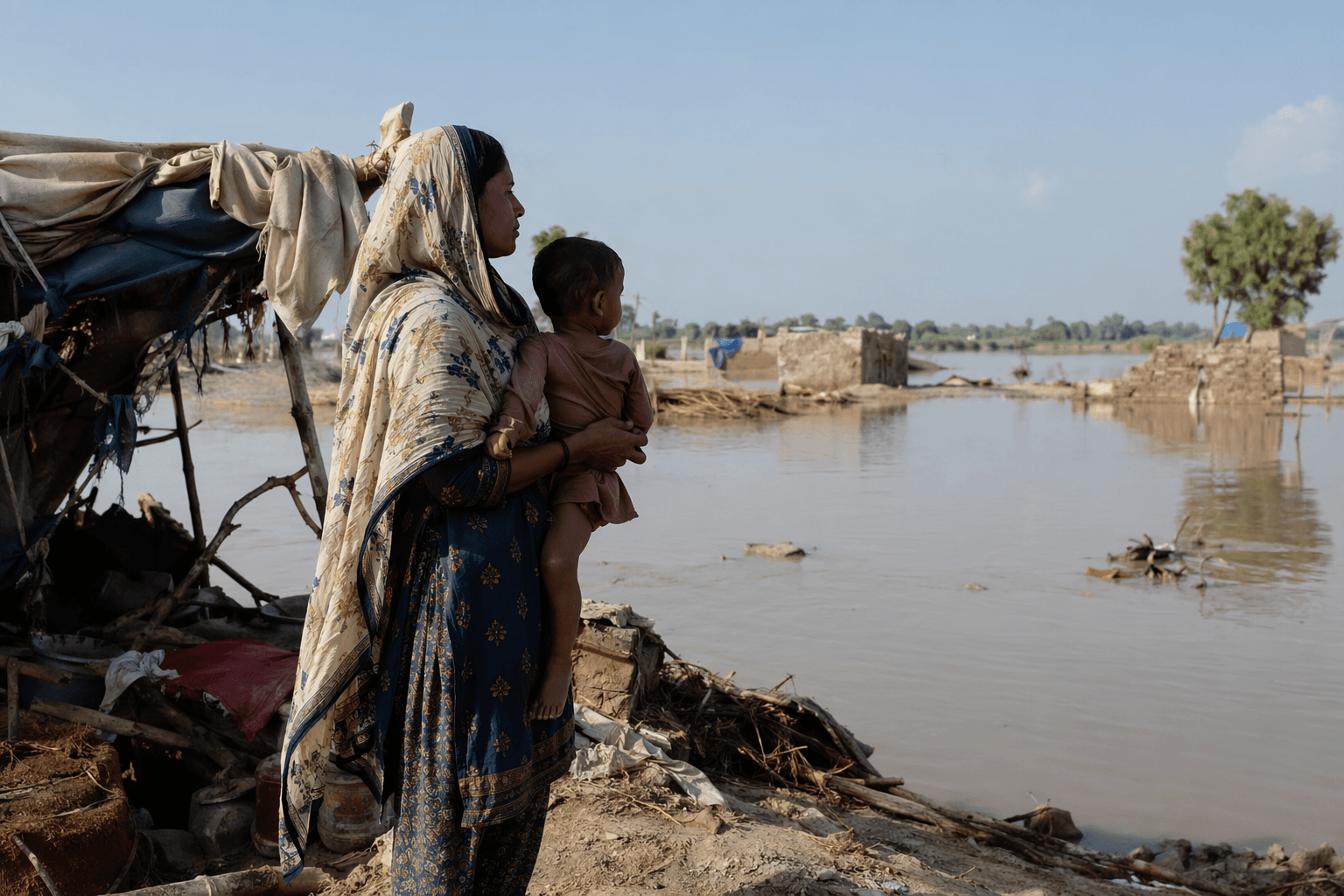
The 2022 floods were among the most destructive disasters Pakistan has faced. Record monsoon rains affected 33 million people, forced nearly 8 million from their homes and caused almost $15 billion in damage. Sindh was hit especially hard, with more than two million homes fully or partially damaged, and Dadu was among the districts severely inundated.
A flood map from PDMA Sindh dated 6 September 2022 showed the scale of the destruction in stark numbers. Dadu district covers 8,032 square kilometers, and 1,979.26 square kilometers were under water. The map showed 58 of 61 union councils affected, a district population of 1,478,068 according to the 2017 census, and 405,296.88 acres of cropland inundated. Those figures translate into a lived reality of ruined harvests, damaged livelihoods and communities cut off from the services they depend on.
Flooding in Dadu is not only about standing water. It is about what comes after the water retreats: broken roads, contaminated wells, livestock losses and the slow dismantling of a local economy built around land and labor. In places where agriculture and livestock are central to survival, every flooded acre pushes families closer to debt, hunger and migration.
What the search for shade means when heat becomes extreme
The heat now adds another layer of pressure. On May 30, 2026, Dadu recorded 51.5 degrees Celsius, a new temperature record and the hottest place in Pakistan that day. That is about 125 degrees Fahrenheit, hot enough to make shade the most valuable resource in the district.
This kind of heat does more than make people uncomfortable. It changes when work can be done, how long someone can stand outside, and how much water a body needs just to keep going. In a district already strained by drought and damaged infrastructure, extreme heat turns simple movement into a test of endurance.
The record also shows how quickly Dadu’s climate baseline has shifted. The previous highest temperature reported for the district was 51.4 degrees Celsius on 18 May 2016, a reminder that what was once rare is now being repeated and surpassed. For people trying to farm, haul water, care for children or sleep through the afternoon, the search for shade is increasingly the search for safety.
Water is getting deeper, and harder to reach
The heat and drought are changing the underground as well as the surface. Local reporting in 2025 described Dadu residents as increasingly unable to sustain farming because the water level is dropping every year. One farmer said drinkable water that used to be found at 25 to 35 feet now often has to be sought at 55 to 65 feet.
That shift is more than a technical detail. Deeper water means more digging, more pumping, more cost and more uncertainty for households already coping with climate shocks. It also means that the most basic needs, drinking, cooking and washing, are becoming harder to meet in the very places where people are expected to stay and rebuild.
When water disappears from familiar depths, the whole community feels it. Crops suffer first, then livestock, then the people who depend on both. The result is a slow squeeze that can make migration seem less like a choice than the only remaining adaptation.
Floods leave behind tents, disease and a long recovery
By late 2024, Amnesty International said major flooding in Sindh had displaced more than 140,000 people, many of them living in tents, with disease, food insecurity and lost livelihoods still widespread in Dadu and Badin districts. Amnesty visited eight flood affected villages in Badin and Dadu in late September 2024 and interviewed 36 people, finding that malaria, skin infections, diarrhoea and vomiting were common.
Those health risks fall hardest on children, older people and pregnant women. Tents offer little protection when heat rises, water is contaminated and mosquitoes spread disease, and temporary shelter can become a long term condition when reconstruction stalls. In that sense, flood recovery in Dadu is also a public health issue, because the failure to restore housing, sanitation and clinics quickly becomes a medical emergency.
The district’s repeated disasters also reveal a larger social inequity. Families with savings can sometimes move, rebuild or deepen wells. Families without money remain exposed in the hottest months, in the most flood prone ground and in the places where the water has already gone too deep to reach easily.
Why Dadu is becoming a migration story
A 2024 study examining how climate hazards are pushing people from Dadu District to move elsewhere points to the district’s growing role as a place of departure as much as survival. That pressure comes from all directions at once: floods that erase assets, drought that drains farms, heat that limits labor and water scarcity that makes every season more fragile than the last.
What emerges is a clear picture of climate adaptation on the ground. It is not an abstract debate about temperature records. It is a daily struggle over shade, shelter, safe water, access to healthcare and whether the next season will demand another evacuation or another move away from home. In Dadu, resilience is being measured one flood, one heatwave and one deeper well at a time.
This article was produced by Prism’s automated news system from verified source data, official records, and press releases, then run through automated quality and moderation checks before publishing. The system is built and supervised by the people who set the standards it runs under. Read our full AI policy.
Know something we missed? Have a correction or additional information?
Submit a Tip