Paramount Secures $24 Billion in Gulf Funding for $81 Billion Warner Bros. Deal
Gulf sovereign wealth funds from Saudi Arabia, Qatar, and Abu Dhabi have committed $24 billion to back Paramount Skydance's $81 billion takeover of Warner Bros. Discovery, raising sharp questions about foreign influence over CNN and HBO.
Paramount Skydance has secured roughly $24 billion in equity commitments from three Gulf sovereign wealth funds: Saudi Arabia's Public Investment Fund, the Qatar Investment Authority, and Abu Dhabi's Investment Authority. The capital forms the financial backbone of Paramount's $81 billion all-cash takeover of Warner Bros. Discovery, a deal that would bring CNN, HBO, Max, and the Discovery cable portfolio under a single ownership structure anchored, in part, by Middle Eastern state money.
The commitment was disclosed in SEC filings, which confirmed that as of early December the aggregate from the three funds reached $24 billion. Paramount has stated in those filings that the sovereign investors "have agreed to forgo any governance rights, including board representation, associated with their non-voting equity investments," and has argued on that basis that the transaction will not fall within CFIUS jurisdiction. CFIUS, the Committee on Foreign Investment in the United States and led by the Treasury Department, is the interagency body responsible for reviewing foreign investments in American businesses for national security risks.
That self-exemption claim has not gone unchallenged in Washington. A group of seven Democratic senators, led by Senator Cory Booker in his capacity as ranking member of the Senate Judiciary Subcommittee on Antitrust, Competition Policy and Consumer Rights, has written to FCC Chairman Carr demanding a formal foreign investment review. The senators, who include Democratic Minority Leader Chuck Schumer, Minority Whip Dick Durbin, Richard Blumenthal, and Mazie Hirono, are asking the FCC to coordinate with CFIUS, the Justice Department's National Security Division, and relevant intelligence agencies before clearing any component of the financing. Their central concern is that the deal involves broadcast licenses for CBS, the news operations of CNN, and a scale of foreign capital that warrants independent scrutiny regardless of Paramount's governance assurances.
The editorial stakes are considerable. Netflix co-CEO Ted Sarandos, who had submitted a competing bid before his company withdrew, called the Gulf backing a "bad idea," describing the funds as coming from "a part of the world that is not very big on the First Amendment." Sarandos questioned how investors committing at that magnitude would remain passive over time, raising the possibility of eventual pressure on editorial decisions at CNN and HBO even absent formal board seats.
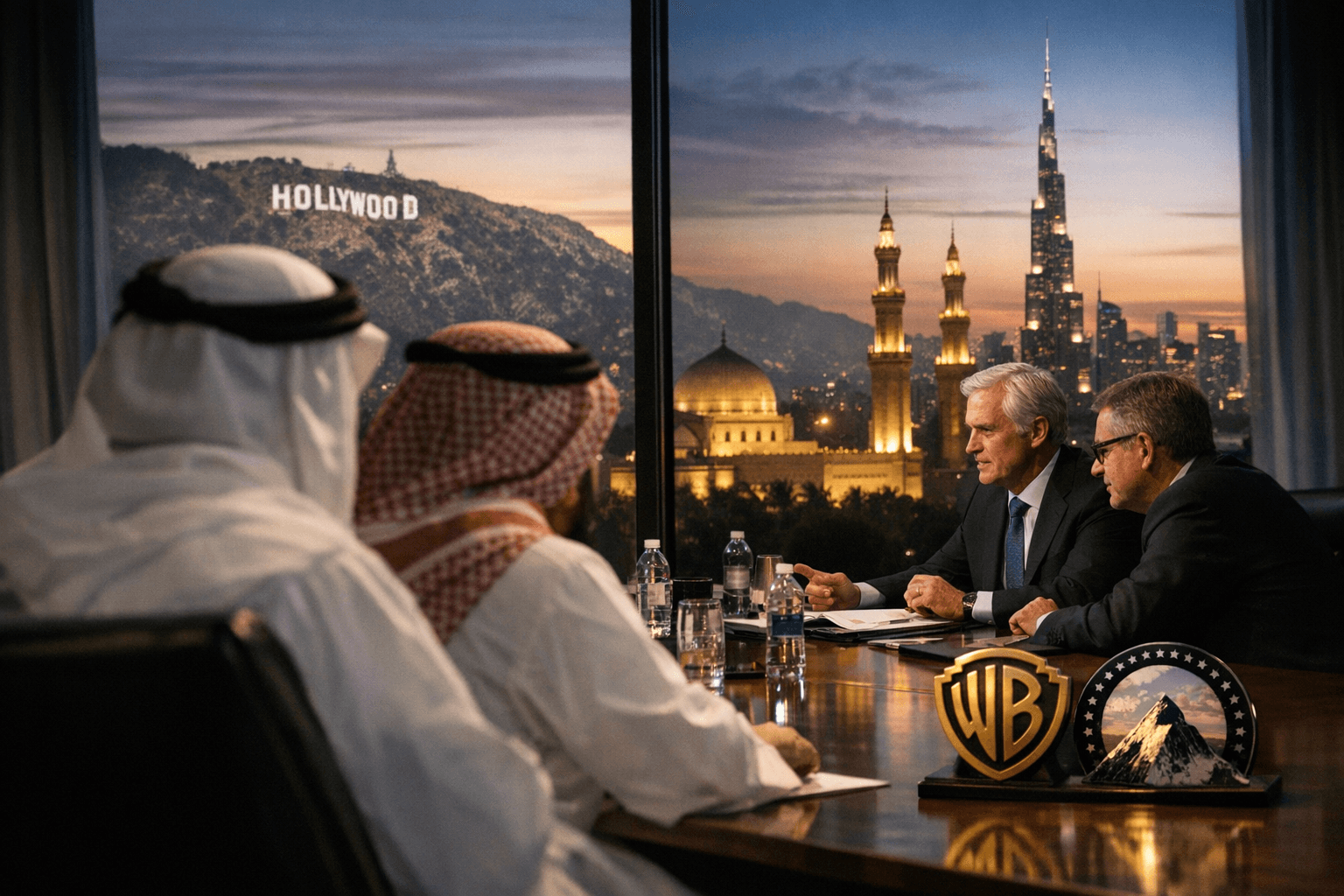
Geopolitical pressure is shaping the deal's timing as much as financial logic. Gulf funds have been actively recalibrating their American investment portfolios as the Iran War continues, and those shifting regional priorities appear to be influencing both the pace and structure of their Paramount commitments.
The path to this arrangement was not straightforward. Warner Bros. Discovery first signed a merger agreement with Netflix in December 2025, a deal that would have transferred WBD's studios and streaming assets while spinning off its linear cable networks. Paramount launched a rival all-cash tender offer days later and revised its proposal repeatedly over the following months. Netflix granted WBD a contractual waiver in February 2026, reopening negotiations, and WBD's board moved toward Paramount by late February.
For WBD's workforce, the consequences could be severe. Paramount and WBD have deep redundancies across news, sports, theatrical production, and streaming, and employees at CNN, TNT Sports, TBS, and the legacy Discovery networks face an uncertain future that a Netflix deal would have largely avoided. Netflix had pledged to leave HBO Max as a standalone service and not acquire the linear cable business at all. The Paramount structure offers no such protection, and with the Gulf funding now reportedly in place, the deal's remaining hurdles are regulatory rather than financial.
Know something we missed? Have a correction or additional information?
Submit a Tip