Peer-Reviewed Study Tests Sustainable Madder Dye Against Synthetic Red on Cotton
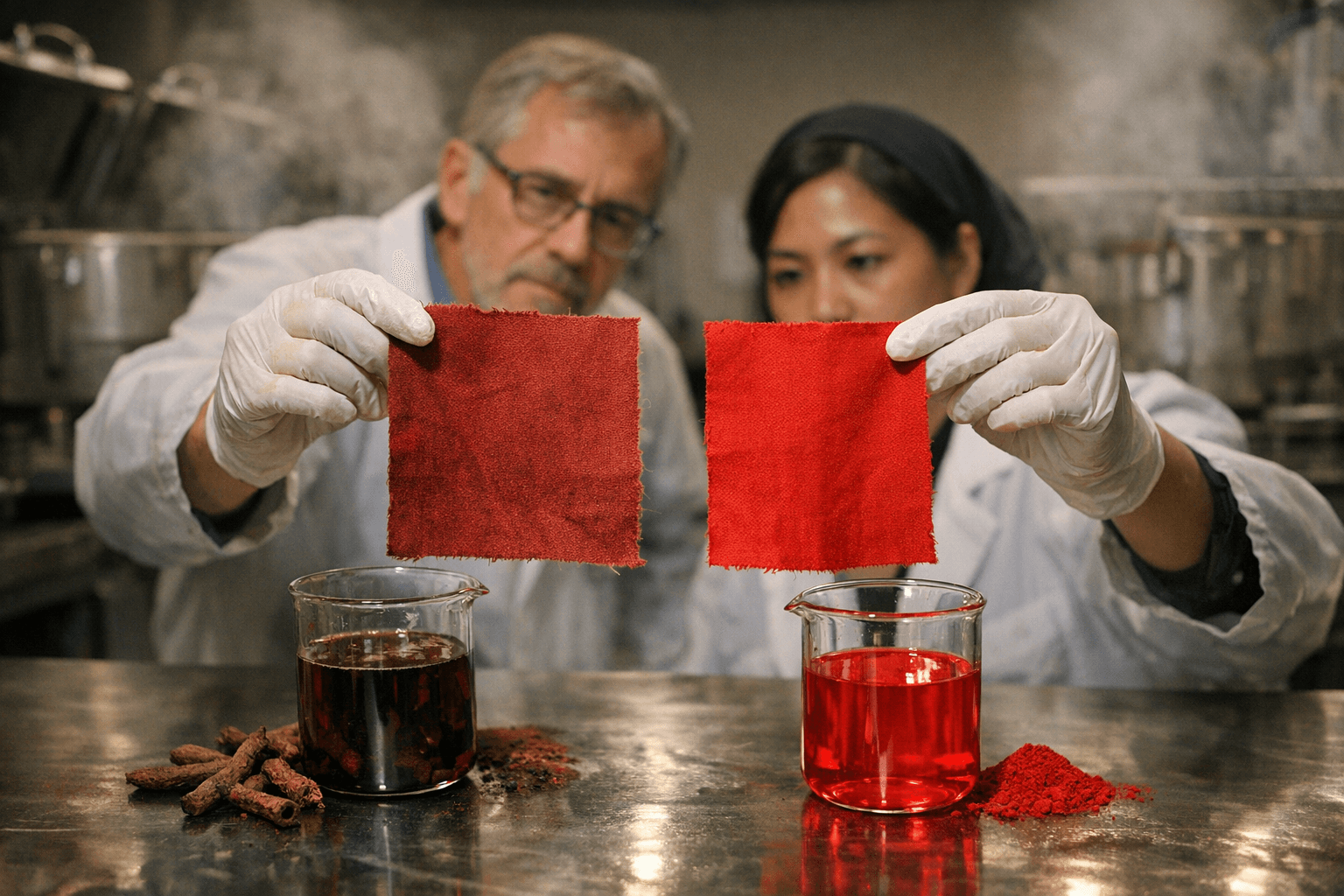
A peer-reviewed engineering study published 5 March 2026 ran a lab head-to-head: madder extract versus C.I. Direct Red 23 on cotton using tightly controlled exhaustion dyeing at target K/S ≈ 12.0.
A lab paper published 5 March 2026 set up a straight fight between madder extract, a traditional natural dye, and the synthetic C.I. Direct Red 23 on cotton, using tightly controlled exhaustion dyeing with a target K/S ≈ 12.0. The study is explicit about substrate, dyes, method and K/S target but the available excerpt cuts off before any measured outcome values are reported.
Parallel to that controlled experiment, Tunisian designers-researchers Jihen Trabelsi and Noureddine Baaka submitted and published a hands-on project in September 2025 titled "Using an Experimental Approach of Sustainable, Ecofriendly Natural Dyeing for The Creation of Sustainable Fashion Accessories." Their article, received September 07, 2025 and published September 18, 2025, documents dyeing textile fabrics such as wool, cotton and linen and mixing them with leather to make modern bags and accessories. As the authors put it, “under real-world conditions. The results demonstrated that the approach not only delivers environmentally responsible coloration but also meets the functional and aesthetic standards expected in contemporary fashion products.” They add that “This direct application highlights the potential of natural dyeing techniques to be integrated into commercial design practices, offering a viable and scalable alternative to conventional synthetic dye processes.”
Scaling those claims into production requires technical levers, and industry guidance flags the obvious: pretreatments matter. Rmcad cites enzyme pretreatment, cationization and scouring as critical steps and notes research in the Molecules journal showing that a combination of enzyme pretreatment, cationization and scouring can improve reactive dyeing. Rmcad also lists fixation pathways designers and mills should consider - Exhaust, Pad-Batch, Steam and UV/Chem-Free options - and warns that “There are different dye classes that bond with specific types of fiber, requiring dyehouses to research the materials of eco-friendly dyes so that they know which dyes will bond during the pigment printing process.”
The environmental stakes are blunt. Rmcad quotes Chemical & Engineering News: “traditional fabric dyes rely heavily on fossil fuels, and the industrial dyeing process uses trillions of gallons of water each year. In fact, these conventional dyehouses account for more than 20% of industrial water pollution worldwide.” That urgency is why manufacturers are tracking Key Metrics: Water, Energy, Chemicals and Effluent when they test natural-dye workflows.
Technological shortcuts are already showing dramatic wins in niche studies. A scientific review on natural dyes highlights microwave-assisted dyeing, noting that “energy is absorbed directly by the dye molecules, inducing their oscillation which in turn favors the diffusion of dye in the fiber structure.” In one polyester/henna study cited in the review, fixation, rate of dye uptake and dyeing time were reduced up to 60–65% compared to conventional heating. The same review points to supercritical carbon dioxide as a waterless solvent alternative that eases dye separation and cuts water use.
Design and production history matters too. Adjournal and cited authors note that “The application process of natural dyes is more difficult than that of synthetic dyes,” and Chang 2021 finds designers should “rely on [a] light color system” for plant dyeing in sustainable clothing. Adjournal also argues that “Only by combining traditional crafts with modern science and technology, can traditional crafts better survive and develop in the new environment,” and it documents artisans using CAD and engraving machines to digitize patterns for scale.
Putting this together, the picture is pragmatic: lab-level comparisons like the 5 March 2026 engineering study give controlled baselines (madder versus C.I. Direct Red 23 at K/S ≈ 12.0), Trabelsi and Baaka demonstrate applied accessory outcomes in September 2025, and industry playbooks from Rmcad plus microwave and CO2 innovations offer real scaling pathways. The missing piece is the hard numbers from the March 5 paper on washfastness, color coordinates and effluent; until those measured outcomes are published in full, madder looks promising and actionable for designers willing to pair traditional pigments with enzyme pretreatments, alternative fixation methods and low-water technologies to meet the Water, Energy, Chemicals and Effluent metrics brands now have to own.
Know something we missed? Have a correction or additional information?
Submit a Tip