Pentagon Weighs Sending Thousands of Troops to Middle East Amid Iran War
The 82nd Airborne's commander has been ordered to the Middle East as the Pentagon weighs deploying 3,000 paratroopers to potentially seize Iran's Kharg Island, handling 90% of its oil exports.
Maj. Gen. Brandon Tegtmeier, the chief of the 82nd Airborne Division, and his headquarters staff have been ordered to the Middle East as the Pentagon weighs its most significant ground escalation since the U.S.-Israeli war with Iran began on February 28 — a possible seizure of Kharg Island, the oil terminal that accounts for nearly all of Tehran's export revenue.
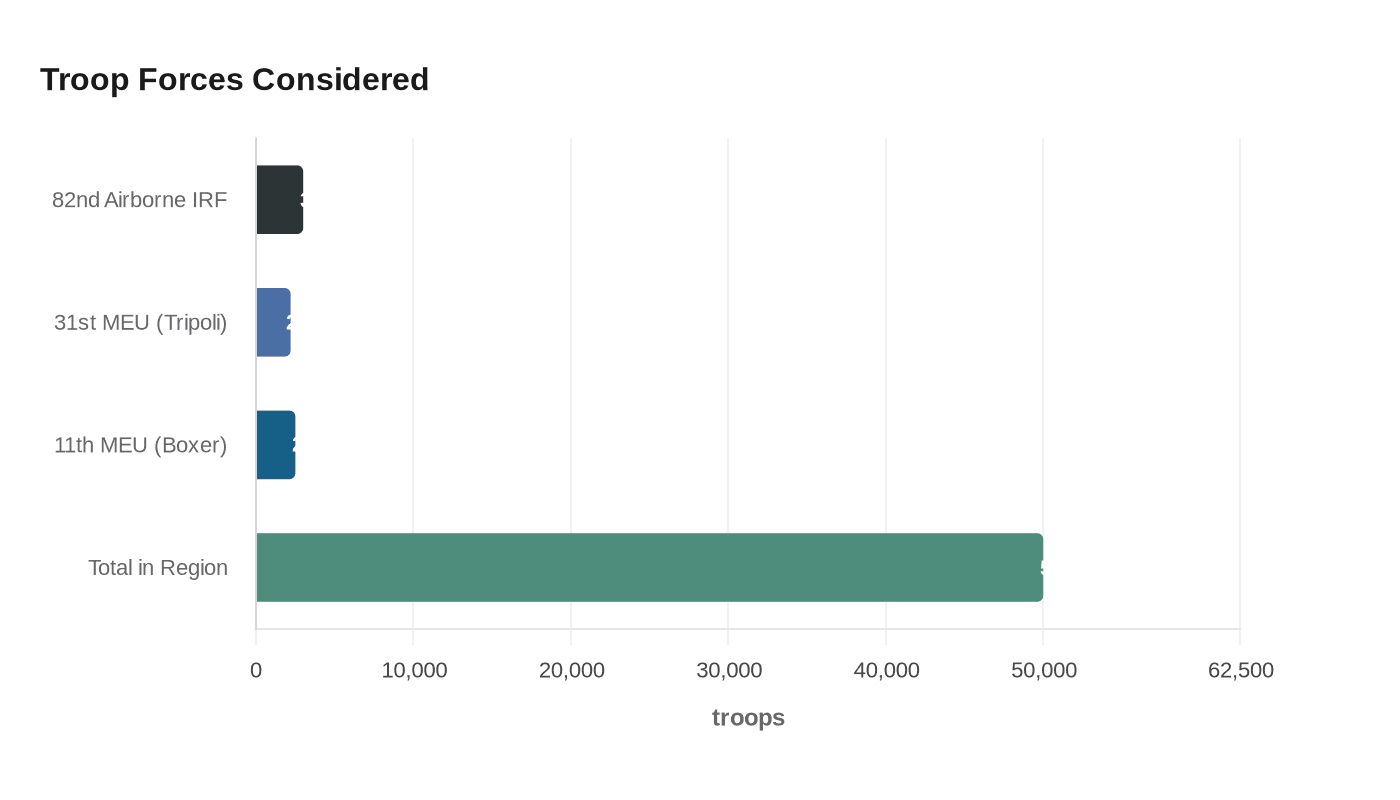
The combat forces under consideration would come from the 82nd Airborne's Immediate Response Force, a brigade of about 3,000 soldiers capable of deploying anywhere in the world within 18 hours, and these forces could be used to seize Kharg Island, Iran's main oil export hub. In early March, the Army abruptly canceled the 300-member headquarters's participation in an exercise at the Joint Readiness Training Center in Fort Polk, Louisiana, with Army officials saying they made the decision to keep the division's command element at Fort Bragg, North Carolina, just in case the Pentagon ordered the ready brigade to the Middle East.
Another possibility being considered, should President Donald Trump authorize U.S. troops to seize the island, is an attack by about 2,500 troops from the 31st Marine Expeditionary Unit, which is on its way to the region. The airfield on Kharg Island was damaged by recent U.S. bombing raids, so former U.S. commanders said it was more likely to first bring in Marines, whose combat engineers could quickly repair airfields and other infrastructure. Once the airfield is repaired, the Air Force could start flowing materiel and supplies, as well as troops, by C-130s. In that scenario, it is possible that troops from the 82nd Airborne would augment the Marines.
The naval buildup accompanying those deliberations is already underway. The Boxer Amphibious Ready Group left port in San Diego on Wednesday, ahead of schedule. The ready group includes the Wasp-class amphibious assault ship USS Boxer, the dock landing ship USS Comstock, and the amphibious transport dock ship USS Portland, and carries roughly 2,500 Marines of the 11th Marine Expeditionary Unit. Reuters reported that the troops departed the U.S. about three weeks ahead of schedule. The Japan-based amphibious assault ship USS Tripoli and the amphibious landing dock USS New Orleans are also crossing into U.S. Central Command, bringing roughly 2,200 Marines from the 31st Marine Expeditionary Unit. The Pentagon has said about 50,000 troops in the region are taking part in aspects of the attack on Iran.
The strategic prize at the center of these deliberations is unmistakable. The critical global shipping lane of the Strait of Hormuz has effectively been closed by Iran since the start of the U.S.-Israeli war, which began on Feb. 28. The administration has discussed sending ground forces to Kharg Island, which houses an oil depot that handles 90 percent of Tehran's oil exports. On March 13, Trump posted on Truth Social that Central Command "executed one of the most powerful bombing raids in the History of the Middle East, and totally obliterated every MILITARY target in Iran's crown jewel, Kharg Island." He added that he chose not to destroy the island's oil infrastructure "for reasons of decency," but warned: "should Iran, or anyone else, do anything to interfere with the Free and Safe Passage of Ships through the Strait of Hormuz, I will immediately reconsider this decision." Iran has warned that it would set oil and gas facilities in the Gulf nations "on fire" if a move against Kharg Island is made, and on Monday also threatened to retaliate by mining the Strait of Hormuz and all other waterways in the region.
Despite the accelerating deployments, the White House and Pentagon have maintained that no ground invasion order has been signed. A White House official, speaking on condition of anonymity, told Reuters: "There has been no decision to send ground troops at this time, but President Trump wisely keeps all options at his disposal. The president is focused on achieving all of the defined objectives of Operation Epic Fury: destroy Iran's ballistic missile capacity, annihilate their navy, ensure their terrorist proxies cannot destabilise the region, and guarantee that Iran can never possess a nuclear weapon." Trump himself told reporters Thursday, "No, I'm not putting troops anywhere. If I were, I certainly wouldn't tell you, but I'm not putting troops." White House spokesperson Anna Kelly followed the next day: "As President Trump said, he has no plans to send troops anywhere — but he wisely does not broadcast his military strategy to the media."
Pentagon officials described the military's actions as prudent planning, noting that nothing had been ordered by the Pentagon or U.S. Central Command, which declined to comment. The tension between those assurances and the tempo of actual deployments is not lost on former officials. Costa, who served as the Pentagon's principal civilian adviser for operational war planning and overseas force posture, told NBC News the United States is being cornered by Iran's closure of the Strait: "So we are in a problematic spot, where putting troops on the ground might be necessary to ensure access through Hormuz, which is far more dangerous for us." He added that Iran's stranglehold on the strait has made it far more difficult for the U.S. to end the war on its own timeline.
The deployments would mark an escalation in the conflict, during which at least 13 U.S. service members have been killed and approximately 200 wounded. Former director of the National Counterterrorism Center Joe Kent, who resigned from the post last week in protest against the U.S.-Israeli war on Iran, told the Washington Post that an American operation on Kharg Island "would be a disaster" and would amount to placing exposed troops on an island well within range of Iranian missiles and drones. Whether Trump ultimately issues the order may depend on whether Tehran blinks first on the Strait — a gamble with consequences measured in barrels of oil, American lives, and the credibility of a president who built his first term on a promise never to start another ground war.
Know something we missed? Have a correction or additional information?
Submit a Tip