Perseverance rover snaps selfie near Mars mission’s 1,800th sol
A 61-image selfie captured at Lac de Charmes showed Perseverance deep in Mars’ northern rim, where fresh abrasion on Arethusa exposed ancient igneous rock.
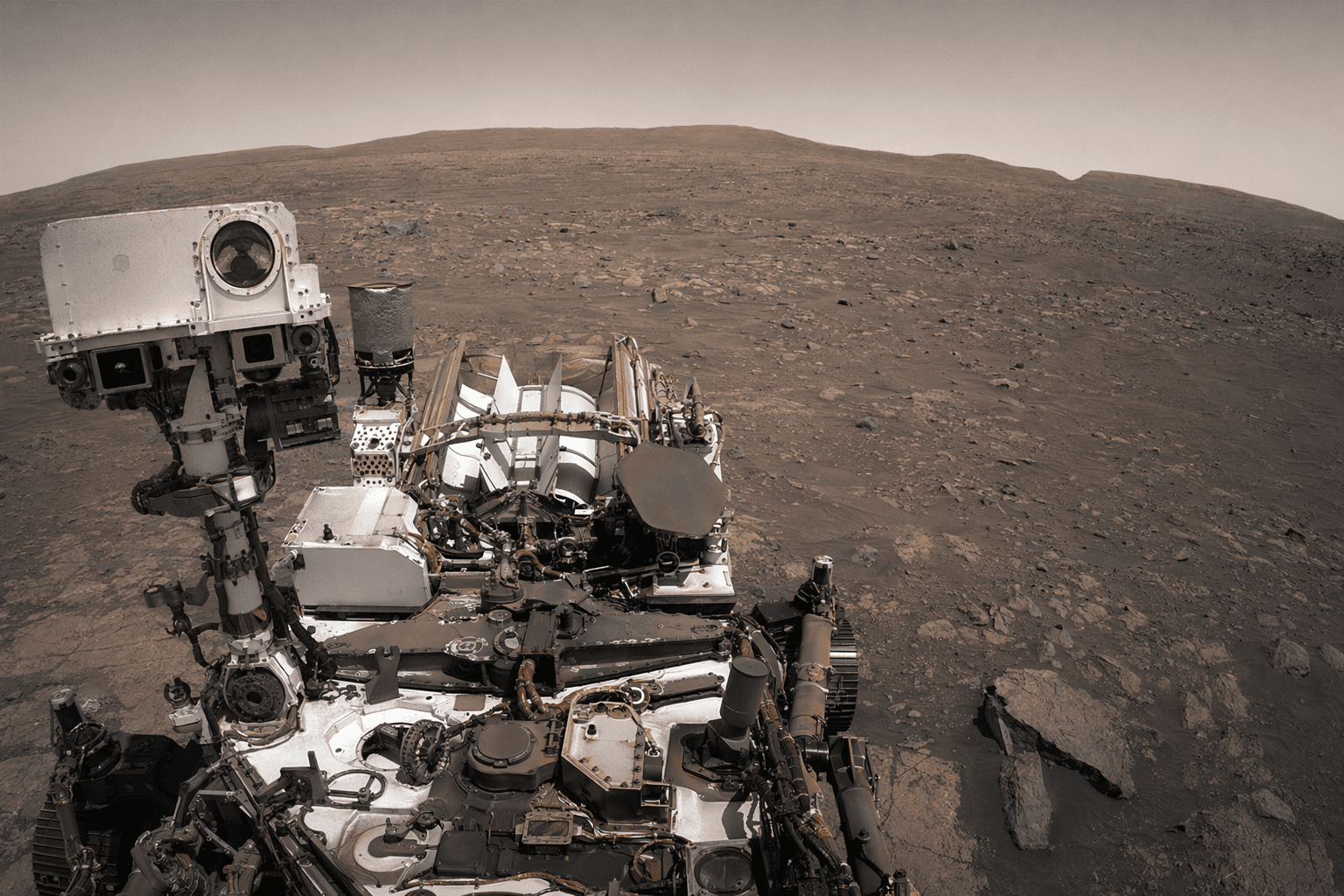
Perseverance paused near Lac de Charmes to turn its arm and stitch together a 61-image selfie, a snapshot taken as the rover closed in on its 1,800th Martian day and pushed deeper west beyond Jezero Crater.
The image, taken on March 11, 2026, came on sol 1,797 and marked the rover’s sixth selfie since landing on Mars in 2021. NASA said Perseverance used the WATSON camera at the end of its robotic arm to make 62 precision movements over about an hour, building the composite from 61 individual frames. What looks playful at first glance is also a status report: the rover is still functioning well enough to keep assembling precise image mosaics after nearly five Earth years on the surface.
The setting matters as much as the pose. Perseverance was working in the Lac de Charmes region during its deepest push west beyond Jezero Crater, as part of its fifth science campaign, the Northern Rim Campaign. NASA scientists said the terrain there is among the most scientifically compelling the rover has visited, with exposed rock and surface textures that can reveal how the crater rim and the older Martian landscape formed.
Just before the selfie, Perseverance abraded a rock outcrop nicknamed Arethusa, cutting a circular patch into the surface so scientists could inspect fresh material beneath the weathered rind. NASA said the abrasion showed Arethusa is made of igneous minerals that likely predate Jezero Crater itself, a sign the rover may be sampling rocks that preserve a very old chapter of Martian geology. For a mission built around patience, that kind of find is the payoff: each scrape, scan and photo narrows the search for environments that may once have supported life.
That search remains Perseverance’s central job. The rover landed in Jezero Crater on Feb. 18, 2021, after a seven-month trip from Earth, and has since collected more than two dozen geologically diverse rock samples for possible return to Earth by a future mission. NASA said one of those samples, Sapphire Canyon from Cheyava Falls, contains potential biosignatures, adding urgency to every new stop along the traverse. Perseverance also captured an enhanced-color panorama of the nearby Arbot area on April 5, 2026, on sol 1,882, showing a windswept landscape marked by varied rock textures. Together, the selfie, the abrasion and the panorama show a rover built for endurance still delivering science that reaches back billions of years.
This article was produced by Prism’s automated news system from verified source data, official records, and press releases, then run through automated quality and moderation checks before publishing. The system is built and supervised by the people who set the standards it runs under. Read our full AI policy.
Did this article answer your question?