Unitree unveils $650,000 rideable mech suit with transformable legs
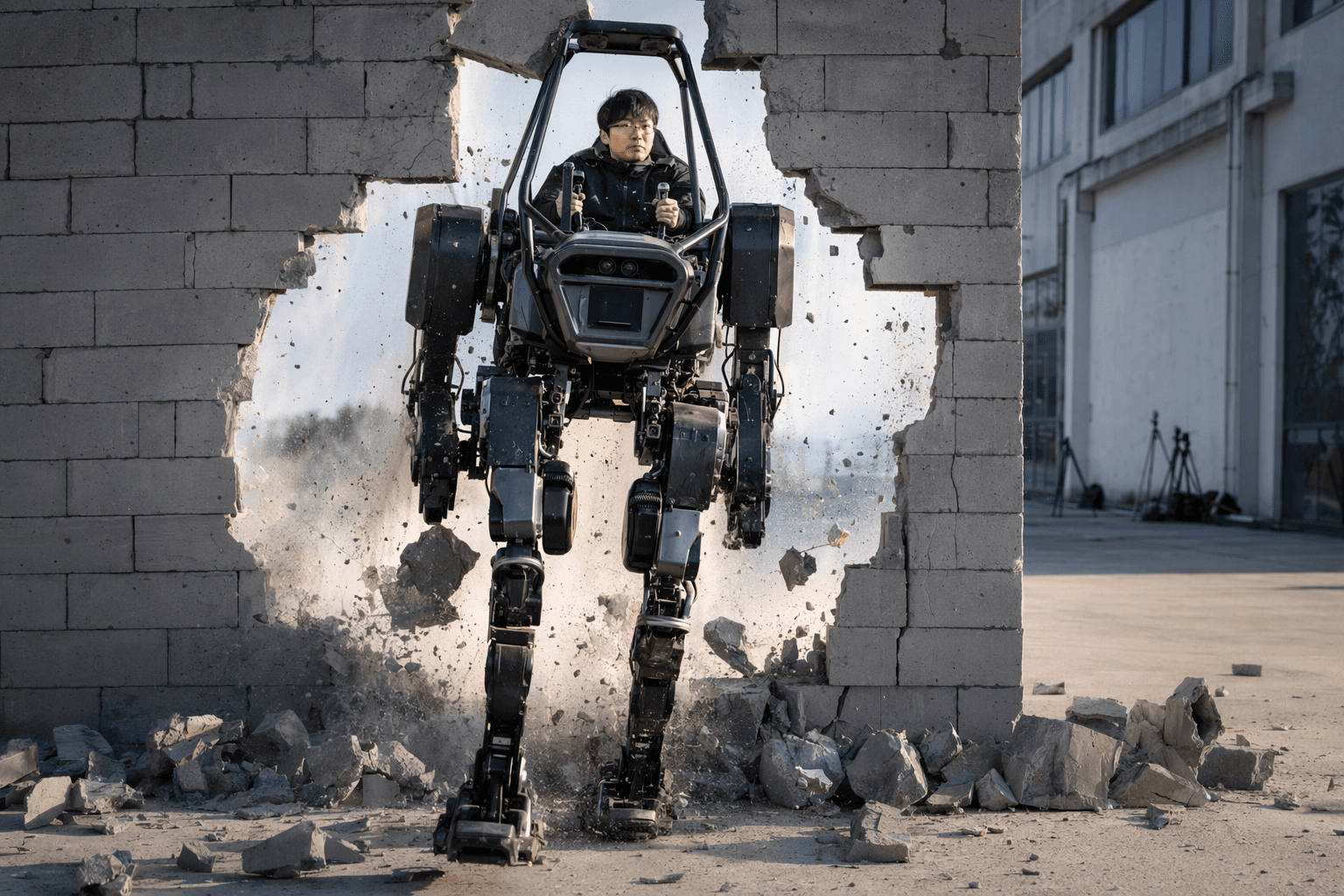
Unitree priced its GD01 at 3.9 million yuan, or about $650,000, and showed founder Wang Xingxing driving it through a wall.

Unitree has pushed the humanoid-robot race into even stranger territory: a rideable mech suit priced at 3.9 million yuan, or about $650,000. The Hangzhou-based company unveiled the GD01 on May 12 and described it as the world’s first production-ready manned mecha, while also framing it as a civilian vehicle rather than a military platform.
Unitree’s launch material says the machine weighs about 500 kilograms with a person inside and can shift between bipedal walking and quadruped mode. In the demo video, founder Wang Xingxing appears in a cockpit-like seat, piloting the robot forward before it slams through a brick or cinder-block wall and then drops into a four-legged stance. The video was enough to trigger heated discussion on Chinese social media, with Chinese outlets and state media quickly amplifying the reveal.
The GD01 is unmistakably designed to provoke attention, but its commercial logic is still the bigger question. Unitree has not publicly laid out detailed technical specifications in the launch coverage, and it did not spell out a clear consumer use case beyond the promise of a civilian machine that can transform, move on legs, and, in theory, be mass produced. That leaves open whether the GD01 is meant to become a real transport product, an industrial or rescue platform, or simply a dramatic proof point for a company that already has unusual brand power in robotics.

That positioning matters because Unitree is not a fringe startup. It is already one of the most recognizable names in humanoid robots, and the GD01 extends that reputation from legged robots toward spectacle-heavy machines that blur entertainment, engineering demo, and product pitch. For a sector still trying to convert attention into reliable deployments, a half-million-dollar-plus mecha is as much a signal as a sale: robotics companies are now competing not only on autonomy and mobility, but on who can command the loudest public imagination while the practical humanoid market is still taking shape.
This article was produced by Prism’s automated news system from verified source data, official records, and press releases, then run through automated quality and moderation checks before publishing. The system is built and supervised by the people who set the standards it runs under. Read our full AI policy.
Did this article answer your question?