Peru extends voting after ballot delivery failures disrupt election sites
Ballot delivery failures forced Peru to extend voting for more than 52,000 Lima voters, exposing how fragile election logistics can undercut trust in democracy.
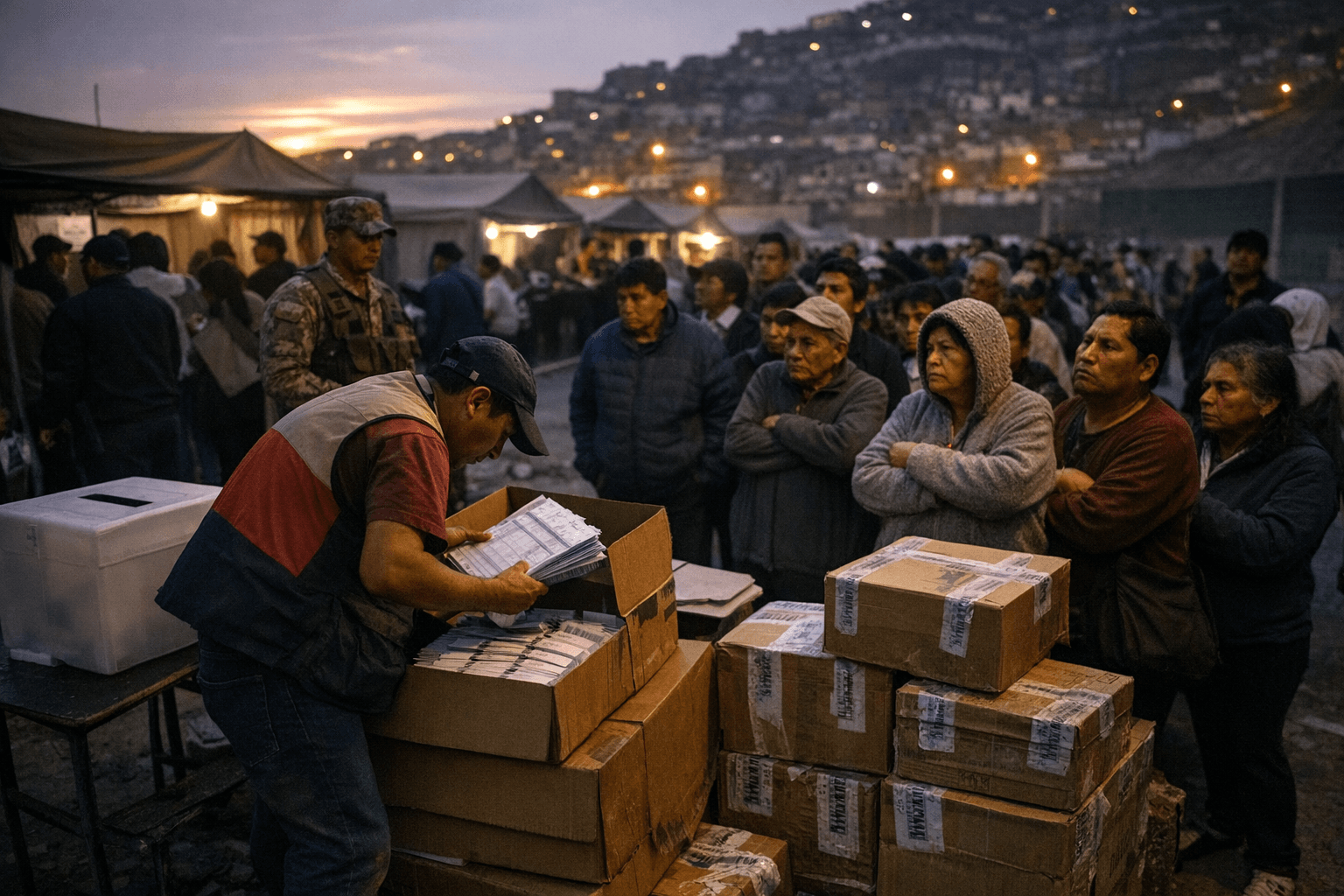
Ballot boxes in Peru became a test of state capacity after electoral authorities failed to deliver ballots on time to some polling sites, forcing a one-day extension for more than 52,000 voters in Lima and for Peruvians registered in Orlando, Florida, and Paterson, New Jersey.
The delay turned a routine election into a live stress test for the country’s institutions. Thousands of voters returned on Monday after polling places did not open as scheduled, with the National Office of Electoral Processes, known as ONPE, saying it would sue the ballot distributor over the breakdown. Bloomberg reported that ONPE said 99.8% of polling locations eventually opened, but 63,300 voters in Lima still were unable to cast ballots because their stations never opened. Another electoral authority said as many as 30% of polling sites had not opened by 1 p.m.
The failure immediately fed questions about credibility in a country where mistrust in political institutions already runs deep. Transparencia, the election observer group, said the delays were unprecedented and demanded explanations. The episode gave candidates and their supporters an opening to argue that administrative weakness, not just voter preference, could shape the result.
Keiko Fujimori’s camp called for voting to be extended into Monday, while Rafael López Aliaga said as many as 1 million voters had been disenfranchised, according to Bloomberg’s coverage. Election authorities did not adopt the broader claim, but the dispute underscored how quickly a logistics problem can become a legitimacy fight in a tightly contested race.
The election itself was already crowded and politically brittle. More than 27 million people were registered to vote, and about 1.2 million Peruvians cast ballots abroad, mainly in the United States and Argentina. Voting was mandatory for citizens ages 18 to 70, with fines of up to $32 for failing to vote. Thirty-five candidates were competing for the presidency, and a runoff in June was considered virtually certain. Peruvians were also choosing members of a bicameral Congress for the first time in more than 30 years.
Police arrested an election official amid an investigation into the delays, adding a criminal probe to the administrative fallout. For Peru, the problem was larger than a late delivery: it showed how badly an election can strain when the machinery meant to run it breaks down, and how fast that breakdown can become ammunition in the fight over whether the result is legitimate.
This article was produced by Prism’s automated news system from verified source data, official records, and press releases, then run through automated quality and moderation checks before publishing. The system is built and supervised by the people who set the standards it runs under. Read our full AI policy.
Did this article answer your question?


