Philadelphia teens turn to music programs to build safer neighborhoods
Philadelphia’s music programs are being tested as violence-prevention tools, with early evaluations and district trends suggesting possible impact beyond inspiration.
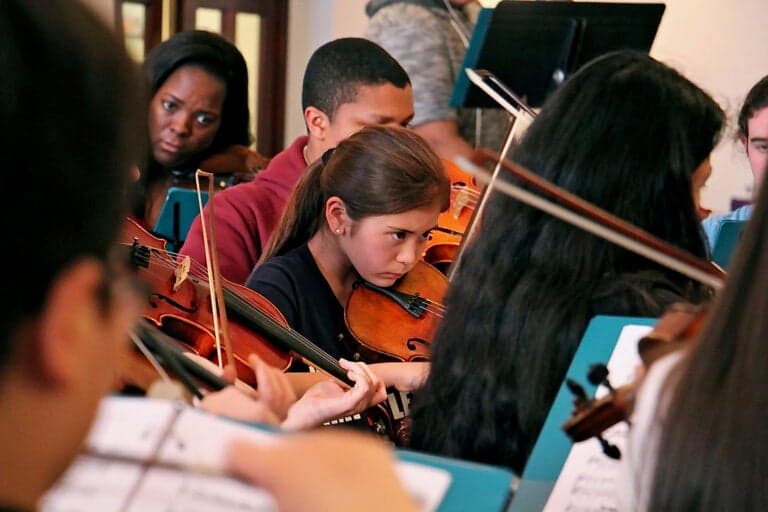
Philadelphia’s music rooms are becoming part of the city’s violence-prevention strategy. In neighborhoods where gunfire has shaped daily life, teens are finding structure, mentorship, and a path into leadership through programs that now stretch from recreation centers to trauma centers and juvenile facilities.
Music as a safety strategy
The question in Philadelphia is no longer whether music can inspire young people. It is whether music-based youth programs can measurably help prevent violence, support re-entry, and strengthen neighborhoods at scale. That matters in a city that recorded 562 homicides in 2021, its deadliest year on record, and has spent the years since investing in youth diversion and prevention while shootings and homicides have eased from their peaks.
City officials describe that work as a violence-prevention system, not a single program. The Office of Safe Neighborhoods and Division of Safe Neighborhoods say their mission is to prevent, reduce, and end violence, with a specific focus on gun violence, by promoting prevention across the city, investing in strategies that work, and strengthening communities. Music programs have become one visible piece of that effort because they can reach young people where other institutions often fall short.
How Beyond the Bars grew into a citywide network
Beyond the Bars began in 2015 as a volunteer music program for youth at the Philadelphia Industrial Correctional Center, founded by Matthew Kerr and Christopher Thornton. What started inside a correctional setting has expanded into a network of more than 55 music labs across Philadelphia, placing instruments and creative instruction in schools, shelters, recreation centers, and trauma centers.
That expansion matters because it shows how the program has moved beyond one site and one population. It now reaches youth in spaces that sit at the edges of the city’s public systems, where trauma, instability, and exposure to violence often overlap. Philadelphia Parks & Recreation said in March 2023 that it had 10 music labs in recreation centers and that more than 500 youth had participated, serving young people generally ages 8 to 18.
The scale is important, but so is the setting. A music lab in a recreation center or trauma center does more than offer a pastime. It creates a supervised space where teens can build routine, trust adults, and stay connected to peers and mentors at moments when isolation can be dangerous.
What the evaluation says beyond feel-good stories
The strongest case for these programs comes from what they appear to change in young people, not just how they feel in the moment. The Children’s Hospital of Philadelphia’s Center for Violence Prevention says Beyond the Bars helps youth express emotions, build confidence, and realize leadership potential. Those are not soft outcomes in a city where emotional regulation, belonging, and adult support can affect whether conflict escalates.
CHOP’s formative evaluation also shows the program is being studied more rigorously than many arts initiatives. Researchers interviewed 17 students, 6 community partners, and 5 program instructors. That kind of evaluation does not prove a direct drop in shootings, but it does show that the program is being examined for the mechanisms public health experts care about: engagement, trust, leadership, and the ability to interrupt cycles of harm.
For violence-prevention advocates, that distinction matters. A moving story about a teen finding purpose through music is meaningful, but it is not enough. The real test is whether those individual changes add up to fewer crises, fewer arrests, and fewer young people pulled deeper into the justice system.
Rock to the Future and the juvenile justice pipeline
Rock to the Future offers another look at how music is being used as intervention and re-entry support. The organization says it has served Philadelphia teens in those programs for more than a decade. It started with 15 students, quickly grew to 30, and now aims to serve all teens in the Juvenile Justice Services Center with weekly music programming for more than 200 youth.
That focus places music where the need is most acute: with teens already involved in the juvenile justice system. Starting in March 2022, Rock to the Future began providing music programs for youth in incarceration, extending its reach from community-based support into the re-entry process.
This model suggests why music can be attractive to policymakers. It is structured, relational, and portable. It can travel into custody settings, return with young people into the community, and continue as they move between institutions that often treat them as problems to manage rather than adolescents to support.
Why the city’s violence trends matter
Philadelphia’s youth-focused violence work is happening in a very specific public-safety landscape. In fall 2024, the city launched its Group Violence Intervention Juvenile program. By March 2026, 55 youth ages 12 to 17 were enrolled, all from the 22nd Police District, an area that has seen at least 223 juveniles shot since 2015.
The district-level numbers suggest why leaders are paying attention. Juvenile shootings in the 22nd District fell from 42 in 2021 to 22 in 2025. Youth arrests for gun crimes in that district also fell, from 32 five years earlier to 22 in 2025. Those declines do not prove that music programs alone are driving the change, but they do show that the city is testing a broader mix of interventions in one of its hardest-hit areas.
That mix includes public agencies, prosecutors, and federal partners alongside nonprofits and arts groups. The Philadelphia Police Department, the District Attorney’s Office, the Pennsylvania Attorney General’s Office, and the U.S. Attorney’s Office all sit within the larger violence-reduction ecosystem, reinforcing the reality that neighborhood safety is being built through coordinated, overlapping efforts rather than one silver bullet.
What it will take to prove impact at scale
Philadelphia’s music programs are strongest when they are treated as part of a public-health strategy, not as decoration around it. The available evidence points to real benefits in emotional expression, confidence, leadership development, and sustained engagement with teens who are often hardest to reach. The programs also show they can scale: Beyond the Bars has spread to more than 55 labs, and Rock to the Future is trying to serve every teen in the Juvenile Justice Services Center with weekly programming for 200-plus youth.
The harder question is whether those gains can be tied to neighborhood safety in measurable ways. For that, Philadelphia will need more than participation counts and powerful anecdotes. It will need long-term tracking of arrests, shootings, re-entry outcomes, and youth retention, matched against the neighborhoods where these programs are concentrated.
The city’s current trajectory suggests why that work matters. Philadelphia is no longer only asking whether music helps young people cope. It is asking whether music can help keep them alive, connected, and out of the cycle of violence that has shaped too many blocks for too long.
This article was produced by Prism’s automated news system from verified source data, official records, and press releases, then run through automated quality and moderation checks before publishing. The system is built and supervised by the people who set the standards it runs under. Read our full AI policy.
Did this article answer your question?